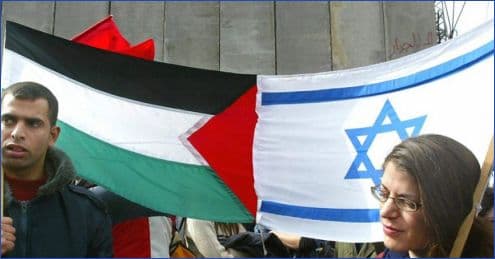
In this episode of FO Talks, Peter Isackson and James M. Dorsey examine how settlement expansion has undermined prospects for a two-state solution. A change in Israeli leadership seems unlikely to alter core policies toward Palestinians, and Gaza’s proposed political transition remains stalled. The US/Israel–Iran war further exposes the gap between military power and lasting solutions.
Transcript
[Host Peter Isackson] Welcome, again, to FO Live. I’m Peter Isackson, Fair Observer’s chief strategy officer. Today I have the pleasure of welcoming James M. Dorsey, Middle East analyst, author, award-winning journalist.
Today we’ll focus the conversation on what’s going on, and there are a lot of things going on in the Israel-Palestine conflict or situation, and it’s only days before the crucial Israeli elections later this month. James, there’s no need to remind the audience that a lot of things are happening in the Middle East but let me start with something that’s a simple and probably impertinent question. Whatever happened with the famous two-state solution?
I believe you formally called it comatose, but would you agree that it’s genuinely dead now?
[James M. Dorsey] Well, first of all, the flip side of what is happening is what is not happening, and that’s actually what your question goes to. I was one of the pioneers of the two-state solution going back to the early 70s, when the notion of a two-state solution was heresy on both sides of the divide, both on the side of the Palestinians, who were at that point aiming for what they described as a secular democratic state in which Jews and Palestinian Arabs would have equal rights, and Israel was insisting on a Jewish state or the Israeli state.
It was relatively shortly after Israel, in the 1967 Middle East war, had occupied the West Bank, the Gaza Strip, East Jerusalem, and Syria’s Golan Heights. For much of the decades since, the two-state solution was a feasible option, and it was something that the PLO, the Palestinian Liberation Organisation, under Yasser Arafat, basically forged a torturous path to accepting. It took it somewhere between 12 to 14 years for it ultimately to accept that in 1988, in exchange for recognition by the United States.
Now, having said that, the settlement policy dates back to those early years. It’s a policy that was initiated not by the right wing in Israel, certainly not by the far right in Israel, but by the Labour Party. The notion was, in contrast to today, not the quest for an Israeli state from the river to the sea, but the argument was security.
The problem with all of this is, I think, twofold. One is that the settlements mushroomed. The longer it took over the years, the more settlements there were.
And then, of course, you started a process in 1977, when Menachem Begin, for the Likud, for the first time won the elections and formed the government, and you embarked on a process in Israel in which the claim to the West Bank in Gaza evolved from a security argument to an argument of a territorial claim.
[Host Peter Isackson] Can I just interrupt for a second? What’s the reasoning? It seems difficult for people today to understand.
What would the reasoning be in terms of security? How could settlements be a factor of security? Today, we see them as a factor of insecurity, right?
[James M. Dorsey] Well, basically, the argument was that you needed some degree of control, and that, you know, Palestinians, that was part of the option that was negotiated when then Egyptian President Anwar Sadat came to Jerusalem in 1977. And you had the subsequent talks in Ismailia, in the Mena House in Cairo, in Camp David. And the formula that was developed was a formula for autonomy.
It was a formula that never was going to work. But the notion was the Palestinians would have a degree of self-rule, but Israel would control security. And settlements within that context played a major role.
[Host Peter Isackson] The problem today is... Was that acceptable? Was it acceptable to the PLO at the time, the idea that Israel could ensure security?
[James M. Dorsey] Absolutely not. But the Israelis were, the PLO wasn’t at the table.
[Host Peter Isackson] All right.
[James M. Dorsey] I mean, take, okay, let me just as an aside, but it’s an important aside. Israeli demands have always been that for negotiations with Palestinians, Palestinians needed to first recognise the state of Israel or the state of Israel’s right to exist. The issue of the right to exist rather than the existence as such is questionable.
It certainly is not anchored in international law. But the second demand was the swearing off of the armed struggle. And that’s what took the PLO so long to come to grips with, in addition to which a two state solution would mean territorial compromise, which, again, was a process for Palestinians to accept.
But what that negotiation strategy on the behalf of the Israelis meant is that the Israelis were essentially saying to the Palestinians, leave your trump cards at the door and then you can come in. Which is essentially the fundamental difference, or one of the fundamental differences in the negotiating strategy of the PLO and the Palestine Authority as it exists today. And Hamas on the other side.
As far as Hamas was concerned, those criteria, whether recognition or a long term ceasefire and the swearing off of the armed struggle were things that the Palestinians would commit to at the end of a negotiation process, not at the beginning. But what I wanted to come back to, the rise of the Likud as the leading government party with Menachem Begin also set off a process in which it was no longer about security. It was about Israeli claims to territory.
And so, but and West Bank or West Bank in Gaza and Gaza. Yeah, yeah. In that process, two things happened.
One is settlements mushroomed. So today you have whatever number of huge, large number of settlements, as well as roughly 750,000 Israeli settlers on what is in international law, Palestinian land. And you had an ideological shift in which the, as now manifested in the Netanyahu government and increasingly in the Israeli military, the rise of the religious ultranationalists.
And so today, so if for the longest period of time, in my mind, you know, the Middle East of the Israeli-Palestinian conflict has always been looked at as intractable. I would argue that for the longest period of time, it was tractable, but may now have become intractable. So when did that actually happen?
It happened gradually with the, and certainly accelerated with the current government. But it happened gradually as the settler community in the West Bank grew exponentially. So today, for a two-state solution, you would have to determine the fate of 750,000 settlers who would either have to fall under Palestinian law, something they’ll never accept, Israel will never accept, would have to be somehow incorporated into the state of Israel, or at least most of them, or would have to be evacuated, which makes it, which makes a two-state solution almost impossible.
And the Netanyahu government has gone out of its way to try and ensure that it’s not possible. And if it’s not possible, then you’re left with two bad options. One is a one-state solution, which at this point, given emotions on both sides, probably is a recipe for civil war.
Or some sort of prolonged, as we’ve had already, no war, no peace situation, which the Israelis act as will, which is also not a sustainable situation.
[Host Peter Isackson] So where does that leave us today? Because if there was, what we see is that in the West, the European countries, and I think even the US officially, although it’s now complicated by the Board of Peace, but they insist that we should be looking at a two-state solution, that that’s the whole point of whatever discussions or negotiations are taking, or can take place. Is that finished?
I mean, and how did, can they maintain that illusion that that’s what everyone is working towards?
[James M. Dorsey] Well, they’re certainly maintaining the illusion. I mean, look, the two-state solution, as a matter of principle, is the best of bad options. It’s not a panacea.
They’re beyond the issue of what happens to Palestinians who are not resident on the West Bank, or in Israel with Israeli citizenship, or Gaza. But what happens to those who are in refugee camps in various countries across the region, and who basically come from 1948 Israel, if you wish. There are going to have to be solutions for that.
And the other thing is, it’s not a panacea in the sense of if we get the creation of an independent Palestinian state, then it’s all lovey-dovey afterwards. Most probably what we will see is a situation as you have between India and Pakistan, which is, no, Kashmir is different. If you have an, Kashmir is not an independent state.
[Host Peter Isackson] No.
[James M. Dorsey] Yeah, so if you have, I mean, Kashmir was a kind of...
[Host Peter Isackson] Could you imagine a territory like Kashmir that’s somehow shared between Israeli settlers and Palestinians? So you could move the Israeli settlers who are there now, the 750,000, into some kind of zone which is a bit like Kashmir.
[James M. Dorsey] But at this point, that would be civil war.
[Host Peter Isackson] Yeah.
[James M. Dorsey] So basically, my gut feeling is that it’s become intractable. That the two-state solution is an illusion that’s being upheld. But what it would take is so humongous that it’s unrealistic.
A one-state solution isn’t a solution. And the status quo or some form of the current status quo is equally unsustainable and unacceptable for all practical matters. So I think everybody’s in a bind.
That’s why everybody or many are upholding the fixes.
[Host Peter Isackson] Now, I assume you’ve seen the recent CIA report from the red cell that said Israel was on the verge of collapse. Do you take that seriously?
[James M. Dorsey] I don’t. I mean, I think, look, there’s no question that for Israel to address various of its problems, massive change in Israel has to take place. The problem with that notion is that it’s not just that you have a far-right government in place.
It’s that these are policies that, you know, by and large, the issues of no Palestinian state, the new military strategic doctrine that goes beyond containment and management of conflicts. All of those things, the settlements and so on, all of those things are things that are broadly supported by the Israeli public and by what is described as the Israeli opposition. And so the Israeli opposition may, if it were to come to office, may be more attentive to Israel’s international standing, to wanting to rebuild its image, to wanting to ensure that Israel remains aligned with the United States.
With other words, shaving off the raw edges of all of this. But on the fundamentals, they don’t disagree. I mean, in many ways, this is an election that’s not about policy.
It’s about persons. In this case, first and foremost, Prime Minister Benjamin Netanyahu.
[Host Peter Isackson] And will he survive? Will he still be the Prime Minister?
[James M. Dorsey] Anybody’s guess. He’s got a fighting chance at this moment, despite everything.
[Host Peter Isackson] There’s no hope of a majority emerging, right? It would have to be a coalition.
[James M. Dorsey] Israel’s always been coalition governments from day one. Israel’s never had a 50% plus majority cabinet. It’s always been coalitions.
[Host Peter Isackson] So what might the combinatorial mathematics look like in terms of what’s going on now?
[James M. Dorsey] You could get a government of the far right and various others, religious parties. Something close, not identical necessarily, but close to what you have now. You could get a opposition government headed by opposition parties, possibly with the support of a Israeli-Palestinian party.
But again, whichever one you get, the fundamental policy outlines remain the same. There may be style differences, tone differences. The music may be a little bit different, but that’s about it.
[Host Peter Isackson] Okay, let me pick up on something you said, you just mentioned a moment ago. And I’ll quote something you wrote in an article on Fair Observer about a year ago. The occupation of Gaza could be the straw that breaks the back of many in the international community.
So, you’re talking about the image of Israel in the international community. I think everyone agrees that it has vastly diminished in the past year and probably more radically in the past few months, especially we’re seeing in the U.S. that the support the population traditionally had for Israel has now turned in the other direction. So what does that mean?
And what does that mean in terms of the stability of whatever government emerges from the election?
[James M. Dorsey] Again, as long as there’s public support in Israel itself, it remains a stable government.
[Host Peter Isackson] But doesn’t Israel depend on support from the U.S.? And if that support wavers or weakens, would that be a change? And is that why the red cell at the CIA is saying that Israel is vulnerable?
[James M. Dorsey] Well, I mean, the red cell was talking about civil war in Israel over policy, Israeli policies. I don’t see that. It’s not clear to me where that notion comes from.
For that, you would have to have a deeply polarised Israeli public. Now, there is polarisation without question. There’s polarisation over the person of Benjamin Netanyahu.
There’s secular versus religious polarisation. But none of those are at a point at which the notion of civil war even appears on the horizon. Now, a second question is, how does Israel deal with the fact that increasingly, but you know, the international community, but perhaps most importantly, Europe and the United States, at least in terms of public opinion, but also in Europe in terms of governments, look at Spain, look at Portugal, look at the Netherlands, in terms of banning products from West Bank settlements, in terms of questions of arms sales. To what degree will that influence Israel? Maybe, maybe not.
In many ways, I mean, look at Iran. Iran’s the question is a country that’s much more cornered than Israel is. And that has a degree of resilience and in some ways has a weaker popular base.
It has a popular base without question. It also has a popular base that to some degree, at least temporarily, has been strengthened by the war and the rallying around the flag factor. I mean, Israel’s popular base is much more solid in that regard.
[Host Peter Isackson] Iran is 92 million people and Israel is 7 million.
[James M. Dorsey] Yeah, I don’t know whether that matters. I don’t know whether you’re 90 million or 7 or 8 million. I don’t know that that makes a difference.
I mean, look, economically, Israel is not a country of 7 million. And in terms of its technological prowess and so on. So, I mean, there are a lot more factors that come to play than simply population numbers.
[Host Peter Isackson] But that’s where I would push, not push back, but ask the question. Israel is much more powerful than any country of 7 million people on Earth. Could be even.
You couldn’t even imagine a country that small having the kind of clout that Israel has. But doesn’t that depend on support from Europe and the US? And if that support weakens, is there a point at which the Israelis feel that they’re abandoned by the people that they were counting on making their success possible?
[James M. Dorsey] I think the proof is going to be in the pudding. We don’t know. Going back to Begin in 1977, he broke with a fundamental principle of Israeli policy, which was until his rise, always to ensure that the United States had Israel’s back.
In other words, to ensure that it didn’t allow whatever differences to get too big. Begin essentially said, we’ve been around for 5,000 years. We take our own decisions.
Now, there’s one other development. Maybe the litmus test for what you’re proposing is going to be negotiations which have started or are about to start on the Israeli-U.S. military relationship. So you have a memorandum of understanding that’s governed that relationship for the past decade, which was signed at the time by Barack Obama as president, was a 10-year memorandum in which Israel had military support worth $3.8 billion a year. Both the Israelis and the Americans have said that they want to alter that relationship. It was initially proposed by the Heritage Foundation, which is the foundation that essentially is the brains of the Trump administration. And their proposal was a plan that would last until 1947, sorry, 2047, in which Israel every year would lose 200, you would maintain the $3.8 or $4 billion a year, but Israel, that would be reduced every year by $250 million. And those $250 million, Israel would have to spend and pay for equipment it buys from the United States. And the notion of thinking of that was that Israel would evolve from being a recipient of U.S. aid to a U.S. partner. There are various clauses in bills that are being discussed in the U.S. Congress at the moment, which would integrate Israel with the United States in a far more reaching way. In response to the Heritage Foundation, and I think in response to some disagreements with the Trump administration, Netanyahu is supported by the late U.S. Senator Lindsey Graham, has come out and said, we need to be self-sufficient within 10 years. So, I think we’re going to, you know, in terms of what all of this means and going forward in U.S.-Israeli relations, I think the MOU, the memorandum of understanding negotiations is going to be one litmus test. And I think the reality on the ground, you know, for the longest period of time, critics of Israel have argued Israel’s dependent on the U.S. period. There are layers of grey in that.
[Host Peter Isackson] Let me introduce another topic, or not another topic, on the same topic, another line of dependency, and that is Saudi Arabia, because my understanding, and I’ll ask you to clarify that, is that Israel has been building a strong relationship with Saudi Arabia, which is possibly one of the factors that could allow it to be more independent of the U.S. And now Saudi Arabia is under serious pressure. Scott Ritter is predicting the fall of the House of Saud.
What does that mean? What does that changing relationship mean in this context?
[James M. Dorsey] Well, first of all, the Israeli-Saudi relationship goes back decades. This is not new. I remember somewhere 30 years ago.
[Host Peter Isackson] The Saudi prince who proposed probably the most viable two-state solution.
[James M. Dorsey] Again, it goes back 30, it goes back 30, if not 40 years. I remember in the early 2000s visiting a businessman in a tower in Tel Aviv who was selling non-lethal equipment to the Saudi military. You had a number of companies operating out of Geneva by Israelis, who were the intermediaries in business transactions between Saudi Arabia and other Gulf states.
You have the 1982 peace plan that was launched by Saudi Arabia, later endorsed by the Arab League, that called for a two-state solution. So none of this is new. That’s one.
The second thing is Saudi Arabia cannot replace the United States. If anything, Saudi Arabia needs the United States. The, you know, the conference Mohammed bin Salman was interested in doing a three-way deal, which was, you know, U.S. nuclear support, a defence shield in exchange for recognition of Israel. He may very well get the nuclear accord, the nuclear deal, without anything else.
[Host Peter Isackson] But he’s got it with Pakistan, no?
[James M. Dorsey] Well, he has a military alliance with a nuclear-armed state, but that doesn’t make Saudi Arabia, doesn’t provide Saudi Arabia with a peaceful nuclear programme, let alone a weapons programme. So he may get the nuclear deal anyways. The defence shield is a question of debate.
Now, having said that, I’m not predicting that the United States is leaving the Middle East. It is not. I think going forward that you will see a possible rejiggering of the spread of bases and a reconceptualization.
And you’ll see that basing in the Middle East will become more conditional and more consultative. But the U.S. will remain the anchor. The real question was whether Israel was willing to cut a deal in which he would make concessions on the Palestinian issue in exchange for Saudi recognition.
In some ways, the model of that being the freeze, only very temporary and long gone, that Netanyahu promised on settlement development in exchange for the UAE establishing diplomatic relations with Israel. We’re long past that.
Given what has happened in the last three years, particularly in Gaza, and given what Saudi and other public opinion more general in the Arab world is, Saudi Arabia will need a lot more. And it’s just said this much. It wants an irreversible, credible pathway to a Palestinian state.
That’s not a realistic option in today’s Israel.
[Host Peter Isackson] So everything we’ve been evoking in terms of possible solutions, you keep telling me that none of them are possible. So where does that leave us?
[James M. Dorsey] I hate to be a prophet of pessimism, and I’m an optimist by nature. But, you know, I look, look at Gaza today. Look at the border of peace.
Well, exactly. I was going to ask you about the border. What we’ve seen in recent months is an expansion of Israeli controlled territory in the Gulf, in Gaza.
We’ve seen maybe at a lower level, but Israel striking at will. We still see aid going into the Gaza Strip, being throttled by the Israelis. Fundamentally, nothing really has changed.
And the border peace, the Palestinian committee, the technocrats that are supposed to run the day-to-day operations, the Israelis won’t let into the country. The stabilisation force that’s supposed to is nowhere to be seen.
[Host Peter Isackson] So isn’t there a point at which that becomes untenable?
[James M. Dorsey] You would have thought we’d been past that point, to be honest. Yeah. I mean, I don’t see how it’s tenable.
But, you know, that could be a recipe for more violence.
[Host Peter Isackson] Well, generally it is. But when the violence reaches a certain level, something, you get to the tipping point and something replaces it. Now, I agree that I don’t know anyone who has a clear idea of what could possibly replace it.
But the idea you seem to be putting forward, the idea that this is just going to carry on for decades, maybe.
[James M. Dorsey] Look, let’s put it this way. I’m a hard realist. Now, what happens if the Trump administration decides after the midterm elections that they’re fed up with Netanyahu and they declare a weapons embargo across the board?
That may or may not spark change in Israel, and it’s change in Israel that you need. But do I think that’s what the Trump administration is going to do? I don’t.
[Host Peter Isackson] No. Right.
[James M. Dorsey] And so, you know, it’s clear what could change things in theory. It’s not clear in reality what’s going to change things. I mean, you know, look at Israel’s response to Britain.
It was to close down the consulate and force diplomats to leave.
[Host Peter Isackson] But Israel’s reactions are pretty predictable. They’re very emotional. I’m talking about Netanyahu.
But as you said, Netanyahu is not all alone. He’s not a unique personality. He reflects what the general feeling amongst the entire hierarchy and the people themselves feel.
And it’s very predictable. They’re very defensive. And then when they’re not defensive, they’re offensive.
What I’m trying to imagine is that as things evolve, some kind of solution, some kind of approach to finding a solution, other than the Board of Peace, which I don’t think you believe in any way represents a solution. Something has to emerge at some point. I mean, the abscess has been going on for so long.
There’s a point at which you have to pierce it.
[James M. Dorsey] No? Let me be clear. The Board of Peace is the only game in town today.
[Host Peter Isackson] Yeah.
[James M. Dorsey] Yeah. So that’s what you have to look at. And, you know, there’s, you would think that Trump has a degree of credibility and prestige invested in that Board of Peace.
And that he would have an interest in ensuring that it goes forward. He certainly hasn’t demonstrated that until now.
[Host Peter Isackson] Well, he was hoping to get a number of countries ponying up with a billion dollars.
[James M. Dorsey] Yeah, but we’re more than a year on.
[Host Peter Isackson] Yeah.
[James M. Dorsey] And he’s done nothing to pressure Netanyahu in this regard. But even having said so, I still would maintain it’s the only game in town. The other, look, the other problem is that you have to agree or have some notion of what the end game is, what the solution is.
There is no agreement on that. You know, there is, you know, there is the Israelis reject the Palestinian state, the Palestinians demand a Palestinian state. You have to bridge that somehow.
Now, potentially, the Board of Peace and Trump’s Gaza peace plan, whatever you think of it, is the only potentially mechanism that could start to build bridges. But that’s been stymied from day one.
[Host Peter Isackson] It doesn’t have broad international support, does it?
[James M. Dorsey] Well, look, there are some 30 countries that have signed on.
[Host Peter Isackson] Yeah, 35, I think.
[James M. Dorsey] Whatever the number is. So it does have international support. And essentially, you know, even Hamas has conceded, maybe not in those words, that it is the only game in town and has engaged with it.
The Israelis are, you know, it’s not that Hamas is innocent in all of this, not at all. But the Israelis have gone out of their way to ensure that it remains stymied. You know, so in that sense, the ball is in the U.S. court. If Trump wants this to happen, he has to do something. All I’m saying is, I’ve seen no indication of that.
[Host Peter Isackson] You know, no one...
[James M. Dorsey] Now, he may be preoccupied with other things, and he may want to do that for various reasons only after the midterm elections. Time will tell. So how...
I would not bet on it.
[Host Peter Isackson] How... Okay, given what you’ve just said, how carefully are things being coordinated in the war against Iran, which was a joint effort between Israel and the U.S.? Are they still coordinating that? Or are they acting separately?
Or is there...
[James M. Dorsey] Israel, for all practical matters, following the initial bombing campaign, has been sidelined. This, at this point, as much as the Iranians want to portray it understandably as a U.S.-Israeli-Iranian conflict, it’s a U.S.-Iranian conflict today. Now, if Trump decides to go back to an all-out war or to a bombing campaign, we’ll see whether he wants Israel involved in that or not.
[Host Peter Isackson] And do you think he has the capacity, militarily, to push it to the point where he thinks he can win a war against Iran?
[James M. Dorsey] I think you’ve got to define capacity. Does he have the means to bomb, even without nuclear? To bomb Iran into the Stone Ages, as he said, or similar language?
Yeah, of course he does. Of course he does. Whether that’s what he wants to do, whether that’s what he feels he politically can do, whether that’s what the military feels it can do, given other commitments it has globally, is a different question.
So, it’s a definition of what you define as capacity. As a matter of principle, unrestrained, unrestricted? Sure.
[Host Peter Isackson] Yeah, but capacity is also what you’re allowed to do on the international stage, because there are points at which you break so many rules that reactions come from elsewhere. But that’s what I’m saying.
[James M. Dorsey] I mean, it depends on how you define capacity. Look, there’s a famous story coming back to Israel-Palestine in the, I forget whether it was the first or the second Intifada, in which the military went to then-Israeli Prime Minister Yitzhak Rabin and said, we can end this, we can do it today, but not at a price that either you or we are willing to accept. So, it depends on what price you’re willing to accept.
That’s going to define your capacity beyond the physical stuff.
[Host Peter Isackson] Well, that’s why everyone is so concerned that Trump, we don’t know what his capacity is, we don’t know what his reasoning capacity is, because it changes from moment to moment.
[James M. Dorsey] I think Trump is much more consistent than people give him credit for, frankly. No, I mean, look, if you look at the last seven, eight months, since February 28th, when the United States and Israel attacked Iran, Trump’s fundamental belief and strategy is that he can force Iran to its knees. And he still believes that, after having failed so far.
Yeah. And that what it’s going to take is more economic pressure, maybe another bombing round. I’m not saying he can do it, but that’s his belief.
And he’s been very consistent in that. And as much as the Iranians have been consistent in their belief that they can ultimately defeat him and emerge at the other end from this conflict. You know, that’s consistency to me.
[Host Peter Isackson] Yes, I mean, he’s also consistent about his belief that he can end the war in Ukraine. But he was supposed to do that on his first day in office.
[James M. Dorsey] Right. And he’s admitted failure there.
[Host Peter Isackson] Yeah.
[James M. Dorsey] Sure. All I’m saying is, you know, I think Trump likes the notion of unpredictability as a tactic.
[Host Peter Isackson] Yeah.
[James M. Dorsey] And I think a lot of people fall for it. And he gives lots of reason to believe that. And there is a degree of unpredictability.
Granted, he changes positions, but the underlying principles, I think, he’s consistent in.
[Host Peter Isackson] Okay, we’re going to bring this to an end. But I do want to ask you another question. Since you’re in Morocco, you’re not in Morocco now, but your base is Morocco.
Morocco is part of the Abraham Accords. How are people in Morocco, how’s the government, but how are people in Morocco interpreting and reacting to the war with Iran?
[James M. Dorsey] I think like in a lot of places, you’re seeing a divide between what public opinion is.
[Host Peter Isackson] Yeah.
[James M. Dorsey] Which is very supportive of the Pale
@stinians. Increasingly anti-Israel.
[Host Peter Isackson] Yeah.
[James M. Dorsey] And a government that is tightening relations with Israel.
[Host Peter Isackson] Yeah.
[James M. Dorsey] You just recently had an agreement to upgrade diplomatic representation to the level of ambassadors.
[Host Peter Isackson] All right.
[James M. Dorsey] And don’t forget that Morocco is the Arab country where probably the Jewish community’s relationship to the monarch, to the monarchy, is the closest. Historically and today. But, you know, public opinion is, I don’t think that you would see Israeli tourists, and I doubt that you’re seeing them, being welcomed in the way they were several years ago in Morocco.
[Host Peter Isackson] Let me ask you just one question about the Jewish community in Morocco. Are they Sepharads or are they remnants of French colonisation?
[James M. Dorsey] No, they’re Sepharads. Again, there’s a community that goes back with the Berbers. Thousands of years.
That’s a Jewish community. There’s a community that goes back to the Spanish Inquisition.
[Host Peter Isackson] Yeah.
[James M. Dorsey] Which is a Sepharad community. So, you know, the Jewish community in Morocco has very deep roots.
[Host Peter Isackson] And are there holdovers from the French period?
[James M. Dorsey] A few, maybe, but no significant number.
[Host Peter Isackson] Okay, James, this has been really interesting. Very depressing in the sense that whenever we try to look for some clarity about what might happen to resolve things, we keep bumping against a wall.
[James M. Dorsey] I’d love to be more optimistic if I could.
[Host Peter Isackson] But I think everything you’ve mentioned is really valuable for understanding what’s going on and our audience will very much appreciate it. So I thank you very much for your participation and hope to see you again soon.
[James M. Dorsey] Peter, it’s been a pleasure. Thank you for having me.
[Host Peter Isackson] Okay, thanks so much.
@ jamesmdorsey@substack.com