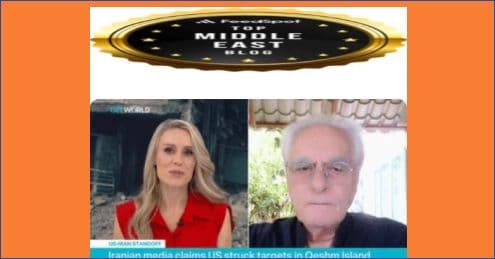
President Donald Trump confirmed that the United States attacked an air defence facility on Iran’s Qeshm Island. The US struck as Mr. Trump weighs resuming the bombing of Iran, with or without Israel. James discusses on TRT World the prospects of renewed hostilities.
Transcript
[Anchor] Let’s talk more about this. We’re Jane Dorsey now, Middle East analyst at Singapore’s S Rajaratnam School of International Studies. Welcome.
So, the US has carried out further strikes on Iran’s Keshav Island, as we know, and this is despite ongoing diplomatic contacts between the two. Are we witnessing a strategy of using military pressure to strengthen Washington’s negotiating position, or is the US moving towards a renewed wider military confrontation?
[James M. Dorsey] I think inevitably we’re moving towards a wider military confrontation. If you look at the last few weeks, we’ve seen a stepped-up Iranian attacks on shipping in the Strait of Hormuz and in the Gulf, to which the United States has not really responded. There have been a number of sort of pricks against Keshav Island, supposedly an air defence facility, and various other similar strikes, but nothing to the degree to which the Iranians have stepped up their attacks on shipping.
On the other hand, Trump, on the one hand, as your earlier guest suggested, with the appointment of Stephen Miller as his new chief of staff, is indicating that he’s going to pursue a hard line, particularly in domestic politics and the relationship with a democratically controlled Senate. But the situation of no peace, no war is unsustainable for Iran, given the blockade of the US naval blockade of Iranian ports and the sanctions on Iranian oil exports. So something is going to give.
There’s no indication that that’s going to be in negotiations, which for all practical matters have been a dialogue of the deaf.
[Anchor] Well, let’s talk more about the wake of the midterm election results then for the US president, where that leaves him. Because does this actually make him more inclined to pursue a dramatic foreign policy victory?
[James M. Dorsey] I think it’s too early to tell. The fact that the United States has not been responding to the stepped up Iranian attacks is partially due to the fact that Trump did not want an escalation prior to the elections, but at the same time indicates that he may be hesitant, despite his bluster, to escalate the war again. On the other hand, the Iranians, the Democrats are not the only victors in the US midterm elections.
So is Iran. At the end of the day, the Iranians, with their strategy of disrupting global energy markets and trying to inflict greater pain on the United States and its allies in the Middle East, has contributed to the affordability crisis in the United States and therefore to the Democrats’ victory. The problem with that side or the downside of that is that the Iranian strategy has probably produced the maximum it can produce.
It’s delivered a decisive defeat to the Republican party in the elections, and the question is what more can it achieve with that, particularly given the indications that Trump is going to be pursuing a more hard line overall in the wake of the elections.
[Anchor] We know that the Iranian foreign ministry has said that Tehran’s demands for peace have been clearly communicated to Washington and the ball, quote, is in the US court. But we know that Iran isn’t particularly reliable either.
[James M. Dorsey] Well, I don’t think it’s a question of reliability. I would argue for all practical matters that both Iran and Trump have been very consistent in the negotiations since the signing of the Memorandum of Understanding, in that they approach negotiations not as a give and take, that aims to find a solution that is mutually acceptable and allows both parties to save face. Instead, they pursued negotiations, both the Trump administration and Iran, as a zero-sum game.
In a sense, a change of Clausewitz’s maxim of war is an extension of politics. In this case, negotiations are an extension of war and they aim to achieve defeat of the other at the negotiating table and a solution on their terms.
[Anchor] Is there a risk right now that US foreign policy becomes increasingly unpredictable as Congress and the White House pursue competing approaches to the conflict?
[James M. Dorsey] I don’t know if it’s going to become increasingly unpredictable. I think we’re in a waiting position, which we have been for now some time, in terms of what Trump decides to do, whether or not he decides to revive the bombing of Iran, and if he does so, how he does it. The Congress doesn’t come into office—the democratically controlled Congress—does not come into office until January.
In other words, Trump has an almost two-month window in which he still has a great degree of flexibility. Post-January, when the Congress is controlled by the Democrats, again, the president retains significant powers, particularly when it comes to war and when it comes to foreign policy. What we are going to see, presumably, is a Democratic move or attempt to cut off funding for the war, but that doesn’t produce a solution.
The Democrats are no less hostile to Iran, even if they would have argued that there were other ways of tackling Iran than launching a war.
[Anchor] James, always insightful to have you on. Thank you very much, James M. Dorsey, in this no war, no peace scenario that we’re in.
@jamesmdorsey@substack.com