Fuzhou, China--------
The 2026 Media Cooperation Forum on Belt and Road has issued the Belt and Road Media Cooperation: Fuzhou Initiative, calling for stronger international media exchanges, professional collaboration and people-to-people connections to advance high-quality Belt and Road cooperation.
More than 200 media representatives from 182 media outlets and institutions across 100 countries along with international and regional organizations participated in the forum. Hosted by People's Daily, the official newspaper of the Communist Party of China Central Committee and the People'sGovernment of Fujian Province, the forum has developed into an important international platform for media cooperation over the past decade.
Held under the theme "Pursuing Common Understandings and Aspirations: A Decade of Belt and Road Media Cooperation", this year's gathering focused on the role of media in a changing international environment, opportunities and challenges arising from artificial intelligence, regional collaboration and global communication.
The Fuzhou Initiative identifies five major areas of cooperation: win-win partnerships, consensus-building, content collaboration, technological advancement and closer ties among peoples and civilisations.
The initiative notes that the Belt and Road Initiative (BRI), proposed by Chinese President Xi Jinping in 2013, has evolved over the past 13 years from a Chinese proposal into an international practice. It says cooperation among partner countries has contributed to global economic growth, improved global economic governance and enhanced people's well-being.
Highlighting the role of media in promoting mutual understanding and trust, the initiative calls on media organisations to uphold professional integrity, avoid subjective bias, identify and reject misinformation, and amplify positive voices. It stresses the importance of rational, balanced and fair reporting in creating an environment conducive to sharing opportunities, addressing common challenges and pursuing shared prosperity.
On media collaboration, the document encourages news organisations to make greater use of multilateral platforms, including the Belt and Road News Network, to undertake joint reporting, exchange professional personnel, share information and co-produce media programmes. It also calls for broader and more regular cooperation mechanisms to produce quality content documenting and promoting Belt and Road cooperation.
The initiative further highlights the growing influence of artificial intelligence and other emerging technologies on the media landscape and public opinion. It urges media organisations to embrace digital and intelligent transformation while ensuring that technology serves progress and the greater good. It also encourages greater media attention to cooperation in green development, digital transformation and health.
A significant part of the initiative is devoted to strengthening people-to-people relations and promoting exchanges among civilisations. It calls on media organisations to expand cultural and grassroots exchanges, encourage mutual appreciation and learning among civilisations, and translate people's shared aspirations into greater mutual trust and understanding.
Referring to Fujian's distinctive identity, the initiative notes that it is the only province in China whose name contains the Chinese character "Fu", meaning blessing. It describes seeking blessings and hoping for a better life as common aspirations among people across countries and cultures. Using this shared sentiment as a bridge, the initiative invites media organisations worldwide to participate in promoting understanding and cooperation.
The forum was initiated to promote greater understanding among media professionals and strengthen professional and institutional links between media organisations across countries. Over the years, it has expanded into a platform bringing together media practitioners, policymakers, entrepreneurs and scholars to exchange experiences and explore areas of common interest.
The previous edition, held in Kunming, capital of southwest China's Yunnan Province, brought together more than 200 representatives from 165 media outlets and organisations from 87 countries, as well as international and regional organisations.
Following the Fuzhou forum, Chinese and international media representatives are also scheduled to participate in week-long media workshops, joint reporting activities and field visits in Fuzhou and other parts of Fujian Province.
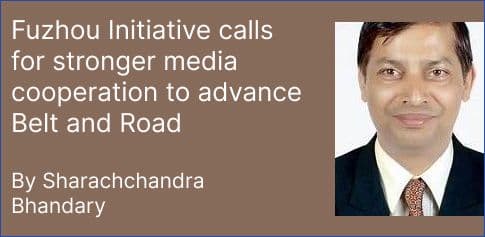
This correspondent has had the opportunity to participate in the previous two editions of the forum, held in Chengdu and Kunming.
The forum has increasingly provided an opportunity for media organisations to share professional experiences, promote greater equity in international communication and encourage mutual learning among civilisations. At a time when technological changes and an evolving international landscape are reshaping the media sector, such exchanges offer an important platform for bringing journalists, societies and people closer through dialogue and a better understanding of one another.
The Fuzhou Initiative concludes by expressing the hope for continued close exchanges among media organisations worldwide and greater media contributions to shared development, building a community with a shared future for mankind and creating a better world.