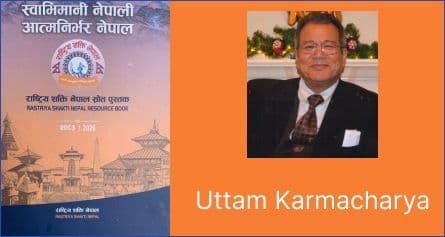
An academic Exercises and analysis of Guiding Principles
By UttamKarmacharya---------------
It is to be noted that Rastriya Shakti Nepal is not a political organization. It is a movement and campaign.It was established in 2076 chaired by Former Honorable MinisterKesharBahadurBista
1. Conceptualization of the need of First Resource Book.
After writing three articles with special reference to Rastriya Shakti Nepal and joining two three meeting of Rastriya Shakti Nepal I was highly interested to develop a Resource Book focusing on following Power Point Prersentation (PPP) on Tuesday, November 3, 2026 / 13 Bhadra 2025 at Taathali Bhaktapur.
1. Conception / conceptualization of Rastriya Shakti Nepal
2. Founders members
3.General members
4.Brouchure in Nepali and English
5. Registered Documents if there is any
6.Major activities to date
7.Minor activities to date
8.List of coordinators and chairpersons of different districts with all executive branch members
9. Collection of photos and photo story
10. Develop at least 25 articles by executive and other members.
11. Biodata of article writers
12. Nomination of Coordinator and Editors
14 .Biodata of board of editors
15 .List of donors and advertisers
16.Greetings from three / five National distinguished personalities of different walks of life
17. Date of completion and draft meetings
18. Press works / selection of Press
19. Unveiling tentative date of the first Resource Book
20 .Tentative schedule of the unveiling program
21.Selection of the chief guest for unveiling program
22. Tentative schedule of the unveiling First Resource book and 6th National Convention .
I was so fortunate to discuss and have interaction on aforesaid issues and contents during Taathali get togetherwholedayprogram hosted by Jayandrra Kumar Rai Sir organized through RS-Nepal Bhaktapur District Samiti amid 15 distinguished RS Nepal executive personalities. After my presentation of 22 PPP issues and agendas , every one agreed to develop a First Resource Book and constributed around one hundred thousand Nepali Currency ( one Lack ) as a seed money for the publication of the First Resource Book on the same first day of meeting. During the second meeting at RS Nepal Central meeting, the coordinator and four editors were nominated by the Chairman . Since then 27 meetings every week were conducted in my College and Hospital office to develop the final draft of the Resource Book . The 28 meeting was conducted in the Central office Lanchaur Kathmandu to present the pre press – published 5 copies of Resorce Book to the chairperson . In response the chairperson handed over four copies to each editors with his signature of Letter of appreciation and felicitation. Then after the quotation of the press and printing schedule was approved by the Board .
2. Major Synopsis mentioned in the First Resource Book
Rastriya Shakti Nepal (RSN) - A Call for National Unity Movement
Nepal has undergone profound political transformations in the past three decades – from the democratic transition of the 1990s, to a decade-long civil war, and the republican shift in 2007. These transitions raised hopes of inclusive governance, economic stability, and stronger foreign policy. Instead, they have delivered persistent instability, weak governance, and deepening public frustration.
Today, Nepal stands at a crossroads. The aspirations of its citizens remain unfulfilled. Political institutions have become platforms for corruption and criminalization, rather than vehicles of democratic accountability. Federalism, instead of empowering people, has drained resources: maintaining seven provincial structures consumes more than Rs. 35 billion annually, while basic services like health and education remain underfunded. Trust in political parties is at an all-time low; surveys show less than 6% public confidence in party leadership.
The socio-economic crisis is equally stark. Nepal’s foreign debt now exceeds USD 15 billion, while youth unemployment is nearly 20%. In FY 2023/24 alone, over 700,000 Nepali youths migrated abroad for work, a record high and a silent indictment of a failed system. Corruption worsens the problem: Nepal ranks 108th of 180 countries in Transparency International’s 2024 Corruption Perceptions Index.
In parallel, Nepal’s cultural identity is under strain. The dissolution of the monarchy and the declaration of secularism have left a void in the national psyche. Religious conversions have accelerated dramatically, with Christians now estimated at up to 10% of the population, compared to less than 1% in 2001. Combined with rising ethnic polarization, these trends threaten Nepal’s social fabric and national unity.
Against this backdrop, a coalition of respected leaders including former ministers, senior journalists, ex-security personnels, ex-bureaucrats, independent experts, and civil society figures has come together to form the Rastriya Shakti Nepal (RSN) movement. RSN is a citizen-led movement, not a conventional political party, formed to fundamentally restructure Nepal’s political paradigm and rebuild stability, dignity, and public confidence in national leadership and administration, grounded in the restoration of constitutional monarchy and a Sanatan Hindu nation.
3. Guiding Principles of Rastriya Shakti Nepal
RSN draws inspiration from the “DibyaUpadesh” of Nepal’s founder, King Prithvi Narayan Shah, emphasizing sovereignty, unity, and self-reliance. Our approach is pragmatic and forward-looking, built on three strategic priorities:
1. Restoring a Neutral and Unifying Institution
o Re-establish a constitutional monarchy as a non-partisan, stabilizing institution above daily politics.
o Preserve a symbol of unity across Nepal’s ethnic, cultural, and regional diversity.
o Provide diplomatic balance between Nepal’s two great neighbors, India and China, while safeguarding independence.
2. Preserving Nepal’s Civilizational Identity
o Protect Nepal’s 5,000-year-old traditions and values rooted in Sanatan Dharma, while upholding religious freedom.
o Curb exploitative religious conversions through legal safeguards while ensuring harmony among all faiths.
o Position Nepal as a cultural and spiritual center for the global Hindu and Buddhist community.
3. Restructuring Governance for Stability and Efficiency
o Replace costly federal structures with a streamlined governance model that empowers local levels directly.
o Ensure separation of powers between the political, judicial, and administrative branches, ending political interference in bureaucracy.
o Promote merit-based leadership and modernize public institutions with innovation and sustainability at the core.
4. Commitments of Rastriya Shakti Nepal
· Constitutional Reform: Formulate a constitution suited to Nepal’s traditions while ensuring inclusivity, justice, and stability.
· Good Governance: Build non-partisan, efficient institutions and root out corruption through accountability and transparency.
· Foreign Policy: Pursue non-alignment, deepen ties with neighbors, and strengthen Nepal’s contributions to global peace and cooperation.
· Ethnic Representation: Ensure leadership reflects Nepal’s ethnic diversity, correcting the current imbalance where Brahmins, just 12% of the population, occupy nearly 70% of government posts.
· Social Justice: End untouchability and all forms of discrimination, while promoting equal opportunity for every Nepali citizen.
5. Major Calls of Rastriya Shakti Nepal
The time has come for a new national awakening. Nepal cannot afford continued instability, mass youth exodus, and erosion of its cultural identity. Rastriya Shakti Nepal seeks to unite moral, patriotic, and capable citizens across all sectors to avert state failure and place Nepal back on a path of stability, prosperity, and dignity.
Under the leadership of Hon. Ex-Minister KesharBahadurBista, RSN commits itself to presenting a credible alternative that international partners, neighbors, and the Nepali people alike can recognize as a force for peace, unity, and progress.
6. Foreward by the chairperson
Mr. Bista was kind enough to wrote his forward in the first Resource Book 2083 as given below :
Nepal today stands at a critical juncture in its history, one that confronts us all. Decades of political experimentation, instability of power, institutional fragility, and hollow, inconsequential implementation of political values have profoundly weakened public trust in political parties. The democratic practices achieved through the people’s sacrifice, struggle, and martyrdom have, in practice, failed to deliver the stability, good governance, and national self-confidence that were once promised.
He further wrote that Rastriya Shakti Nepal (RSN) is guided by the clear conviction that Nepal requires the restoration of democracy with the monarchy, rooted in our country’s identity as the only Sanatan Hindu Kingdom, and governance that suits the nation’s soil and our realities. Our action to begin a patriotic movement was deliberate; a movement committed to the fundamentals of nationalism, reform of the state system, awareness among citizens of the responsibilities of political structures, and the fundamentals of democracy.
Against this backdrop, the RSN Department of Research has proposed the very first edition of the Resource Book, which brings together the movement’s ideological foundations, objectives, and direction. It seeks clear answers to why RSN was established and why Nepal urgently needs to seek its roots, its indigeneity, and long-term solutions. By critically examining the instability, institutional decay, identity crisis, and erosion of national self-respect evident under the current republican system, the Resouce Book illuminates why democracy with the monarchy remains indispensable for national unity, constitutional continuity, and a balanced distribution of power.
Anchored in the ideal of Nepal as a “shared garden of all communities,” the Resource Book highlights the long-standing tradition of mutual respect and coexistence among all castes, faiths, and cultures within Nepali civilization. It also makes clear how the concept of secularism has been unnecessarily imposed upon Nepali society and, at times, used as a means to facilitate religious conversion. In doing so, the Resource Book raises a serious and thoughtful discussion on how secularism should be properly understood and applied in a nation founded upon Sanatan civilizational values. Another significant feature of this work is its comprehensive district profiles of Rastriya Shakti Nepal, archives of important documents released by RSN, and photo of different activities of RSN all across Nepal.
As Chairperson of Rastriya Shakti Nepal, He extended his heartfelt gratitude to all office bearers, the secretariat, dedicated workers across the country, and every individual who has contributed to this campaign intellectually, morally, and practically. He offered special appreciation to Prof. Dr. Uttam Krishna Karmacharya (Chief Coordinator) for his visionary proposal to prepare the first resource book; former Lieutenant General and National Vice-Chairperson Ram Krishna Thapa; former Additional Inspector General of the Armed Police Force RavirajThapa; former State Minister and RastriyaYuwa Shakti Coordinator BirajBista; and the contributing authors. Theirs experience, discipline, patriotism, and intellectual commitment have endowed this movement with ideological depth, organizational clarity, and long-term direction. Rastriya Shakti Nepal stands today as a result of your integrity, hard work, and collective dedication, for which I am deeply grateful to all of them .
He firmly believed that Nepal’s future does not lie in imported ideologies or fleeting popularity, but in resolute decisions grounded in our own history, values, and national needs. RSN moves forward with this conviction. With the hope that this book will inspire deep reflection and constructive national debate among patriotic Nepalese Nationalists all over the world.,
In conclusion, on behalf of the coordinator and chief editor of the First Resource Book Rastriya Shakti Nepal, I have a strong suggestion to disseminate and distribute this first Resource Book to all the libraries of the Universities of Nepal , in the libraries of the major colleges and schools of Nepal ,among the GOS , NGOS and INGOS of Nepal including foreingn Diplomats and embassies in Nepal as reference Resource Book of RS Nepal to promote strong feeling of nationalism in Nepal
( Professor Dr. Uttam K. Karmacharya (Ph.D) presently working as a Board of Director of Dr. Iwamura Memorial Hospital and Iwamura College of Health Science. Prof. Karmacharya of Tribhuvan University was a former Resource Person for China ( Unesco Nanjing), Denmark, World Education, Banepa Municipality and LRCs of Indonesia, Iran, Myanmar, The Philippines, SriLanka, Thailand, (Unesco Bangkok).Former Secretary General , National Resources Center for NFE (NRC-NFE) ACCU Japan / Nepal and Director, Center for Education for All (CEFA) Banepa Nepal; and Consultant Advisor of Banepa Municipality and BhaktapurMunicipaly)
Sunday, September 27, 2026