27 October, Kashmir bleeds under Indian illegal occupation.
By Rajan Karki------------
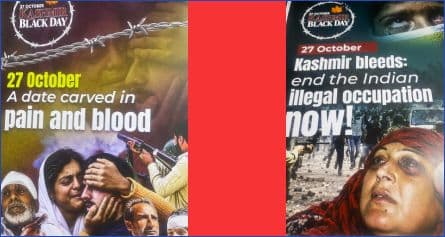
The bloodshed in Kashmir began on 27 October 1947, when Indian troops landed in Srinagar. For Kashmiris, this was the day India took control of Jammu and Kashmir against the wishes of its people and in disregard of the Indian Independence Act and the Partition Plan. Consequently, Kashmiris remember 27 October as a Black Day in Kashmir's history and observe it annually as such.““In remembrance of this Black Day, friends of Kashmir around the world express their solidarity with the Kashmiri people.
The plan to partition British India into India and Pakistan was announced on 3 June 1947. According to the plan, Hindu-majority regions were to join India, while Muslim-majority regions in the western provinces and eastern Bengal were to become part of Pakistan. This arrangement was subsequently approved by the British Parliament on 18 July 1947. At that time, there were also 568 princely states, which became independent and were advised to accede to either India or Pakistan.
On 19 July 1947, a meeting of the Jammu and Kashmir Muslim Conference was held at Abi Guzar in Srinagar. The meeting passed a resolution favoring accession to Pakistan, noting that Jammu and Kashmir had an 87 percent Muslim majority.
India emerged as a violator of the agreed principles of partition. It disregarded the rules, conditions, and understandings of division and intervened in Hyderabad, Junagadh, and Kashmir to establish control. At that time, Maharaja Hari Singh ruled Jammu and Kashmir. In agreement with leaders of the Indian National Congress and British authorities, he announced accession to India through the so-called Instrument of Accession. The details of that agreement remain controversial. This accession became the root of the Kashmir dispute, a poisonous tree whose effects continue to shape Kashmir's future even after 79 years.
British historian Alastair Lamb is among those who challenged India's claim regarding the Instrument of Accession. In his book The Birth of a Tragedy, he argued that Indian troops had entered Kashmir before the document was allegedly signed. For this reason, critics argue that India has never been able to publicly present the original document before international forums. Kashmiri researchers such as Andrew Whitehead and Basharat Hussain Qazibakhsh have also questioned India's claims, describing the document as disputed and arguing that no original document has been conclusively produced. Adding to the controversy, India's archives reportedly declared the document missing.
A Boundary Commission headed by British lawyer Sir Cyril Radcliffe was established to draw partition boundaries. The commission's decision to award the Gurdaspur district to India, thereby providing India direct access to Jammu and Kashmir, further complicated the dispute. Some analysts therefore regard the British boundary arrangements as a major factor in the origin of the Kashmir conflict.
As opposition to Indian control intensified, the Kashmir issue eventually reached the United Nations.
Kashmir at the United Nations
Strong Kashmiri resistance placed India in a defensive position. On 1 January 1948, India referred the Kashmir dispute to the United Nations Security Council.““Debates were held in the Security Council, which subsequently adopted a number of resolutions. Both India and Pakistan initially accepted these resolutions. Among the key provisions were granting the Kashmiri people the right to self-determination and conducting a plebiscite under United Nations supervision. While Indian leaders initially accepted these resolutions, critics argue that India later retreated from those commitments and increasingly described Jammu and Kashmir as an integral part of India.
Rising Kashmiri Resistance
The dispute continued to intensify because the UN resolutions were accepted but never fully implemented. Kashmiri resistance gained momentum. In 1989, Kashmiris intensified their struggle for self-determination, presenting both a warning and a challenge to India.
From January 1989 to September 2018, according to figures cited by Kashmiri sources, large-scale military operations took place. These sources claim that 95,129 Kashmiris were killed, 22,882 women were widowed, 107,723 children were orphaned, and 11,082 women suffered sexual violence. They also report that more than 8,000 young people were arrested or disappeared.
The movement for self-determination in Kashmir has not ceased. A major uprising occurred in 2008. On 8 July 2016, popular young Kashmiri leader Burhan Muzaffar Wani was killed. Following his death, protests and resistance intensified significantly. Reports alleged that Indian security forces used pellet guns against Kashmiri protesters, causing deaths, injuries, blindness, and permanent disabilities.
India continues to suppress Kashmiri activists under allegations of terrorism, while supporters of the independence movement remain committed to their cause. Despite extensive security measures, the movement has not been eliminated. Critics argue that India seeks to integrate all of Kashmir into India and alter its Muslim demographic composition.
Measures cited include the revocation of Articles 370 and 35A of the Indian Constitution, granting Indian citizens the right to settle in Jammu and Kashmir, and increasing pressure on local residents through various state institutions and security mechanisms.
Pakistan, meanwhile, has consistently supported what it describes as the Kashmiri people's right to freedom and self-determination. Pakistan maintains that a peaceful resolution of the Kashmir dispute is essential for lasting peace in South Asia. Despite facing diplomatic and military pressure from India, Pakistan has continued to support the Kashmir issue internationally.
Some Positive Developments
19 January 2017 saw a serious debate on Kashmir in the British Parliament.
On 18 July 2018, the European Parliament issued a document addressing the history of Kashmir and the relevant United Nations resolutions.
The All-Party Parliamentary Group on Kashmir in the UK also initiated further research into the situation in Kashmir.
On 14 June 2018, the United Nations High Commissioner for Human Rights published a report expressing concern about the human rights situation in Kashmir.““According to the Kashmir Human Rights Report, between 1989 and 2026, 7,421 people were allegedly killed after being arrested, 950,151 were severely beaten or tortured, 4,592 were injured by pellet guns, including 139 who lost their eyesight. A total of 184,675 people were forcibly detained, 22,997 women were widowed, and 108,015 children were left without support.
These developments prompted expressions of concern regarding the human rights situation, including from the President of Chile.
On 1 May 2026, the United Nations Human Rights Commission adopted a resolution expressing concern, while on 18 June 2026 various international organizations issued a joint statement condemning what they described as abuses committed by Indian security forces against Kashmiris. Amnesty International also publicly expressed concern on 18 June 2026, and on 23 July 2026, the SOS Torture Network voiced serious concern. On 24 July 2026, the International Federation of Journalists issued a statement describing the situation as intolerable. Numerous international organizations, individuals, and commissions have continued to call for a resolution of the Kashmir issue. International media outlets such as Al Jazeera, Islamicity, Sri Lankan Guardian, Middle East Eye, and TRT World have, from time to time, drawn global attention to the need for resolving the Kashmir dispute.
Kashmiris and peace-loving people around the world continue to observe 27 October as “Black Day”, demanding a resolution to the Kashmir issue. The purpose of observing Black Day is to remind the international community of its responsibility to resolve the dispute in accordance with United Nations resolutions and the wishes of the people of Jammu and Kashmir. It is also intended to remind India of its responsibilities. Another purpose of Black Day is to convey the message that the Kashmiri people will continue their struggle until they obtain the right to self-determination.
India has fallen asleep in the pursuit of its own interests, or rather, it is pretending to be asleep. One can awaken a person who is genuinely asleep, but it is extremely difficult to awaken someone who deliberately keeps his eyes closed while awake.
The Kashmiri voice declares:
Blood cannot wash away the quest for freedom.
27 October, a date carved in pain and blood.
27 October Black Day, the day the troops landed.
27 October, Kashmir bleeds under Indian illegal occupation.
The same question is being raised across the world:
When will Kashmiris be allowed to determine their own future?
For this reason, the significance of 27 October continues to grow.
After India incorporated Jammu and Kashmir into its political map on 5 August 2019, the Kashmir issue has increasingly become like a volcano. Further bloodshed has been inflicted upon the Kashmiri people.
For this reason as well, the observance of 27 October as Black Day and the Kashmiri struggle for freedom have come to be seen as a movement for justice and a quest for rights.