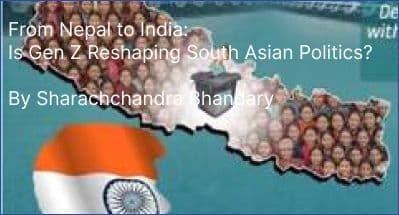
Democracy in South Asia faces a question that elections alone cannot answer: will those in power listen when young citizens challenge them? Nepal’s Gen Z uprising in September 2025 brought down a government, while India’s Cockroach Movement is demanding accountability over voter-list revisions. The two movements have followed different paths, but both highlight the growing influence of youth mobilisation and the dangers of assuming that every protest will produce the same political outcome.
The contrast is striking. Nepal’s protests left at least 19 people dead on the first day and forced Prime Minister K. P. Sharma Oli to resign. India’s Cockroach Movement, organised around the satirical Cockroach Janta Party (CJP) and supported by student groups and opposition parties, is challenging the authorities over electoral accountability. More than a year after Nepal’s uprising, the Indian movement’s political consequences remain uncertain.
In India, the Cockroach Movement has developed from an unconventional form of protest into a campaign with a clear political demand. Its members and supporters allege that revisions to electoral rolls have unfairly removed eligible voters, potentially depriving them of their voting rights. They have called for the resignation of Chief Election Commissioner Gyanesh Kumar and demanded explanations from the Election Commission.
According to international media reports, more than 130 million names have been removed from India’s electoral rolls during the Special Intensive Revision (SIR), prompting protests across several cities. Critics argue that the process risks excluding eligible voters, particularly migrants, poorer citizens and minorities who may struggle to provide the required documents. The Election Commission and the ruling Bharatiya Janata Party (BJP) have rejected allegations of political manipulation, maintaining that the exercise is intended to remove duplicate and ineligible entries. The reported scale of the deletions makes scrutiny important, but the number of names removed does not, by itself, establish that the exercise was intended to favour one party. That question requires evidence, transparent procedures and credible avenues for affected voters to challenge their exclusion.
The controversy is about more than one election official. Electoral democracy depends on public confidence that eligible citizens can vote and that the institutions overseeing elections act impartially. When doubts arise, the appropriate response is to make the process open to scrutiny and provide clear answers. Dismissing every criticism as politically motivated will not restore confidence; nor should allegations be treated as proof before they have been examined.
The government’s handling of the protests has raised a related question: how much room is available for dissent in the world’s largest democracy? Authorities have restricted demonstrations, deployed heavy security and detained protesters. On October 14, CJP leaders Ashutosh Ranka and Saurav Das were remanded to five days in custody over their presence at the restricted Jantar Mantar protest site. On October 16, police detained CJP founder Abhijeet Dipke ahead of a planned rally in New Delhi. Demonstrators nevertheless gathered in Connaught Place, while protests were also reported in other cities. Officials have cited public-order concerns, while critics argue that the measures have curtailed peaceful political expression.
Maintaining public order is a legitimate responsibility of the state. But restrictions must be proportionate, and peaceful assembly cannot be treated simply as a threat because demonstrators challenge the government or a constitutional institution. The right to question those in power is not an obstacle to democracy; it is one of its essential features.
Nepal’s recent experience shows what can happen when an immediate grievance becomes the expression of much deeper frustration. The social media restrictions imposed by Oli’s government provided the trigger for the September 2025 demonstrations. Many young Nepalis, however, were already angry about corruption, nepotism, unemployment and the apparent distance between political leaders and ordinary citizens.
The ban was widely seen by protesters as an attempt to restrict their ability to communicate and expose wrongdoing. Demonstrations that began around this issue rapidly broadened into a challenge to the political establishment. On September 8, security forces used force against protesters, and at least 19 people were killed. The government subsequently lifted the ban, but the anger did not subside. Oli resigned the following day.
For Nepal, the immediate political consequence was unmistakable: a youth-led movement helped bring down the government. Yet the resignation was not the same as resolving the problems that brought people onto the streets. The questions of corruption, accountability, employment and public trust remained. The deaths also left a painful reminder of the cost of a confrontation in which institutions failed to manage public anger peacefully.
India’s movement has followed a different course. It has focused on electoral rolls and the credibility of the Election Commission, while Nepal’s protests became a wider revolt against the government. India has not experienced an equivalent change of national leadership as a result of the Cockroach Movement’s campaign. It would therefore be premature to predict that the protests will produce a similar outcome.
What the two cases share is a demand that authorities take young citizens seriously. What separates them is the political context, the breadth of public grievances and the consequences of the confrontation. A comparison is useful precisely because it reveals those differences rather than assuming that every Gen Z movement follows the same path.
Political analyst Lokesh Dhakal sees the Indian protests as a revolt for change that should not be viewed negatively. He interprets them as a warning to the government of the world’s largest democracy against becoming authoritarian. In his view, accountable government is an aspiration shared not only by India’s Gen Z but by politically conscious people around the world.
Dhakal’s observation gets to the heart of the debate. Democracy cannot be measured by elections alone. It also depends on whether citizens can question public decisions, whether institutions respond to criticism and whether governments accept scrutiny without treating dissent as disloyalty. These tests matter in India, Nepal and elsewhere in South Asia.
The region has seen similar challenges in recent years. In Sri Lanka, the 2022 Aragalaya movement grew out of an economic crisis that left people struggling with shortages, inflation and the collapse of confidence in the government. Mass demonstrations contributed to President Gotabaya Rajapaksa’s departure from office. In Bangladesh in 2024, student protests over public-sector job quotas expanded into a broader movement against the government, culminating in Prime Minister Sheikh Hasina’s resignation.
Neither case was identical to Nepal’s uprising or India’s Cockroach Movement. The grievances, political systems and immediate circumstances differed. But all illustrate how a specific dispute can become a much larger challenge when it connects with frustration that has accumulated over time.
Generation Z has particular advantages in organising such challenges. Young people have grown up with digital communication, and information can travel quickly beyond the control of established political parties or traditional media. Online networks can turn an individual grievance into a public campaign, help protesters coordinate and circulate images of events as they unfold. Satire, as the Cockroach Movement demonstrates, can also provide a memorable symbol around which discontent gathers.
But digital mobilisation has limits. Online popularity does not necessarily translate into broad public support, and a large crowd does not always agree on what should happen next. False information can spread as quickly as verified reporting. Movements may unite people against a policy or a leader but struggle to agree on a common programme for governing or reforming institutions.
That is why the question of whether Gen Z is an unstoppable political force needs a qualified answer. Young people can disrupt established political calculations, expose grievances that leaders have neglected and force issues onto the public agenda. Nepal’s experience showed that a youth-led uprising can have immediate consequences at the highest level of government. India’s protests show how a campaign that begins with a specific institutional dispute can draw in wider opposition and public concern.
Neither example proves that Gen Z is unstoppable. Movements can lose momentum, become divided or fail to secure lasting change. Their influence depends not only on the ability to mobilise but also on the strength of their demands, the breadth of public support and the response of political institutions.
Governments, meanwhile, face a choice. They can respond to criticism with explanations, transparent investigations and meaningful opportunities for peaceful participation. Or they can rely primarily on restrictions and force, risking a deeper loss of trust. The latter approach may disperse a demonstration for a day, but it does not necessarily resolve the grievance behind it.
For India, the immediate challenge is to ensure that concerns about voter-list revisions receive credible, evidence-based scrutiny and that peaceful protest remains possible. For Nepal, the challenge is to turn the political shock of September 2025 into meaningful improvements in governance and accountability. For South Asia as a whole, the lesson is that the health of democracy depends as much on how power responds to dissent as on how it is acquired.
Young people are not asking only for a place in the electoral process. They are demanding institutions that listen, public officials who answer questions and governments that can be held accountable between elections. Whether their movements produce lasting reform will depend on what happens after the streets empty.
From Kathmandu to New Delhi, Gen Z has made one point difficult to ignore: political leaders cannot assume that younger citizens will remain silent when they believe their rights or their future are at stake. The generation may not be unstoppable, but neither can its grievances be dismissed indefinitely.