CONFIDENTIAL • STRATEGIC EXECUTIVE SUMMARY Nepal Green Hydrogen Company Pvt. Ltd. (NGHC) |
Nepal’s Green Urea Project
(Koshi Pride Project)
Nepal’s First Integrated Green Hydrogen – Ammonia – Urea Industrial Ecosystem
Udaipur, Koshi Province • GoN MOU Executed May 2025 • June 2026
1,000,000 MT Phase III Urea Capacity per year | $7.05B Total Project Investment Three-phase deployment | 15.9% Composite IRR (10-yr) Phased self-financing | $650M/yr Forex Retained at Phase III vs. import alternative |
NPR 28.8B Annual Subsidy Eliminated At full Phase III scale | ~100,000 Ecosystem Jobs Direct & indirect at maturity | NPR 500B+ 10-Year Cumulative Savings Estimated NPR | GH Policy 2024 Policy Alignment Nepal Green Hydrogen Policy |
Executive Summary of the Strategic Pre-Feasibility Report • Prepared by NGHC • June 2026
Liaison & Legal Counsel: galabdhungana@esquirepc.com | +1 (917) 273 9312
| 01 THE PROBLEM NEPAL CANNOT IGNORE |
Nepal’s Fertilizer Crisis — The Numbers
- NPR 114 Billion ($870M) spent on fertilizer subsidies over five years (2021–2026)
- NPR 28.82 Billion annual subsidy cost in 2026 — and structurally rising
- 600,000 MT imported annually; effective demand consistently exceeds 800,000 MT
- 200,000 MT structural supply deficit forces black market prices to NPR 130/kg
- Official price NPR 14/kg = 85% government subsidy on every bag sold
- March 2026 Gulf crisis: 19% urea price spike in a single week
- Zero domestic production. Zero strategic reserve. Zero hedge against the next shock.
The Structural Vulnerability Nepal imports 100% of its urea from India, China, and Gulf states. Every price shock, export ban, or shipping disruption directly becomes a larger line item for the Ministry of Finance and empty shelves for Nepal’s three million farming households. For every bag a farmer buys at NPR 14/kg, the Government of Nepal has already paid for six more. This model is not merely expensive — it is structurally untenable. |
| 02 THE SOLUTION: NEPAL’S GREEN UREA PROJECT |
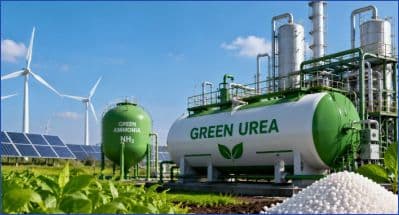
Nepal’s Green Urea Project converts three co-located assets into a circular green manufacturing platform: Nepal’s surplus hydropower and solar energy, captured CO₂ emissions from Udaipur Cement Industries Ltd (UCIL), and the Sindhali Limestone Reserve. Green hydrogen produced via water electrolysis combines with captured CO₂ and atmospheric nitrogen to synthesise urea through the Haber-Bosch process. The blended electricity cost is 3.5¢/kWh — secured through a Solar-Hydro Barter with the Nepal Electricity Authority — placing NGHC among the most cost-competitive green urea producers in Asia.
The Core Structural Thesis The Government of Nepal is the guaranteed offtaker. Revenue is benchmarked to import substitution savings, not volatile global spot markets. This is the structural difference between Nepal’s Green Urea Project and every other green hydrogen project globally that has failed to achieve financial close. |
Phase | Capacity | CAPEX | IRR | Payback | Annual Saving | |
|---|---|---|---|---|---|---|
Phase I — Establish | 200 KTPA | $965 Million | 11.5% | 8.4 yrs | ~$130M/yr | |
Phase II — Scale | 500 KTPA | $2.12 Billion | 15.8% | 6.2 yrs | ~$325M/yr | |
Phase III — Self-Sufficiency | 1,000 KTPA | $3.97 Billion | 18.5% | 5.5 yrs | ~$650M/yr | |
| 03 THE FINANCIAL CASE | ||||||
Three-Phase Summary
Why This Project Is Bankable
- Nationally secured offtake — Government of Nepal is the guaranteed buyer at all three phases
- Revenue benchmarked to import substitution economics, not volatile international spot markets
- No foreign energy dependency: every production input is sourced within Nepal
- Each phase is financially self-sustaining before the next phase begins
- PPP structure with GoN equity unlocks DFI concessional finance and sovereign de-risking instruments
- Composite 10-year IRR across all phases: 15.9%
- Phase III annual revenue: $900 Million; annual forex retained: $650 Million
- 10-year cumulative NPR savings: 500+ Billion
Key Financial Assumptions
- Electricity cost: 3.5¢/kWh (Solar-Hydro Barter with NEA)
- Urea production cost: $285–$460/MT vs. $700/MT import border landing cost
- Reference exchange rate: 1 USD = 150 NPR (March 2026 baseline)
- Concessional debt: 40–55% of Phase I capital structure; reducing to 30–40% by Phase III
- Natural currency hedge: NPR depreciation raises import cost, strengthening domestic production case
Severe Downside Stress Test Under simultaneous adverse conditions — electricity at 5¢/kWh, urea price at $280/MT, 25% CAPEX overrun, zero carbon revenue, 18-month construction delay, and 33% NPR depreciation — Phase II and Phase III remain viable above DFI minimum thresholds. Phase I requires Viability Gap Funding under Nepal’s PPP Policy 2020, precisely the instrument available for this structure. |
| 04 THE TECHNICAL ARCHITECTURE |
Process Unit | Technology | Global Technology Providers |
|---|---|---|
Green Hydrogen | Alkaline + PEM Electrolysis | Nel Hydrogen, ThyssenKrupp Uhde, John Cockerill, Siemens Energy |
Ammonia Synthesis | Haber-Bosch Process | Topsoe (Denmark), KBR (USA), Casale (Switzerland) |
Urea Synthesis | CO₂ + NH₃ Reaction | Saipem/Stamicarbon, Casale, Technip Energies |
CO₂ Capture (UCIL) | Post-combustion MEA Scrubbing | Linde, Air Liquide, Aker Carbon Capture |
Air Separation | Cryogenic Separation | Linde, Air Products, Air Liquide |
Energy Supply | Solar-Hydro Barter @ 3.5¢/kWh | Nepal Electricity Authority (NEA) — PPP mechanism |
Water Stewardship: Zero Liquid Discharge Commitment NGHC is committed to a Zero Liquid Discharge design. Advanced condensation recovery will recycle an estimated 70% of gross water volume. Net fresh abstraction at Phase III: ~2.25 million m³/yr from the perennial Koshi/Triyuga River system. Downstream agricultural irrigation holds strict regulatory priority over industrial abstraction during the dry season (February–April). |
▸ Seismic Compliance: The project site is located in Nepal’s Seismic Zone IV (high hazard). Structural engineering will be designed to Nepal Building Code NBC 105:2020 standards. A formal Seismic Hazard Assessment is Workstream 1 of the DFS/DPR geotechnical investigation and a mandatory DFI condition precedent.
| 05 WHY NEPAL HAS A STRUCTURAL COMPETITIVE ADVANTAGE |
Nepal does not compete with Gulf states or Australia on export volume. Nepal competes on a structurally different model: nationally anchored offtake + integrated CO₂ feedstock + import substitution economics. No other country in this comparison possesses all three simultaneously.
Factor | Nepal | Gulf States | Australia | India |
|---|---|---|---|---|
Renewable energy cost | Favorable (3.5¢/kWh) | Favorable (solar) | Favorable | Neutral |
Nationally anchored offtake | Favorable — GoN buyer | Challenging — export only | Challenging — export only | Neutral (domestic) |
Integrated CO₂ feedstock | Favorable — UCIL co-located | Challenging — no source | Neutral | Neutral |
Solar-hydro seasonal synergy | Favorable — unique barter | Challenging — solar only | Neutral | Neutral |
No maritime export dependency | Favorable — landlocked | Challenging — shipping req. | Challenging — shipping req. | Neutral |
Subsidy replacement logic | Favorable — NPR 28.8B/yr | Not applicable | Not applicable | Favorable |
| 06 NATIONAL STRATEGIC SIGNIFICANCE |
This Is Not a Fertilizer Plant — It Is Nepal’s National Industrial Transformation Platform Nepal’s Green Urea Project is simultaneously:
• Nepal’s largest energy storage platform (1,500–2,000 MW electrolyser fleet) • Nepal’s largest industrial decarbonisation platform • Nepal’s entry point into global green hydrogen and ammonia markets • Nepal’s largest single CO₂ capture installation in South Asia • A grid stabilisation and hydropower monetisation mechanism • A nationally anchored import substitution platform
All financed by the elimination of a subsidy liability that would otherwise continue growing indefinitely. |
National Multiplier Effects
Multiplier Domain | Impact at Phase III Scale |
|---|---|
Jobs — Direct & Indirect Ecosystem | ~100,000 direct and indirect jobs across the full green hydrogen–urea ecosystem at maturity (construction, operations, supply chain, logistics, agriculture, engineering services, industrial clusters) |
Foreign Exchange Retention | $650M/yr permanently retained — equivalent to Nepal’s entire annual capital expenditure budget |
Fiscal Swing | NPR 40–50 Billion net annual fiscal swing at Phase III (subsidy eliminated + corporate tax + royalties + dividend income) |
Agricultural Productivity | Eliminates 200,000 MT structural deficit; reliable affordable urea supply for all 3M+ farming households |
Industrial Cluster Formation | Hydrogen-ammonia hubs generate industrial clusters 5–10× the size of the anchor plant (precedent: Jubail, Rotterdam) |
Carbon Revenue (Supplementary) | 850,000 t CO₂/yr captured at Phase III; at $25/t = $21.25M/yr supplementary — not required for base IRR |
| 07 THE COST OF INACTION | |
If Nepal does not proceed, six structural risks compound year on year without a domestic production alternative:
Risk | Consequence of Inaction |
|---|---|
Rising subsidy burden | From NPR 12B (2022) to NPR 30B (2024) to NPR 28.8B (2026 est.) — no mechanism to control this trajectory without domestic supply |
Geopolitical supply shocks | March 2026: 19% price spike in one week. Russia-Ukraine 2022: prices doubled for 18 months. Indian export bans recur without warning. |
Hydropower monetisation failure | Wet-season surplus sold to India at commodity prices rather than converted into nationally retained industrial value |
Missed hydrogen transition window | First-mover DFI financing relationships, technology partnerships, and carbon registrations being locked up by India, Oman, Morocco, Australia |
Future CBAM exposure | EU Carbon Border Adjustment Mechanism covers fertilizers. Continued grey urea use becomes a liability for Nepal’s agricultural export sector |
Continued forex leakage | $650M/yr permanently exported for urea imports — compounding with NPR depreciation every year |
| 08 GOVERNANCE & FINANCING STRUCTURE |
Legal Entity & Capital Structure
- Koshi Pride SPV — incorporated under Nepal law; ring-fenced project assets
- NGHC: ~60% | Government of Nepal: ~30% | DFI equity: ~10%
- Board: 3 NGHC + 2 GoN + 1 independent director + 1 DFI observer
Capital Instrument | Phase I | Phase II | Phase III |
|---|---|---|---|
Concessional debt (DFI) | 45–55% | 35–45% | 30–40% |
Commercial project debt | 20–25% | 25–30% | 30–35% |
GoN equity | 15–20% | 15–20% | 15–20% |
NGHC equity | 10–15% | 10–15% | 10–15% |
DFI equity | ~5% | ~5% | ~5% |
* Ranges are indicative and will be optimised during DFI syndication based on final concessional debt allocation, co-financing mix, and Phase I operational results.
Target DFI & Financing Partners
- Tier 1: Asian Development Bank (ADB), IFC (World Bank Group), AIIB, Green Climate Fund
- Tier 2: World Bank / IDA, European Investment Bank (EIB), OPEC Fund for International Development
- Export Credit Agencies for political risk, currency transfer risk, and ECA-covered debt tranches
- De-risking: Government guarantee on NEA barter commitment; Viability Gap Funding (Phase I); USD cost-indexation in Government Procurement Agreement
| 09 PATHWAY TO BANKABILITY: THE DFS/DPR |
This document is a Strategic Pre-Feasibility Report establishing that Nepal’s Green Urea Project is technically viable, commercially rational, and financially robust. The immediate next step is a jointly commissioned Detailed Feasibility Study and Detailed Project Report (DFS/DPR) — the 12–16 month process that produces investment-grade documentation for DFI financial close.
# | Workstream | Category | Key Output |
|---|---|---|---|
1 | Geotechnical Investigation | Technical | Site characterisation; seismic hazard; foundation design |
2 | Hydrological & Water Resources Study | Technical / ESG | Water availability; IFC PS6 compliance; water use permit |
3 | Environmental & Social Impact Assessment (ESIA) | ESG — Critical Path | ESIA to IFC Performance Standards; EIA to MoFE |
4 | Grid Integration & Transmission Study | Technical — Critical Path | NEA interconnection; barter agreement technical basis |
5 | Electrolyser Technology Selection & FEED | Technical | Preferred technology; vendor pre-qualification; P&IDs |
6 | Ammonia / Urea Process Design | Technical | Licensor pre-qualification: Topsoe, KBR, Casale |
7 | Bankable Financial Model | Financial | 20-yr DCF; Monte Carlo P10/P50/P90; DSCR; auditor-reviewed |
8 | Sovereign Offtake Agreement (GPA) | Commercial / Legal | 15-yr GPA; USD indexation; UNCITRAL dispute resolution |
9 | DFI Engagement & Term Sheets | Financial | Non-binding terms: ADB, IFC, AIIB; ECA engagement |
10 | Independent Engineer Appointment | DFI Mandatory | Technical review of all deliverables; construction oversight |
Milestone | Timeline | Key Output |
|---|---|---|
GoN & NGHC jointly commission DFS/DPR | Month 0 | Board approval; terms of reference agreed; specialist firms appointed |
EIA scoping submitted to MoFE | Month 2–3 | Critical path — longest-lead regulatory approval |
Technology vendor pre-qualification | Month 3–6 | Preferred electrolyser and synthesis technology selected |
NEA grid study & barter agreement formalised | Month 3–8 | Long-term Power Purchase / Wheeling Agreement signed |
Bankable financial model complete | Month 8–10 | Independently audited; submitted to DFI lenders |
DFI term sheets received | Month 6–14 | Non-binding terms from ADB, IFC, AIIB |
DFS/DPR complete & independently reviewed | Month 12–16 | Investment-grade feasibility report delivered |
Financial close on Phase I | Month 18–24 post-DFS | All conditions precedent satisfied; construction begins |
| 10 THE GOVERNMENT OF NEPAL’S DECISION |
Four Decisions That Unlock Everything (1) Formally approve Nepal’s Green Urea Project (Koshi Pride) for advancement to full DFS/DPR
(2) Designate a nodal Ministry (recommended: Ministry of Finance / PPP Directorate) as co-commissioning authority for the DFS/DPR
(3) Allocate GoN budget contribution for DFS/DPR co-commissioning and regulatory fee payments
(4) Initiate SPV incorporation process and formal DFI engagement (ADB, IFC, AIIB)
These four decisions, made together, place Nepal’s Green Urea Project on the path to financial close and construction — and permanently transform Nepal from a price-taker in global fertilizer markets into the nationally governed controller of its own food security. |
The Strategic Imperative Nepal’s Green Urea Project (Koshi Pride) is, at its core, a national security project. It replaces Nepal’s most dangerous structural dependency — a 100% import-dependent food supply chain — with a domestically owned, profitably operated, government-guaranteed industrial platform. Every input is sourced within Nepal. Every tonne of urea is consumed within Nepal. Every dollar of savings is retained within Nepal. No political event abroad, no war in a distant region, no export ban by a neighbouring country, no shipping disruption, no commodity price shock can undermine this system once it is built. Nepal transitions from being a price-taker in global fertilizer markets to being the nationally governed controller of its own food security. |
Nepal Green Hydrogen Company Pvt. Ltd. (NGHC) Nepal’s Green Urea Project (Koshi Pride) • Udaipur, Koshi Province, Nepal • June 2026 MOU: Government of Nepal (May 2025) • Green Hydrogen Policy 2024 • Advisor: Green Hydrogen Lab, Kathmandu University Liaison & Legal Counsel: galabdhungana@esquirepc.com | +1 (917) 273 9312 |