Nepal and the Sociology of Permanent Crisis
Nepal has no ocean. Yet it has learned how to produce a tsunami without a sea. The first was political. The second is Himalayan, ecological, and humanitarian. They are different phenomena, but they expose a similar institutional weakness: when societies become accustomed to crisis, crisis itself begins to look normal. Exploring how Nepal’s institutions respond to these crises reveals systemic vulnerabilities that shape societal reactions and resilience.
On September 8 and 9, 2025, Nepal experienced a political tsunami. A youth uprising shook the political establishment, exposed the distance between the governing class and a generation that no longer trusted the old political vocabulary, and left 76 young people dead. The streets became the place where political legitimacy was contested.
Now, less than a year later, Nepal is confronting another kind of tsunami.
This time the wave came from the Himalayas.
On August 26, a catastrophic debris flood swept through the Lhende Khola, Bhote Koshi, and Trishuli river systems after a complex chain of mountain events involving ice, rock, water, and debris. The destruction spread far downstream, devastating communities, infrastructure, roads, bridges, and hydropower facilities. The flood also crossed the Nepal-Tibet ecological frontier, reminding us that mountains and rivers do not recognize political boundaries.
By August 28, the scale of the catastrophe had become staggering. Nepal had confirmed 579 deaths, with 1,924 people still missing. China had reported additional deaths and missing people in Tibet. The numbers kept changing as rescue teams searched through devastated communities and along the river system.
But numbers, however horrifying, tell only part of the story.
Behind every number is a person with a name, a family, a history, and a future. Recognizing these stories can inspire collective responsibility and hope for social resilience.
And the catastrophe was not necessarily over.
A debris-dammed lake created another threat, raising fears of a secondary flood and temporarily disrupting rescue operations. Authorities warned people downstream to move to safer, higher ground. The possibility of another wave turned an already devastating disaster into an ongoing emergency.
This is where the phrase “Himalayan tsunami” becomes more than a metaphor.
A conventional tsunami begins with a disturbance in an ocean. Nepal’s tsunami began in the mountains and traveled through rivers, carrying water, ice, rock, and debris into human settlements. The Himalayas are not merely a spectacular landscape. They are a living ecological system upon which millions of people depend.
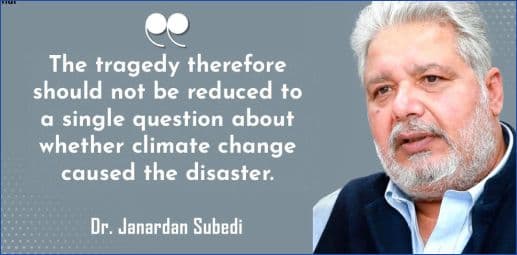
The tragedy therefore should not be reduced to a single question about whether climate change caused the disaster. Scientists are still reconstructing the precise chain of events. What is already clear is that the Himalayan environment can produce cascading hazards, and that communities living below these mountains can become extraordinarily vulnerable when natural forces meet fragile infrastructure and limited preparedness.
Nature creates hazards. Institutions must proactively address vulnerabilities to foster confidence and a sense of agency in managing disasters.
That distinction matters.
Another image from Kathmandu deserves attention, not because any individual in it should be condemned, but because it reveals the social distance between power and suffering.
On August 27, as the Himalayan catastrophe was unfolding and communities were already facing death, displacement, and destruction, a photograph was taken showing Finance Minister Swornim Wagle, elite members of Parliament, and prominent business figures at a wine-and-dine gathering with Indian parliamentarian and author Shashi Tharoor, who was in Kathmandu to introduce the Nepali edition of his book, Why I Am a Hindu. The photograph circulated publicly on August 28, when Nepal was mourning its dead and families were desperately searching for those still missing.
The photograph is not, by itself, evidence of wrongdoing. Nor should Mr. Tharoor, the Finance Minister, parliamentarians, or business leaders in the photograph be turned into villains. Diplomatic, intellectual and social engagements do not automatically become immoral because a country is experiencing a disaster.
But sociology asks a different question.
What does the photograph reveal about visibility?
At one level, it makes visible the world of political and economic privilege: people who have access to one another, comfortable spaces, food, conversation, networks and international connections. At another level, it makes less visible the people whose lives were being destroyed by the flood.
That contrast is sociologically significant.
The contrast between visible suffering and elite social life highlights the need for societal empathy and awareness of those most affected by disasters.
This is the sociology of visibility.
What becomes visible in a society is not necessarily what is most important. It is often what power, privilege, and social position allow society to see.
The photograph should therefore be read less as an accusation against individuals and more as a mirror of Nepal’s social structure. On one side of the national picture, citizens were mourning, waiting, searching, and surviving. On the other were people continuing with the routines of elite social life.
Both realities could exist simultaneously.
That is precisely what makes the image uncomfortable.
A society can experience catastrophe and normality at the same time.
The deeper question is whether those with political and economic power remain sufficiently connected to the suffering outside their immediate social world.
Visibility is a form of political power. Those who are visible receive attention. Those who are institutionally visible are more likely to receive resources. When disaster victims remain invisible, they risk neglect, highlighting the need for policies that enhance the social and political visibility of marginalized communities affected by crises.
Those who remain invisible can disappear twice: first physically through disaster, and then politically through neglect.
This problem of visibility connects Nepal’s two tsunamis.
Young people became visible when they occupied the streets. Their frustration had existed long before the protests, but political institutions did not adequately see it. Their anger became impossible to ignore only when it entered public space with extraordinary force.
Mountain communities experience a different form of invisibility. Their vulnerability exists long before the river rises. They live with landslides, floods, fragile roads, limited communications, and difficult access to emergency services. Their vulnerability is often known. But knowledge without institutional action is another form of invisibility.
Citizens should not have to die before institutions notice them.
Young people should not have to fill the streets before politicians listen. Villages should not have to disappear before disaster preparedness becomes a national priority. Families should not have to search through rivers for bodies before the state recognizes the vulnerability of the communities living beside them.
Nepal’s problem is therefore larger than one political party, one government, one minister, or one natural disaster.
It is institutional.
Nepal has demonstrated extraordinary capacity to survive crises. But survival should not be confused with resilience.
Resilience requires preparation, coordination, scientific knowledge, early-warning systems, responsible infrastructure planning, transparent communication, and institutions capable of acting before catastrophe rather than merely responding afterward.
The Himalayan disaster should also force Nepal to reconsider its relationship with the mountains.
For generations, the Himalayas have been treated as scenery, pilgrimage destinations, sources of hydropower, tourist attractions and geopolitical frontiers. They must increasingly be understood as ecological infrastructure upon which the survival of millions depends.
The mountains are not simply beautiful.
They are vulnerable.
And what happens in the mountains eventually travels downstream.
The same is true of politics.
What happens in the political center eventually travels into society.
This is why the Himalayan crisis cannot be understood only within Nepal’s national boundaries. The Himalayas connect Nepal, Tibet, and India through an ecological system that ignores political borders. Rivers cross boundaries. Glaciers do not carry passports. Atmospheric changes recognize no nationality.
A river has no religion, nationality, or race.
It does not know whether the person standing beside it is Nepali, Tibetan, Indian, or Chinese. It does not know whether someone is Hindu, Buddhist, Muslim, Christian, or atheist. It simply flows according to gravity, geography, and the physical conditions of the landscape.
That should change the way we think about responsibility.
Nepal has responsibilities. India has responsibilities. China has responsibilities. International institutions have responsibilities. And humanity has a collective responsibility because the Himalayan environment is connected to a much larger climate system.
The point is not to identify a villain.
The point is to recognize interdependence.
Development cannot mean building first and asking about ecological consequences later. Hydropower cannot be treated simply as an economic commodity. Roads cannot be carved through fragile mountain terrain without understanding their environmental consequences. Settlements cannot continue expanding in high-risk areas without adequate warning, evacuation, and communication systems.
Nor can disaster preparedness remain a ceremonial exercise that becomes visible only after disaster strikes.
The political tsunami of 2025 and the Himalayan tsunami of 2026 therefore belong to the same sociological story.
In both cases, ordinary citizens became visible only after crisis became impossible to ignore.
The young became visible when they occupied the streets.
The victims became visible when the rivers carried their homes away.
This is the tragedy of a crisis-driven society.
A government that is constantly reacting to emergencies eventually becomes an institution of reaction rather than prevention. Political leaders move from one crisis to another. Bureaucracies issue statements. Citizens organize their own survival. Relief arrives after destruction. Commissions are formed. Promises are made.
Then public attention moves elsewhere.
This is how permanent crisis is produced.
The danger is not simply that Nepal experiences repeated disasters. The greater danger is that repetition can normalize them.
When political instability becomes routine, people stop expecting institutions to function normally. When corruption becomes ordinary, it loses its capacity to shock. When disasters repeatedly destroy communities, vulnerability begins to look like fate.
But vulnerability is not destiny.
It is often the product of social organization.
The Himalayan tsunami should therefore not be understood simply as an unfortunate natural event. It should be understood as a test of Nepal’s institutional imagination.
Can the state see beyond Kathmandu?
Can it see the mountain village before it becomes a statistic?
Can political leaders see the young citizen before that citizen becomes a protester?
Can development planners see the river not merely as a source of electricity but as a living ecological system?
And can neighboring countries see the Himalayas not only as a geopolitical frontier but as a shared ecological civilization?
These questions are more important than political speeches after the disaster.
Nepal’s two tsunamis have arrived from opposite directions.
The political tsunami came from below, from a generation that felt ignored by institutions.
The Himalayan tsunami came from above, from an ecological system under extraordinary stress.
One exposed a crisis of legitimacy.
The other exposed a crisis of vulnerability.
Both ask the same fundamental question:
Can Nepal’s institutions see what is coming before it becomes a catastrophe?
If the answer remains no, Nepal will continue moving from one permanent crisis to another, celebrating its capacity to survive while failing to develop the capacity to prevent.
The lesson of the Himalayan tsunami should therefore not be simply that Nepal is unfortunate.
It should be that Nepal must become institutionally awake.
The river has no religion, nationality or race. The mountain has no political party. Disaster does not ask whether its victims voted for the government in power.
Perhaps that is the most important sociological lesson of all.
Nature does not discriminate.
Society does.
And when society decides whose suffering is visible and whose suffering can remain invisible, disaster becomes more than an act of nature.
It becomes a test of the state’s moral and institutional character.
Author Janardan Subedi is Professor Emeritus of Sociology at Miami University, Ohio, USA.
@DeshSanchar