ICIMOD is pleased to present the regional cryosphere strategy for the Hindu Kush Himalaya, a framework to chart for sustained, standardised, and basin-representative monitoring of glaciers, snow and permafrost across the region.
Why the strategy matters now?
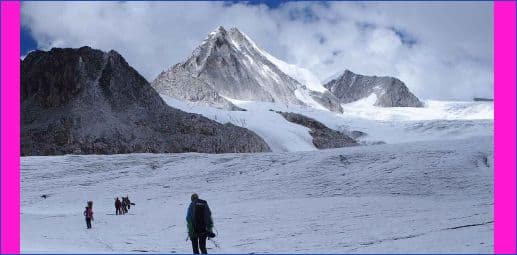
The HKH holds the largest concentration of ice outside the polar regions. This frozen sphere is critical water source for sustaining mountain ecosystems and livelihoods, serving more than 270 million people in the mountains and over two billion people downstream.
The HKH cryosphere is changing rapidly: glaciers are losing mass at an accelerated rate, snow patterns are shifting later in the year and reducing, permafrost is degrading, and the river flows are becoming increasingly unpredictable. Impact of these changes are intensifying disaster events across the region, events such as glacial lake outburst floods, avalanches, thermokarst, debris flows and landslides are on the rise, with cascading impacts on settlement, infrastructure, water and energy security and food systems. Despite the magnitude of these risks, cryosphere monitoring across the region remains sparse and uneven. For instance, the HKH has an inventory of over 63,700 glaciers, but only 18% of the 38 monitored glaciers meet the World Glacier Monitoring Service’s (WGMS) benchmark standards.
Additionally, major glacierised Himalayan regions remain under monitored. This also means, even if there are data, these data do not provide collective picture of how HKH cryosphere is changing.
The strategy developed by former and current cryosphere experts in ICIMOD proposes a four connected pillars connecting to cross-cutting priorities to monitor cryosphere comprising of:
Harmonised monitoring of glaciers, snow, and permafrost using standardised methods
Stronger regional capacity for sustained field and technical work
The HKH CryoHub, a coordination mechanism for quality assurance and governed access to interoperable data
Translation of science into services for water and energy planning, hazard preparedness, infrastructure protection, and climate adaptation
These pillars aim to turn fragmented, country-level observations into trusted, shared knowledge to support regional resilience planning and strengthening the HKH's contribution to global climate action.
The strategy builds on decades of learning about cryosphere change in the HKH region and responds to the need for more connected action across upstream and downstream systems. It aims to strengthen collective understanding of the links between cryosphere change, water security, hazards, and adaptation needs.
Available for interview
Sher Muhamad, Remote Sensing Specialist, ICIMOD- Lead Author
Mohd Farooq Azam, Senior cryosphere specialist, ICIMOD- Author
Zhang Qianggong, Head of Climate and Environmental Risks, ICIMOD- Author
Additional co-authors available on request:
Miriam Jackson, Research scientist, NVE | Co-chair, scientific steering group, CliC- Author
Download Strategy Document
An accompanying illustration depicts the HKH as a connected landscape: snow-covered mountains, glaciers, rivers, field instruments, satellite observations, and digital information systems with researchers and practitioners in the foreground examining regional data together, symbolising the institutions and partnerships that turn observations into knowledge.
High-resolution versions, and other relevant visual assets are available on request.
About International Centre for Integrated Mountain Development (ICIMOD)
The Hindu Kush Himalaya (HKH) region stretches 3,500km across Asia, spanning eight countries – Afghanistan, Bangladesh, Bhutan, China, India, Myanmar, Nepal, and Pakistan. Encompassing high-altitude mountain ranges, mid-hills, and plains, the zone is vital for the food, water, and energy security of up to two billion people and is a habitat for countless irreplaceable species. It is also acutely fragile, and vulnerable to the impacts of the triple planetary crisis of climate change, pollution, and biodiversity loss.
The International Centre for Integrated Mountain Development (ICIMOD), based in Kathmandu, Nepal, is an international organisation established in 1983, that is working to make this critical region greener, more inclusive and climate resilient. For more information, read our Strategy 2030 and explore our website.
For media inquiries, please contact:
ICIMOD (Kathmandu)
Raz Tuladhar, Media Officer
Anshu Pandey, Senior Media Associate
Email: media@icimod.org