The False Choice: What Nepal’s 3% Education Debate Missed
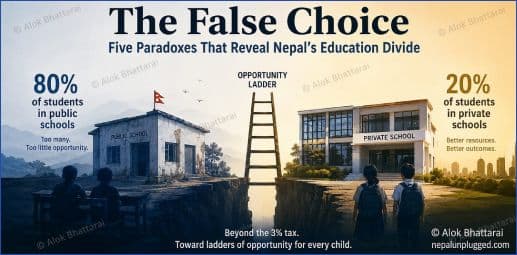
Five Paradoxes That Reveal Nepal’s Education Divide
Dr. Alok K. Bohara
Preamble
Finance Minister Dr. Swarnim Wagle introduced the proposed 3% education equity fee with a straightforward objective: asking those who could afford private education to contribute modestly toward expanding educational opportunities for disadvantaged children.
Opposition leaders—including Gagan Thapa—along with many parents, school operators, and commentators, pushed back. They argued that private education is no longer a luxury. Many ordinary families already make enormous sacrifices to send their children to private schools because they have lost confidence in the public system.
Within days, the government withdrew what had been one of its most publicized budget measures.
The government may have misjudged the instrument. The opposition rightly highlighted the burden on many families. Yet both sides largely missed the deeper fault lines that the controversy exposed.
The debate focused around the price of private education. It should have been about the value of public education and the ladders to opportunity economy.
Five paradoxes help explain why.
Where the Unequal Journey Begins
A little over a year ago, I joined a FaceTime conversation with the headmaster, teachers, parents, and school-management committee of a public school on the remote Gulmi–Pyuthan border.
They had recently received the results of the Secondary Education Examination. Of the school’s twenty-nine students, only one had passed.
The school was not entirely without resources. It had nearly two dozen computers although a very thin teachers pool. Computers were largely unused or unusable. Qualified teachers in mathematics, science, and English, in particular, were difficult to find. The teachers and community leaders were plainly worried about their children’s future, but they did not know where to begin.
Their question was simple:
How do we give our children a real chance?
I remembered that conversation as Nepal debated the government’s proposed 3% Education Equity Fee on private-school charges.
The intention behind the fee was understandable.
In fact, nearly two decades ago, during the height of the Maoist movement—when private schools were often portrayed as symbols of bourgeois privilege and occasionally became targets of political hostility—I suggested, through the newspaper op-ed and position white papers, a modest education levy as a calmer alternative. Rather than attacking private education, those who could afford it would contribute modestly toward expanding opportunities for disadvantaged children that Maoists said they cared so much about.
The underlying principle still strikes me as reasonable. In fact, carefully designed earmarked taxes are not unusual. Many countries use property taxes to support local public schools, fuel taxes to help finance transportation infrastructure, or state lotteries to fund scholarships and higher education. Here in New Mexico, for example, lottery revenues help support college tuition through the Legislative Lottery Scholarship.
The question, therefore, is not whether society should ever ask those with greater means to contribute more toward expanding opportunity. Many successful societies do exactly that. The real question is whether the chosen instrument addresses the underlying problem—and whether citizens have confidence that the resources will actually produce better educational outcomes.
The government wanted to raise resources for disadvantaged children, remote communities, educational infrastructure, and greater social equity. It also carried an unmistakable constitutionally mandated social-democratic signal: those purchasing private services would contribute modestly toward improving access for those left behind.
But the fee provoked an immediate backlash.
Private schools, parents, media commentators, political leaders, and much of the urban professional class argued that private education was no longer limited to the rich. Many lower- and middle-income parents make extraordinary sacrifices to send their children to private schools because they lack confidence in the public alternatives. A tax imposed on school fees, they argued, would ultimately be transferred to parents.
Faced with this opposition, the government suspended the policy.
The government may have identified a real equity problem. But the 3% fee was the wrong medicine—or at least a poorly designed one. More importantly, the controversy revealed how narrowly Nepal continues to discuss educational inequality.
The debate focused on the cost of escaping the public-school system. It paid far less attention to the children who cannot escape it.
Five paradoxes help reveal what was missing.
1. The 80–20 Quality Paradox
Roughly four out of every five Nepali schoolchildren depend on public or community schools. Yet educational achievement is disproportionately concentrated among the minority attending private institutions.
The precise percentages vary by year, examination, and definition. Yet the overall pattern is unmistakable. In the most recent SEE results, more than 80% of public-school students failed, while approximately 95% of private-school students passed. Whether one looks at pass rates, learning outcomes, or progression into higher education, the same fault line appears repeatedly. The educational system serving the overwhelming majority of children continues to produce disproportionately weaker outcomes, while the system serving a much smaller and generally better-off population produces disproportionately stronger ones.
Back to my conversation with the rural headmaster —an extreme but painfully recognizable example: one student passed out of twenty-nine.
This is the central 80–20 paradox. Nepal’s long-term human-capital future depends primarily on the education received by the 80%, but public attention repeatedly gravitates toward the choices and costs facing the 20%.
The 3% debate followed precisely this pattern. The country mobilized quickly around a modest increase in private-school costs. Yet the chronic failure of schools educating most poor children rarely generates comparable urgency.
Removing the tax may provide relief to families already paying private-school bills. It does almost nothing for the child in a rural public school where twenty-eight out of twenty-nine students failed.
2. The False Choice Paradox
The strongest argument against the fee was that even poor families send their children to private schools.
There is truth in that claim—but also considerable misdirection.
Available household evidence suggests that only around 8–10% of children from the poorest quintile attend private schools. The exact estimate should be examined carefully, but the larger point is clear: more than nine out of ten children from the poorest households remain in public schools.
Invoking “the poor parent sacrificing for private education” therefore uses an exceptional case to represent the whole population.
The image is emotionally powerful. It is also politically useful. It allows private-school owners, affluent parents, media personalities, and policy elites to present their own resistance to taxation as a defense of the poorest.
But whom does tax removal primarily serve?
Certainly, it helps some lower-income families struggling to pay fees. Their hardship should not be dismissed. Yet most of the benefit necessarily goes to the much larger population of middle- and upper-income families whose children are far more likely to attend private institutions.
This does not mean the fee was well designed. A tax can be poorly targeted even when its stated purpose is worthy. It means only that the public argument should be honest about its incidence.
The real false choice facing lower-income parents is not simply between a public and private school. It is between:
making a severe financial sacrifice today and accepting what they fear will be diminished opportunity tomorrow.
They do not necessarily love private education. They are purchasing an exit from a system they no longer trust.
3. The Income-Share Paradox
A fixed school fee does not impose the same burden on every household.
Suppose the average private-school cost is compared with annual per capita income or consumption. For affluent households, tuition may consume a manageable share of resources. For lower-income families, the same amount can consume an extraordinarily large proportion.
My preliminary calculations (google search) suggest that private-school expenses could approach a very high share of the per capita resources available to families near the bottom of the distribution, while accounting for perhaps one-fifth or less among affluent households. These estimates require additional verification because household size, number of school-age children, location, transportation, uniforms, food, and other charges all matter.
But the underlying relationship is unmistakable:
The poorer the family, the greater the sacrifice required to purchase educational quality privately.
This creates another paradox. Removing a 3% tax may be presented as a major pro-poor victory, but it scarcely alters the deeper arithmetic. A household already devoting a very large share of its resources to education remains under enormous pressure whether its bill falls from 103 to 100.
The affluent family receives the same percentage relief but experiences little change in its standard of living.
The controversy therefore mistook a small adjustment at the margin for a solution to the underlying burden.
The poor family does not primarily need a 3% discount on an expensive ladder. It needs access to a credible public ladder.
4. The Human-Capital Supply-Chain Paradox
Nepal liberalized education after 1990. That reform expanded choice, encouraged private investment, and created institutions that served many families well.
But it also contributed to an increasingly bifurcated human-capital system.
One educational stream leads disproportionately toward English-medium schooling, higher examination performance, professional education, foreign universities, and higher-income opportunities. The other leaves too many students with weak foundational skills and few viable paths, for example, into productive domestic employment.
These trajectories are not deterministic. Many public-school students succeed brilliantly, and many private-school graduates struggle. But the probabilities have become disturbingly unequal.
At one end of the chain, children in weak public schools fall behind in mathematics, science, English, and increasingly digital capability. At the next stage, they confront limited technical and higher-education options. At the labor-market stage, many find that Nepal’s economy offers few intermediate-productivity jobs.
The human-capital supply chain then splits again.
One stream exports less-skilled young workers to difficult blue-collar employment in the Gulf, Malaysia, and elsewhere. Another exports better-educated young people to universities and professional pathways in Australia, the United States, Europe, Japan, and other destinations.
One group exports labor. The other exports emerging human capital.
Nepal loses at both ends.
This is why the education issue cannot be separated from the country’s larger productivity problem. Weak foundational education constrains technical capability. Weak technical capability constrains industrial development. Weak industries limit productive employment. The absence of domestic opportunity then reinforces migration.
Nepal debates school fees at the beginning of the pipeline and remittances at the end, while neglecting the broken production and capability system connecting the two.
5. The Ladder Paradox
Parents do not merely purchase schooling. They purchase the possibility of upward mobility.
A lower-income mother or father who gives up food quality, housing improvements, medical care, or personal comfort to pay school fees is not primarily making a consumer choice. The family is attempting to buy a rung on the opportunity ladder. That sacrifice deserves respect.
But it also reveals the deepest paradox:
Those who most need the ladder are least able to afford it. This is where both the government’s original policy and much of the opposition response fell short.
The government proposed taxing private access to finance equity elsewhere. Its critics defended the ability of individual families to continue buying private access. Neither side sufficiently addressed the central challenge: rebuilding public ladders that millions of children can climb without purchasing an escape route.
A truly pro-poor education strategy must therefore go beyond taxing or subsidizing private schools.
It must ask how Nepal can make public education credible and competitive.
From Taxing the Ladder to Building It
The 3% fee was designed as a financing instrument. But Nepal’s public-education crisis is not merely a shortage-of-money problem. It is also a problem of teacher capability, accountability, curriculum, institutional incentives, technology, local leadership, and system learning. The political infiltration is the other one.
Still, that does not mean financial resources are unimportant. It means that new revenue must be connected to an implementable design.
A more credible equity initiative might begin with a limited number of demonstrable public-school transformations, particularly in districts producing persistently poor learning outcomes. Each pilot could combine:
* capable and accountable teachers;
* focused instruction in mathematics, science, English, and digital literacy;
* adaptive tutoring (e.g., AI) and remedial support;
* functioning computer laboratories;
* transparent learning assessments;
* non-partisan local-government and community participation;
* and public dashboards showing whether students are actually learning.
In my earlier essay on bridging Nepal’s educational divide, I discussed adaptive and AI-supported tutoring experiments used in parts of Africa. Some operate with limited bandwidth or offline content, diagnose individual learning gaps, and allow students to progress at their own pace.
AI tutoring is not a substitute for teachers, leadership, or institutional reform. Nor is it a magic answer. But in remote schools that cannot consistently attract qualified STEM teachers, technology can become one component of a broader recovery system.
The twenty computers in the Gulmi–Pyuthan school should not remain silent witnesses to institutional failure.
The larger principle is experimentation with accountability: try multiple approaches, measure results, retain what works, and continuously correct what does not.
Learn, apply, repeat!
The Second Educational Divide
Repairing public schools addresses the first leakage in Nepal’s human-capital system. A second leakage occurs after secondary education.
Every year, a vast number of young Nepalis seek permission to study abroad. The Ministry of Education operates the No Objection Certificate system for this expanding outward flow.
Again, overseas education is not inherently a problem. International exposure, knowledge networks, and mobility can benefit Nepal. The problem arises when studying abroad becomes the default ladder for capable students because domestic universities no longer offer credible alternatives.
Nepal therefore needs a second set of reforms:
* differentiated research, teaching, and community or technical institutions;
* stronger links between universities and provincial economies;
* programs aligned with agriculture, energy, tourism, health, engineering, data science, and other productive needs;
* merit-based academic leadership;
* work-study and targeted scholarship models;
* partnerships with industry and the diaspora;
* and regional universities serving as anchors of local capability.
Public-school reform and higher-education reform are not separate agendas. Together, they form the national human-capital ladder.
The first gives children a fair start.
The second gives young people credible reasons to deepen their capabilities at home.
The economy must then provide productive places to use those capabilities. Otherwise, even successful education reform will merely improve the quality of Nepal’s exports.
A Better Social-Democratic Test
The proposed equity fee reflected a defensible social principle: citizens with greater means should contribute to extending opportunity to those with less.
But social democracy cannot be reduced to imposing a surcharge and transferring the revenue. Its deeper test is whether the state can build durable public capabilities.
Can it create schools that poor parents trust?
Can it help a child in a remote village master mathematics and science?
Can it connect secondary education to technical training, universities, enterprises, and productive employment?
Can it turn education into a ladder toward a domestic middle class rather than a sorting mechanism between two forms of migration?
The government was right to recognize the inequality. It was also right to listen when citizens raised concerns about the instrument. Backtracking need not be interpreted as intellectual defeat. A learning government should be willing to revise a weak design. But policy learning requires more than withdrawal.
It requires replacing the abandoned instrument with something more credible.
The real choice is not between imposing and removing a 3% fee. Nor is it between defending public schools and attacking private ones. The real choice is between continuing to subsidize individual escape from a failing system and undertaking the harder task of rebuilding that system.
The parents who sacrifice for private education are sending the state a powerful signal. They are telling us that they want a ladder for their children.
The challenge for this young, educated, and reform-minded government is not merely to make that privately purchased ladder 3% cheaper.
It is to build a public ladder strong enough for every child to climb.
Dr. Alok K. Bohara, Emeritus Professor of Economics at the University of New Mexico, writes as an independent observer of Nepal’s democratic evolution through the lens of complexity and emergence science. His systems-policy essays on Nepal’s socio-economic and political landscape appear on Nepal Unplugged.
Appendix:
A. Notes on Illustrative Calculations
The numerical comparisons presented in this essay are intended as illustrative, back-of-the-envelope estimates rather than precise econometric calculations. They draw on publicly available household survey statistics, government reports, and other online sources available at the time of writing.
Some figures—particularly those involving household income, private school attendance by income quintile, and the share of income devoted to education—are sensitive to assumptions regarding household size, number of school-age children, geographic variation, and school fees. Readers are encouraged to verify or refine these estimates using the original data sources.
The broader argument of this essay does not depend on the exact numerical values. Rather, it rests on the structural patterns they illustrate.
B. Readers interested in the broader discussion of AI-assisted learning in rural Nepal may wish to see my earlier essay, “Bridging Nepal’s Educational Divide with AI,” where I discuss adaptive tutoring systems and examples from South Africa.