Mahesh Bajgai------------------------
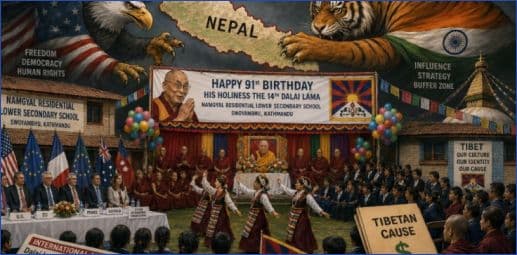
The 91st birthday of the Tibetan separatist leader, the Dalai Lama, was celebrated in Kathmandu on the July 6. The event was organized within a Namgyal Residential Lower Secondary School premises in Swoyambhu. There were no public demonstrations or rallies held anywhere. However, this birthday event has sparked controversy for specific reasons.Although the event was confined within a school, it was attended by ambassadors from several Western nations. This gave the event distinct diplomatic and political overtones.
The main celebration of the 91st birthday of the 14th Dalai Lama, was held on July 6 in Leh, Ladakh, India, where the Dalai Lama himself was present. After India, Nepal hosts the second-largest population of the Tibetan refugee community.Therefore, organizing his birthday celebration here is not altogether surprising. However, the core issue lies in how it was organized, the message it conveyed, and whether or not politics was intertwined with it.
According to data released by the Government of Nepal some time ago, there are around 12,540 Tibetan refugees residing across 21 districts. Informal statistics, however, suggest that the actual number of Tibetans in Nepal exceeds 20,000.To this day, there are 20 Tibetan refugee camps spread across various districts. Restrictions have been placed on their political activities for several years now. Specifically, after a nearly six-month-long anti-China Tibetan protest erupted in Kathmandu in 2008, a tighter lid began to be placed on Tibetan activities. A few years later, when some Tibetans attempted self-immolation in Kathmandu to target China in protest, these restrictions were tightened even further.
Therefore for Tibetans separatist element operating in Nepal it is easy to convey a political message through religious and personal events such as Dalai Lama’s birthday celebration. Similarly the Tibetan separatist community and its western backers do not want to miss such opportunities. This year, the Dalai Lama's birthday program was organized within the premises of Namgyal Residential Lower Secondary School, located in the Nagarjun Municipality of Kathmandu.In a sense, it was an event confined inside a school. The head lama of Ani Gumba (nunnery) in Swoyambhu attended as the chief guest. Tibetan representatives from various monasteries, teachers, students, and Buddhist devotees were also present. Alongside this gathering, there was a visible Western diplomatic presence stationed in Kathmandu. Notably, the ambassadors of France, Australia, and the European Union were in attendance. The Chargé d'Affaires (acting ambassador) of the United States was also present, along with representatives from several other international organizations.
On the occasion of his birthday, a cake was cut in the Dalai Lama's name, cultural programs were held, and traditional Tibetan tableaux were displayed. News and photographs of the event were subsequently dispatched by various foreign news agencies, leading to immediate publication and publicity. Following this international coverage, the level of hype it generated far exceeded the actual scale of the event held at Namgyal School, creating an impression that a massive, wide-ranging program had taken place.
This event has caused stir in Nepali politics. Politician and general people are questioning how Nepal government allowed such a anti China program to happen in Capital city. Seven former Nepali ambassadors who served in China have issued a joint statement. Furthermore, a former Deputy Prime Minister and former Foreign Minister of Nepal has also expressed objections and shared his views on social media.
The former ambassadors who released the joint statement include Rajeshwar Acharya, Mahendra Pandey, Tanka Karki, Mahesh Maskey, Leelamani Paudyal, Bishnu Pukar Shrestha, and Krishna Prasad Oli. In their statement issued on the 25th of Asar (July 9), they raised objections to the celebration of the Dalai Lama's birthday and the presence of representatives from foreign diplomatic missions at the event.
Celebrationof Dalai Lama’s birthday in Nepal or Kathmandu is not a novel occurrence. It has been happening in previous years as well. However, its nature has varied from time to time.Since the ban on Tibetan protests came into effect, Tibetan leaders in Nepal have been utilizing the Dalai Lama's birthday or similar festivals as an opportunity.In the past as well, foreign diplomats, particularly Western ambassadorsused to attend the Dalai Lama's birthday celebrations. They likely determined the scale or level of their participation based on the prevailing time and circumstances.Generally, it used to be lowkey events. This time, their presence was significantly more visible, and their attendance was deliberately publicized through photos and news reports.
Concurrently, the program at Namgyal School was conducted with formal clearance from the District Security Committee. Granted, the District Security Committee's meeting had explicitly banned any public rallies, mass gatherings, or demonstrations featuring posters, and a heavy police presence was deployed to enforce that restriction. We must also view this sequence of events against the backdrop of apprehensions being expressed by a certain segment of society—specifically, whether the current government is attempting to distance itself from China, and whether Tibetan activities are trying to gain a greater foothold in Nepal following the recent Gen Z rebellion.
Immediately after then-Prime Minister K.P. Sharma Oli returned from China, his government collapsed. The Gen Z rebellion in Nepal erupted in a completely unexpected manner, triggering a major political transformation—a virtual paradigm shift in Nepal. Some even go so far as to label it a complete regime change. During the Gen Z movement, a group known as TOB (Tibetan Original Blood) was active on the streets without the knowledge or prior information of the core Gen Z activists. They played a prominent role in escalating tensions and intensifying the protests, particularly by mobilizing on motorcycles. It has been believed that they played a role of crack force in Gen Z revolt.
When Sushila Karki became Prime Minister, the Dalai Lama and the elected Tibetan government-in-exile sent congratulatory messages. A similar message was also sent to the current Prime Minister, Balendra Shah; however, Nepal did not officially respond to these congratulatory messages from the Dalai Lama or the Tibetan authorities. This lack of response likely reflects an official state policy. Nevertheless, it demonstrates that the Tibetans have sought to prioritize expanding relations with Kathmandu, viewing Nepal’s shifting political coalitions as a window of opportunity.
US has prominent role in propping up Tibetan separatist movement in Nepal. They have been allotting a significant budget to Tibetan cause. A portion of the budget that the United States allocates for the Tibetan community in recent years is also invested in Nepal’s Himalayan regions and communities. Interestingly, the American definition of the "Tibetan community" often encompasses Nepali citizens residing in these northern Himalayan belts as well.
Furthermore, a law passed by the U.S. Congress last February includes provisions that could bar government officials in South Asia from entering the United States and freeze their assets, provided there are credible grounds to believe they have been actively involved in violating the human rights of the Tibetan community.This law applies to Nepal as well. Numerous current and former Nepali officials maintain personal and familial connections in the United States. Many have relatives residing there, and rumors often circulate that some have even funneled financial investments through their relatives. Under these circumstances, the policy adopted by the United States—which has now been codified into formal lawcould exert psychological pressure on Nepali officials. Specifically, it sends a clear signal that they should not adopt harsh or restrictive policies toward the Tibetan community. This is the main reason behind Nepalese official soft corner toward Tibetan separatist element in Nepal.
Dalai Lama birthday celebration has shown the strengthening of separatist Tibetan elements in Nepal. It has also shown a nexus between Western power especially US and its local lacey Nepali bureaucrats and politician in sustain Tibetan separatist elements in Nepal.
With the Dalai Lama advancing in age, the process of determining his succession has become a buring issue. He has publicly declared that his reincarnation will be discovered in the "free world" beyond China's borders, a concept he has already put into practice. In 2023, he officially recognized Aguidai Altannar, an eight-year-old Mongolian boy born in Washington, D.C., as the 10th Khalkha Jetsun Dhampa Rinpoche, Tibetan Buddhism's third-highest spiritual leader. Inevitably, a crisis of legitimacy will emerge when Beijing appoints its own Dalai Lama while the exiled Tibetan administration recognizes its own candidate. Consequently, given its sizable Tibetan refugee population, Nepal is poised to be pulled into the geopolitical vortex surrounding the Dalai Lama's succession.