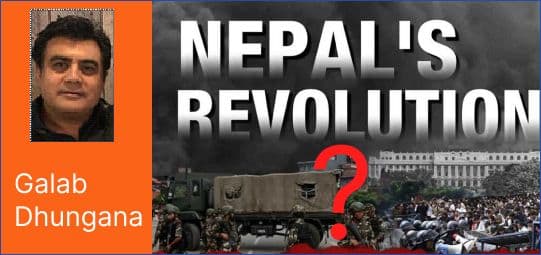
Every Nepali has seen Singha Durbar, yet few pause to consider what it represents. Standing before one of the largest government palaces in Asia, one cannot help but ask how a country that remained among the poorest in the region for much of its modern history built such an extraordinary symbol of political power and privilege. The answer lies not in architecture but in Nepal’s political economy. Revolutions have repeatedly changed who governs the state without changing how economic opportunity and national wealth are created and distributed, political leadership moving far faster than the institutions that shape who gets rich and how. In September 2025, Gen Z protesters set fire to the palace’s main building, a fitting image for a structure that has now outlasted the Ranas, the Panchayat, and a republic, while the grievance driving each generation to its gates has stayed largely the same.
The Rana period established the pattern. After the Kot Massacre of 1846, in which Jung Bahadur Rana seized the state in a palace bloodbath, executive authority and control over state finances concentrated in a hereditary prime minister, with little distinction between the public treasury and personal wealth. Singha Durbar itself was built by Prime Minister Chandra Shumsher in a few years on land he acquired near Thapathali, using conscripted, largely unpaid labor, at a cost of roughly five million rupees, a fraction of the twenty million rupees he then charged his own government to buy it as the prime minister’s official residence. He used the proceeds to build nine more palaces for his sons. Chandra Shumsher’s government also abolished slavery in 1924 and secured a 1923 treaty with Britain that formally recognized Nepal’s full independence, but the same concentration of power behind those reforms let him treat the state’s finances as an extension of his household, a pattern later prime ministers would repeat in smaller ways.
The 1951 revolution ended hereditary Rana rule but not the fusion of political authority and economic privilege. Under King Mahendra’s Panchayat system after 1960, Nepal built highways, schools, banks, and industry, counting well over a thousand registered industrial units by the mid 1980s. Even so, the palace stayed close to the country’s biggest businesses. Kathmandu’s first modern hotels, Soaltee and Hotel de l’Annapurna, were founded with royal capital, and Hotel de l’Annapurna’s sister ventures, Yeti Travels and the Fishtail Lodge resort, were owned outright by Princess Helen Shah, wife of King Mahendra’s brother Prince Basundhara. Soaltee itself was chaired for decades by Prabhakar Shumsher Rana, who grew up inside Singha Durbar and later advised King Birendra on foreign affairs. Licensing, procurement, and development patronage spread from the palace into the wider bureaucracy, and the commercial stripping of the Terai forests, timber sold across the border even as domestic industry starved for investment, became its enduring symbol.
B.P. Koirala, Nepal’s first elected prime minister, had already diagnosed this pattern before his death in 1982. He described a new economic class, neither feudal nor capitalist, that depended on neither village prosperity nor market growth. It had “no roots here,” he said, having grown prosperous chiefly through foreign aid, corruption, deforestation, and illegal trade.
No episode illustrates that broker class more precisely than Surya Bahadur Thapa’s premiership during the referendum of 1979 and 1980. Installed by King Birendra in 1979 to save the Panchayat system from pro-democracy protests, Thapa was widely accused, and never formally charged, of financing the campaign through unregulated Terai logging permits and timber smuggled over the Indian border. The Panchayat side won, 55 to 45 percent, on May 2, 1980, delaying multiparty democracy for another decade, and Thapa was ousted by the National Panchayat in July 1983 by a lopsided 108 to 17, amid rumors that Prince Gyanendra had turned against him from inside the palace. His policies never catered to the feudal class or the capitalist class, but to the same middleman class Koirala had warned about, one that ran on foreign backing, palace favor, and quid pro quo rather than on anything it produced.
When multiparty democracy finally arrived in 1990, what had been a pattern of individuals became a pattern of institutions, the same behavior now spread across parties, agencies, and committees instead of concentrated in one prime minister at a time. Thirty of the 66 public enterprises the state had built since the 1960s were privatized or dissolved after 1992, often amid allegations of favoritism, without building a competitive economy in their place. Manufacturing stagnated, imports now run many times ahead of exports, and hundreds of thousands of Nepalis leave each year for work in the Gulf and Malaysia, their remittances doing more for growth than the domestic economy does. Out of this weak governance came the Maoist insurgency of February 1996, which killed more than seventeen thousand people over ten years, roughly two government or Maoist deaths for every one uncertain casualty, before ending in the 2006 peace accord and the monarchy’s abolition in 2008. That peace carried its own price. Of the 32,250 Maoist fighters registered in cantonments monitored by the UN, only 19,602 were ever verified as genuine combatants, yet the state spent Rs 9.79 billion over nine years on salaries and upkeep calculated against the larger, padded rosters. A still unresolved probe into roughly Rs 4 billion of that sum has named Maoist chairman Pushpa Kamal Dahal, former prime minister Baburam Bhattarai, and former minister Krishna Bahadur Mahara, none of whom has been charged.
Democracy did not close this ledger. The republic that followed only added to it. The Lalita Niwas scandal saw 143 ropanis of government land around the prime minister’s own residence carved up through cabinet decisions in 1990, 1992, 2005, 2010, and 2012. The CIAA charged 175 people in 2020, but the former prime ministers whose cabinets made the key decisions were shielded as mere “policy choices.” Prosecutors’ own charge sheet put a price on the theft, accusing key architect Sobha Kanta Dhakal of causing the state a loss of Rs 6.84 billion and Bhatbhateni Supermarket owner Min Bahadur Gurung of causing a further Rs 4.91 billion, figures that alone put the government’s documented loss above Rs 12 billion before counting the dozens of other defendants named in the case.
The years that followed produced a fresh scandal almost every season. In February 2020, a leaked recording caught Communications Minister Gokul Baskota demanding a bribe of over Rs 700 million on a printing press deal. He resigned, and the CIAA’s own investigation later cleared him outright. A month later, the Omni Group sold the government overpriced, substandard Covid 19 test kits, and paid for it with a one year blacklist. A parliamentary committee found Rs 4.35 billion in corruption in Nepal Airlines’ 2017 widebody jet purchase, a case still unresolved in the Supreme Court years later. And on July 7, 2026, a Kathmandu court convicted 23 people, including a former deputy prime minister and a former home minister, of a scheme that prosecutors’ own charge sheet says defrauded ordinary Nepalis of roughly Rs 288.1 million on the false promise of resettlement in America as Bhutanese refugees, a verdict three years in the making that still awaits sentencing. Exposure, outrage, a committee, then silence. It was this accumulated history of unpunished theft, not any single scandal, that brought the Gen Z protests of September 2025, sparked by a social media ban that was later reversed but fed by decades of anger the state had never answered.
From the end of the Panchayat era, when public debt stood at roughly two billion dollars, about 100 dollars per citizen, to today, when it exceeds nineteen billion dollars, several times that per citizen even after accounting for a larger population, one question has never changed. It is not whether Nepal can borrow, but whether it has built anything productive to match what it owes, factories, exportable goods, jobs, rather than an economy kept afloat by remittances and aid. Out of that unanswered question, and the corruption and impunity behind it, came the Gen Z uprising, which toppled Oli’s government in September 2025 and delivered, six months later, a landslide election to Balendra Shah and the Rastriya Swatantra Party, the first government formed by one party with a majority since 1999 and the clearest break yet from three decades of rotating establishment leaders. The people have placed enormous hope in that outcome, even as fresh unresolved cases keep surfacing on its watch, from a multi-billion rupee telecom license dispute involving Ncell and Smart Telecom to a Rs 10 billion electronic passport contract with two German firms now under investigation, reminders that scrutiny alone has never yet been enough. Singha Durbar is already being rebuilt, as it has been rebuilt before. Whether Nepal’s oldest cycle, corruption followed by impunity, finally breaks under the government now moving into it, or simply finds a new generation of stewards, is the question this revolution, like every one before it, will now have to answer.