World politics has entered a phase of intense polarization. The post-Cold War unipolar structure is gradually weakening, yet a stable, just, and universally acceptable multipolar system has not yet been fully institutionalized in its place. In this transitional period, Asia is once again growing in its potential to become the center of world politics, economics, technology, energy, security, and civilizational dialogue. At the heart of this possibility lies the role of countries such as China, Russia, India, and North Korea, the understanding among them, and the broader question of Asian stability.
The political systems, strategic priorities, security concerns, and historical experiences of China, Russia, India, and North Korea are distinct. To place all of them within a single political framework would be simplistic yet incomplete. The reality, however, is that these four powers are directly connected to Asian geography, historical memory, the experience of Western dominance, the aspiration for strategic autonomy, and the discourse on a multipolar world order. If a minimum level of trust, practical cooperation, and long term regional understanding can be maintained among these powers, Asia can become not only an economic hub but also an intellectual, diplomatic, and civilizational center for alternative global power balancing.
In this context, the idea of "the triumph of Eastern civilization" should be understood not as the defeat of any other civilization, but as the restoration of balance, respect, coexistence, and plurality in the world order. The historical foundation of Eastern civilization is centered more on coexistence, community, long term thinking, family and social structures, spiritual restraint, the balance between state and society, and the relationship between nature and development, rather than on confrontation, domination, and continuous military expansion. If Asian powers can connect this civilizational consciousness with modern statecraft, technology, infrastructure, financial autonomy, and security cooperation, this could constitute a positive contribution to the global order.
In today's world, the balance of power is determined not merely by military capability or the size of the economy. Energy routes, supply chains, digital infrastructure, alternative payment systems, food security, maritime routes, land connectivity, technological standards, information architecture, and social stability have also become fundamental pillars of power. From this perspective, Asia occupies a unique position. China is the world's leading productive power. India is a rapidly rising market, demographic, and technological power. Russia is a power with energy, defense technology, vast geography, natural resources, and strategic depth. North Korea is a decisive factor in the security equation of the Korean Peninsula. If a minimal understanding rather than hostility can be established among these four powers, a major transformation in Asia's security environment could follow.
The Four Foundations of Possibility
The first foundation of this possibility is the deepening strategic coordination between China and Russia. China and Russia have consistently expressed shared concerns regarding Western pressure, sanctions, security alliance expansion, and international institutional imbalances. Their cooperation extends across energy, defense, financial transactions, infrastructure, science, space, diplomacy, and multilateral forums. Although this relationship is not a formal military alliance, it carries a profound impact on global power balancing. The stable understanding between China and Russia provides a foundation for constructing an alternative power structure across the Eurasian landmass.
The second foundation is India's strategic autonomy. India does not wish to become a permanent subordinate of any single power bloc. India cooperates with the United States, Europe, Japan, and Australia, yet it also maintains its historical strategic relationship with Russia. Despite border disputes and mutual mistrust with China, both India and China are vast civilizational states, emerging economies, and influential voices of the Global South. If India can utilize its strategic autonomy as a bridge between West and East, the possibility of practical cooperation with China, Russia, and other Asian powers remains open.
The third foundation is the potential for improving relations between China and India. There are serious disagreements between China and India regarding border disputes, trade imbalances, maritime competition, regional influence, and security perceptions. However, there is no inevitability that these disagreements must transform into permanent enmity. If both countries expand cooperation in border management, military disengagement, trade transparency, water resource dialogue, Himalayan environmental issues, counterterrorism, health security, and multilateral economic reform, a new door for Asian stability may open. Competition between China and India will persist, but if that competition can be managed, it need not devolve into conflict.
The fourth foundation is the management of tensions on the Korean Peninsula. Viewing North Korea solely as a security problem or a subject of sanctions makes regional solutions unattainable. North Korea is a harsh reality of the Asian security architecture. Its security concerns, historical war memories, experiences under sanctions, and perception of external military pressure must be understood. The new strategic partnership between Russia and North Korea has altered the power equation on the Korean Peninsula. China's historical influence, Russia's renewed activism, India's potential neutral diplomatic role, and regional multilateral dialogue can move the Korean question beyond mere military tension toward security assurances, humanitarian contacts, economic phased approaches, and political dialogue.
The Nature of Understanding: Not Alliance, But Cooperation
At the center of such Asian understanding, no aggressive military bloc should be constructed. If the proximity among China, Russia, India, and North Korea is limited to an anti-Western security alliance, it would only generate new polarization. However, if this understanding is based on peace, development, connectivity, economic autonomy, cultural respect, noninterference, United Nations system reform, and regional crisis management, its historical significance will be fundamentally different. Positive Asian cooperation does not mean war preparation; it means building a trust structure that reduces the probability of war.
A Ten Point Agenda
The first requirement for this is a new framework for Asian security dialogue. Currently, Asia has many security forums, but a comprehensive and inclusive framework for confidence building remains weak. Although platforms such as the Shanghai Cooperation Organization, BRICS, ASEAN related forums, the East Asia Summit, and bilateral dialogues exist, a permanent crisis management mechanism connecting China, Russia, India, and the Korean Peninsula is still insufficient. An Asian Strategic Stability Dialogue is necessary, one that can encompass border management, military exercise transparency, nuclear risk reduction, cybersecurity, counterterrorism, maritime security, and crisis communication.
The second requirement is a policy that economic cooperation should not be completely held hostage by security tensions. Asia's development potential is immense, yet political mistrust restricts supply chains, energy trade, technological cooperation, and financial connectivity. If China's production capacity, India's market and service sectors, Russia's energy and resources, Central Asia's transit geography, Southeast Asia's industrial dynamism, and the Korean Peninsula's strategic location can be linked, a new phase of Asian prosperity could begin. This requires local currency transactions, cooperation among development banks, energy infrastructure, rail and road connectivity, digital payments, food security storage, and health supply chain construction.
The third requirement is to transform Eastern civilizational dialogue into modern policy. If China's "Community with a Shared Future," India's "Vasudhaiva Kutumbakam," Russia's multipolar world vision, and North Korea's self reliance and security consciousness can be reinterpreted from the language of confrontation into the language of coexistence, Asian civilizational dialogue could give world politics a new linguistic and ethical direction. The purpose of this is not the dominance of any one civilization, but the restoration of dignity, equality, and cultural diversity in international relations.
The fourth requirement is to place the interests of small and medium sized Asian nations at the center. If Asian power cooperation is limited to power sharing among large nations alone, it will generate new imbalances. Without respecting the sovereignty, development needs, and security sensitivities of Nepal, Bhutan, Mongolia, Sri Lanka, Maldives, Bangladesh, Myanmar, Laos, Cambodia, Central Asian republics, and Southeast Asian countries, Asian stability is impossible. True Eastern civilizational advancement is proven only when powerful states treat smaller states not as zones of pressure but as equal members of a partnership.
The fifth requirement is long term confidence building between India and China. This is the most difficult yet decisive link in Asian consensus. Without stability between India and China, Asia cannot fully become a global power center. Both countries must manage their border dispute without allowing it to become a permanent source of military confrontation. They must expand transparent patrolling in border areas, military commander dialogue, emergency contact systems, political directives, trade balancing, student and intellectual exchanges, religious and civilizational tourism, Himalayan climate cooperation, and coordination in multilateral forums. If India and China persist in strategies of mutual containment, external powers may exploit Asian divisions. Yet if both transform competition into structured coexistence, Asia will become stable.
The sixth requirement is to positively institutionalize Russia's Eurasian role. Russia is not merely a European power; it is a deeply Eurasian power. Its energy resources, geography, military technology, Arctic access, historical ties with Central Asia, and old strategic partnership with India play a significant role in Asian balancing. Russia's proximity to China and its trusted relationship with India make Moscow useful not as a rigid mediator between Beijing and New Delhi, but as a strategic balancer. If Russia can maintain balance in both its cooperation with China and its relationship with India, Asian multipolarity could become more stable.
The seventh requirement is long term thinking to bring North Korea into a crisis management structure. A war or military accident on the Korean Peninsula could be devastating for Asia's overall stability. Therefore, limiting relations with North Korea solely to the language of sanctions, military pressure, and isolation is insufficient. Limited frameworks such as security assurances, phased dialogue, humanitarian cooperation, health and food security, emergency communication, and nonmilitary economic contacts can reduce tensions. China's and Russia's influence, India's neutral dialogue capacity, and regional multilateralism can collectively make this possible.
The eighth requirement is alternative financial and development architecture. The experience of using the dollar, sanctions, financial controls, and payment systems as political tools in the global economy has driven many countries to seek alternative arrangements. This does not mean abruptly displacing the existing system. However, structures such as local currency transactions, regional payment connectivity, development banks, infrastructure finance, energy payment diversification, digital currency dialogue, and emergency financial security funds can be developed. If BRICS, the SCO, the Asian Infrastructure Investment Bank, the New Development Bank, and other regional structures can be practically linked, Asia's economic autonomy will increase.
The ninth requirement is technological and knowledge cooperation. Future power is increasingly dependent on artificial intelligence, semiconductors, energy storage, quantum technology, space, cybersecurity, biosecurity, and green industries. China is a leader in technology and production. India is becoming powerful in software, digital public infrastructure, space, and talent generation. Russia has experience in defense science, nuclear energy, space, and fundamental sciences. If these capabilities are limited only to competition, Asia will remain divided. If areas of cooperation can be identified, Asia could become an alternative standard setter in global technology governance.
The tenth requirement is to transform Eastern peace philosophy into actual policy. It is easy to speak of peace, coexistence, and civilizational respect in rhetoric; it is difficult to translate them into policy. The first test of this is restraint on borders, transparency at sea, respect for smaller nations, noninterference in internal political differences, local interests in economic projects, and extreme caution in the use of military force. If Asian powers wish to present themselves not as replicas of the West but as powers bearing a different civilizational responsibility, their conduct must accordingly reflect that.
Concrete Gains in Regional Stability
Such understanding can yield concrete benefits for regional stability. If tensions between China and India decrease, the Himalayan border could stabilize. If energy, trade, and diplomatic coordination among Russia, China, and India increase, Eurasian connectivity could be strengthened. If the door to dialogue opens on the North Korean question, the risk of war on the Korean Peninsula could diminish. Small nations in South Asia, Central Asia, and Southeast Asia can benefit not merely from competition among great powers but also from connectivity, investment, and market access. This holds the potential to make Asia not a consumer of external military polarization, but a builder of its own security architecture.
Obstacles and Realities
However, this possibility does not materialize on its own. There are serious obstacles. There is border mistrust between China and India. Defense and technology cooperation between India and the United States is closely watched by China and Russia. Tensions between Russia and the West place India in a diplomatic balancing act. North Korea's security policy remains a subject of regional and global contention. Economic imbalances and public skepticism exist between China and India. Smaller Asian countries do not wish to become new dependencies among major powers. Merely chanting the slogan of Asian unity while ignoring these obstacles is not real policy.
Therefore, a combination of idealism and realism is necessary. A positive vision can support Asian cooperation, but it requires a phased action plan. The first phase involves dialogue and crisis communication. The second phase involves limited economic and humanitarian cooperation. The third phase involves regional infrastructure and financial mechanisms. The fourth phase involves security confidence building. The fifth phase involves long term civilizational and educational partnership. By advancing gradually in this manner, cooperation becomes possible even amid political differences.
Conclusion: The Path of Dialogue, Restraint, and Shared Development
The core message for policymakers is clear. Asian consensus is not an emotional slogan; it is a potential structure of power balancing in the 21st century. A minimal understanding among powers such as China, Russia, India, and North Korea does not mean complete agreement on all issues. It means a minimum consensus to avert war, reduce external polarization, prioritize development, respect the sovereignty of smaller nations, and institutionalize a multipolar world order.
For politicians, the message is deeper still. Asia's future depends not solely on military alliances, but on the living standards of its people, dignified development, civilizational self confidence, cultural dialogue, and regional justice. If Asian leadership can transform historical pain, colonial memory, border disputes, ideological differences, and current power competition into restrained diplomacy, Asia could become a peaceful power center of the 21st century.
For think tanks, the task ahead is not to intensify ideological polarization, but to build practical policy bridges. Concrete research is needed on issues such as China-India border management, Russia-India energy and defense balancing, China-Russia economic connectivity, Korean Peninsula tension reduction, local currency transactions, food and energy security, Himalayan climate risks, counterterrorism, cybersecurity, and the role of smaller nations. Knowledge production, policy dialogue, and alternative institutional design are essential to make the concept of Asian consensus successful.
Ultimately, the possibility of Asia becoming a global power center is real, but it is not self evident. This possibility will be realized not through power projection, but more through restraint, dialogue, inclusive development, and historical responsibility. If a minimal structure of understanding can be built among China, Russia, India, and North Korea, Asia can bring a new balance to world politics. However, if that balance becomes vengeful, militaristic, or exclusionary, long term peace will remain impossible. Conversely, if this cooperation is based on multipolarity, sovereign equality, noninterference, shared development, cultural respect, and regional stability, it can be called a positive resurgence of Eastern civilization.
The true triumph of Eastern civilization is not the occupation of territory, but the reduction of the possibility of war. It is not the humiliation of any power center, but the restoration of respect and balance in international relations. It is not the elevation of any single nation to supremacy, but the safeguarding of regional coexistence. China's production power, India's demographic strength and democratic diversity, Russia's strategic depth, North Korea's security question, and the entire civilizational memory of Asia. If all these are connected within a common framework of peace and development, Asia can become not merely an economic center, but a moral, diplomatic, and civilizational power center of the 21st century.
This very possibility is today's greatest policy question. Will Asia become divided and serve as a field for external polarization, or will it become coordinated and serve as a new foundation for global stability? The answer is not easy, but the direction is clear. Dialogue, restraint, shared development, and civilizational respect constitute the most reliable path for Asia's future.
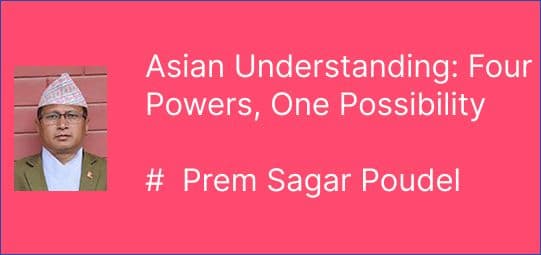
The author, Prem Sagar Paudel, is a senior journalist and international relations analyst from Nepal. He has conducted in depth research on Nepal-China relations, the geopolitics of the Himalayan region, and Asian security issues.