Sharachchandra Bhandary------------------
Last October, I had the opportunity to visit the Chinese capital in connection with a journalistic assignment. A couple of months earlier, I had traveled to the Xizang Autonomous Region, Yunnan, Henan, and Chongqing, witnessing firsthand the transformation of both rural and urban landscapes. Over the past 25 years, I have visited the Xizang Autonomous Region, formally known as Tibet, on several occasions. Sharing a border with Nepal, Xizang is familiar to many Nepalis, including myself. Yet each visit reveals a scale of change that continues to command attention.
When our aircraft descended over the vast plateau and touched down at Lhasa Gonggar Airport, it became clear that Xizang was no longer the remote frontier many once imagined. A decade after my previous visit, the transformation was striking — modern infrastructure, seamless connectivity, and a renewed sense of confidence reflecting a broader national development trajectory.
Reflecting on these changes, former Foreign Minister and Nepali envoy to China Mahendra Bahadur Pandey has often emphasized the importance of long-term policy continuity in China’s development path. My own repeated visits to different provinces over the years have reinforced a similar observation.
During these visits, I observed that China places strong emphasis on environmental protection, tourism development, poverty alleviation, integrated settlement construction, expansion of road and air connectivity, renewable energy transition, and modernization of agricultural systems. The continuity of planned programs appears to serve as a foundational pillar of its development approach. Institutions function within a centrally coordinated framework that aligns national vision with local implementation. Through sustained effort over decades, the country has advanced steadily toward what it describes as high-quality and balanced modernization.
Many Nepalis have noted visible physical transformation in Xizang over the past 15 years. Investments spanning decades have yielded tangible outcomes. During a ceremony in Lhasa last year, national leaders called upon citizens to work with determination for continued progress — a message that, according to Nepali student Hari Subedi studying at Sichuan University, resonated strongly among local communities.
While reviewing policy documents, a statement by President Xi Jinping drew my attention, reflecting the leadership’s long-term vision for rural revitalization. Xi emphasized:
“Efforts should be made to ensure grain production and enhance the efficacy of policies that strengthen agriculture, benefit rural areas, and enrich farmers… Region-specific measures should be adopted to build a beautiful and harmonious countryside that is desirable to live and work in… China should strive to build agriculture into a major modernized sector and basically ensure modern standards of living in rural areas so that farmers can enjoy a more prosperous life.”
These words not only articulate the national strategy but also demonstrate how Xi’s guidance shapes policy continuity, influencing coordinated implementation across provinces and linking high-level vision to tangible improvements in rural communities.
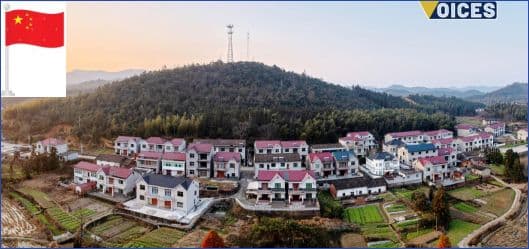
What distinguished these words was their translation into visible reality. Across rural areas in Xizang, Yunnan, Xi’an in Shaanxi, Henan, and Chongqing, development was evident not in slogans but in infrastructure, organized settlements, diversified livelihoods, and rising confidence among villagers.
In Xizang, despite challenging geography and high altitude, well-maintained roads connect remote communities. Modern housing has replaced vulnerable structures. Electricity, telecommunications, schools, and health services are accessible even in distant settlements. Organized livestock, horticulture, specialized crop cultivation, greenhouse vegetable production, and niche industries such as crocodile farming reflect diversified rural economies. Community-based tourism initiatives supplement income streams. Renewable energy installations — wind turbines along ridges and solar panels across sunlit slopes — supply clean electricity to households and institutions.
In Yunnan Province, renewable energy expansion forms part of this broader transformation. The Tongquan Wind Farm in Malong District of Qujing represents a major onshore wind project developed across mountainous terrain. Built in phases using large modern turbines, the facility generates close to a billion kilowatt-hours annually from its principal phase, with additional capacity emerging through expansion. By feeding electricity into the regional grid, it strengthens supply reliability, reduces coal dependency, lowers emissions, and stimulates local economic activity through infrastructure upgrades and long-term operational employment.
Ecological rehabilitation is equally significant. The Baofeng Peninsula Ecological Wetland along Dianchi Lake in Kunming illustrates how degraded lakeside land has been restored into marshes, reed beds, and shallow-water ecosystems. Beyond biodiversity conservation, the wetland naturally filters pollutants, enhances flood resilience, and provides public space for environmental education and recreation. Its international recognition during the Conference of the Parties of the Convention on Biological Diversity underscored its role as a model of integrating environmental restoration with urban and regional planning.
Xi’an and Henan presented yet another facet — large-scale mechanized agriculture integrated into national supply chains. Extensive wheat fields, advanced irrigation systems, grain storage facilities, and agricultural research centers demonstrate how traditional farming has evolved into a modernized sector. Farmers participate in structured value chains, while rural youth engage in agribusiness, logistics, and agricultural technology services.
In Chongqing, historical continuity is visible at the Shizitan Hydropower Station in Changshou District. Constructed during the First Five-Year Plan in the 1950s, it was among the earliest large hydropower projects independently designed and built by Chinese engineers. Combining electricity generation with irrigation, flood control, and regional development, it symbolized early industrial ambition and laid technical foundations for subsequent expansion in the energy sector. Its continued operation today links past industrialization efforts with present energy provision and regional socio-economic development.
Laxmi Prasad Niraula, Consul General of Nepal in Lhasa, shared his impressions of Xizang’s transformation. He noted that infrastructure expansion in roads, railways, aviation, and public facilities has directly benefited citizens, whose improved living standards are increasingly visible.
Across regions, what stood out most was integration. Agricultural modernization, renewable energy deployment, ecological restoration, infrastructure connectivity, and social welfare initiatives moved in coordination rather than isolation. Rural revitalization appeared structured and long-term, not episodic. Community participation complemented institutional planning, reinforcing development outcomes.
My visits reinforced a central lesson: development gains meaning when policy translates into everyday improvement. Mechanized farms, diversified livelihoods, clean energy grids, restored wetlands, connected markets, and stable incomes are not abstract indicators — they are lived experiences shaping confidence and social stability.
Comprehensive rural revitalization requires sustained planning, policy continuity beyond political cycles, integration of agriculture with energy and ecology, and grassroots implementation. From Xizang to Henan, what I witnessed was not merely infrastructure expansion but an evolving development framework rooted in villages and communities. When rural citizens thrive — supported by opportunity, connectivity, environmental stewardship, and energy security — the broader foundation of the state strengthens.
Sharachchandra Bhandary
Executive Editor
National News Agency (RSS)