We all know the United Nations exists to maintain international peace, develop friendly relations, and achieve international cooperation in solving global issues while upholding human rights and sustainable development globally. It has 193 member countries. It also plays a vital role in preventing conflict between countries. It holds the General Assembly every year, and delegates from all countries participate in it. Though I never had an opportunity to go there as a delegate, my beloved wife, Shanti Mishra, had the opportunity to represent the country as one of its delegates in 1977. At that time, Mr. Shailendra Kumar Upadhyaya was our permanent representative to the organization. I am proud to remember that my wife, Shanti, a well-known academician and skilled speaker, achieved a remarkable record of active participation, unmatched by anyone from our country during Mr. Upadhyaya’s tenure, as he once told me.
Despite the remarkable role of the United Nations in maintaining peace and cooperation worldwide, we have all witnessed several wars between countries. If we want, we can list more than two dozen major wars since 1960. In this context, I want to give just a few examples:
1. Sino-Indian War (1962) – India vs. China over Himalayan border disputes.
2. Indo-Pakistani War (1965) – India vs. Pakistan over Kashmir.
3. Six-Day War (1967) – Israel vs. Egypt, Jordan, and Syria.
4. Indo-Pakistani War (1971) – India vs. Pakistan; led to the creation of Bangladesh.
5. Iran–Iraq War (1980–1988) – Iran vs. Iraq, one of the longest conventional wars of the 20th century.
6. Kargil War (1999) – India vs. Pakistan in Kashmir.
7. U.S. invasion of Afghanistan (2001) – U.S.-led coalition vs. Taliban (more of an intervention than a state-to-state war).
8. U.S. invasion of Iraq (2003) – U.S.-led coalition vs. Iraq (Saddam Hussein’s regime).
Besides the above wars, we are currently witnessing the following conflicts:
1. Russia–Ukraine War (2022–present) – Russia’s full-scale invasion of Ukraine, ongoing.
2. Israel–Hamas War (2023–present) – While primarily Israel vs. Hamas, it involves cross-border clashes with Lebanon’s Hezbollah and Iran-backed groups.
These days, every day, I read in newspapers and watch these wars on TV, and I get extremely sad and disturbed to see the killing of innocent people with warplanes, drones, and missiles owned or supplied by superpowers. Everyone is aware of it. The whole world, including the United Nations, is watching as spectators, as if it were a bullfight or a sheepfight. On the other hand, lakhs of wounded people—losing their hands, legs, eyes, and faces—are suffering without medicine, food, or shelter, as if there is no one, no country, that stands for justice and gives justice to them. How pathetic, sad, and disgraceful it is. How could the entire world watch and stay as spectators, not stopping it¿ How could the superpower watch this unbearable, heinous crime¿ This is the situation and result of war and conflict in the present-day world. Might makes right. He who has the power to enforce his will is the one who determines what is right.
We have a beautiful country with two giant, friendly neighbors—India and China. We have an excellent relationship with them due to the loving and cordial understanding established by our country’s wise rulers for centuries. Both are our well-wishers, supporters, and helpers in our development and infrastructure. In size, they are big and we are small. According to the saying of Great King Prithivi Narayan Shah, the creator of modern Nepal and the father of our nation, our country is like a yam between two giant stones. We can learn a lot from this saying. One who has experience of digging deep to get yams from between big stones understands the correct meaning of this saying. I have this experience. We have varieties of yams. But such yams are called Ban Tarul—‘Tarul from the forest
I know how a big boulder can fall on you when you have no skill in moving the stones while harvesting yams. I know that the present leaders of our republic, Nepal, think they do not need to learn from this, as they consider themselves the wisest and think they know everything. I know one of our prime ministers, considered a wise man by his supporters, proposed to change and replace that proverb with his progressive version. But I think the Great King’s proverb is still the big mantra for dealing with our neighbors and establishing good relations with them for mutual benefit.
After Chinese Foreign Minister Wang Yi visited India in August 2025, India and China reached a series of new understandings to normalize relations. In this context, they also made an understanding and agreement to reopen the border through key Himalayan passes, including Lipulek ( Lipulekh ), on our land, but without our consent. We still do not know whether they did it intentionally or out of ignorance. This became a big issue, a significant concern, and a worry for us. Naturally, we need to be upset and sad, and it is necessary to react and make them correct the mistake.
According to the report, Our government had sent a diplomatic note to the countries, India and China many months ago. . Our people were in the streets to voice their opposition, and our parliamentarians expressed their anger and concern about this grave issue. Not only that, some of our YouTube speakers presented their views on going to war. Even the present government under the Premiorship of Balen Shah sent a deplomatic note to both the government - India and China about the topic on May 3, 2026.
This is the scene we see today. I think the problem suddenly came upon us because of mishandling and a lack of skill in harvesting yams. In this context, I remembered a Newari Proverb - A sparrow annoys with its loud chirping, but a pigeon strikes with force (Chhakhunchaya Tiri Tiri, Bakhunchaya Twak). This is similar to an English proverb: The sparrow chirps, the eagle strikes. We are mercilessly stricken.
We all know we have leaders in our country who consider themselves wise and superb and speak like the English proverb: A jack of all trades is a master of none. One of them has been chirping on any subject in the world, being himself a living encyclopedia of the world —science, technology, history, religion, borders, geography, etc.—without worrying about what others think. I can assume his undiplomatic chirping about cultural and geographical funny expressions undoubtedly irritated our neighbors. I know if I open the Pandora’s box of his wrongdoings and harm to the country as a chirping sparrow, I would be mercilessly attacked by his followers, misunderstanding my honest writing aimed at the benefit and welfare of the country.
In this context, I remember a Nepali proverb heard from a motherly woman: “If you want to know the quality of oil, look at its flow; if you want to know about a son, look at his friends.” (तेल के हेर्नु तेलको धारा हेर्नु, छोरा के हेर्नु, छोराको साथी हेर्नु). It means that just as the flow shows the quality of oil, a son’s character can be judged by the company he keeps. This proverb can also be applied to judge most of our leaders and political parties that are linked to the well-known gangsters. I do not want to say more than this. We need to solve our problem of reclaiming our land with goodwill and good intentions, with love and kindness. We need to understand everything with the intention of cooperation. I firmly believe that one can achieve anything through love and trust, which cannot be done by enmity.
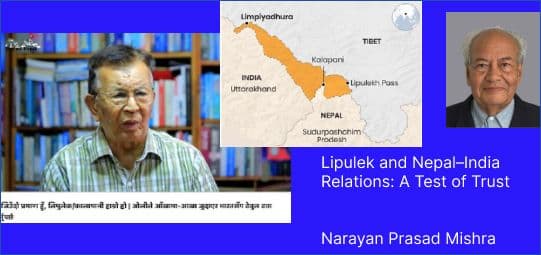
There is no doubt that Lipulek, Kalapani, and Limpiyadhura cannot be separated from our country. They are an inseparable part of our body. Buddhi Narayan Shrestha, the foremost border expert of our country, a well-known author of several books on the subject, the most respected and awarded border expert of the land, my college friend, and a good friend, has written many books and articles with convincing history and historical documents on the topic. He has been speaking tirelessly on the problem.
I also watched some of his interviews and presentations on YouTube, including the above. According to him, the history of the land proves that it is unquestionably ours. Our treaty with British India, named the Sugauli Treaty of 1816, undoubtedly, proves that it is our land. Several other documents and maps he possesses also clearly prove it. Similarly, Dr. Jagat Kumar Bhusal, a well-known expert on the rivers and water resources of our country, has also been speaking and writing on the subject, drawing on his strong, well-documented expert views. However, there are controversial maps created by British India between 1827 and 1879, which showed it differently to their advantage before India’s independence. The brief account of the issue in chronological order is also given by Bishwa Mani Subedi in his article written in Nepali titled “Let us look at these facts: What is Lipulekh, and how is Nepal losing it” यी तथ्यमा हेरौँ लिपुलेक के हो र कसरी नेपालले गुमाउँदैछ ? which appeared on nepalpress.com on August 25, 2025 (Bhadra 9, 2082).
We all understand that, despite centuries of mutual love and good relations, misunderstandings and problems may sometimes arise with our neighboring countries, just as disputes can occur over land and property within our own neighborhoods. We also know that if we fail to consider each other’s views and documents, we risk becoming entangled in disputes for years, depriving us of peace and rest. We need to clarify the misunderstanding created by British India to our friendly present-day India in order to resolve the issue in a spirit of brotherhood. With this understanding, we must resolve our problems with love, kindness, cooperation, and mutual support, drawing on our history of standing together in both joy and sorrow.
In the context of our talks with India, our government must give experts such as Buddhi Narayan Shrestha, Dr. Jagat Kumar Bhusal, or other well-known authorities on the subject an opportunity to present our case with documented evidence. I urge India, as a true friend of our country, not to avoid dialogue. The people of Nepal have grown increasingly distressed over this issue in recent years, even though it was not so before.
The way forward lies in peaceful solutions and mutual understanding—for fights and disputes have no place between true neighbors. The Lipulek controversy now stands before us as a test of our long friendship.
narayanshanti70@gmail.com