I watched a BBC documentary about Nepal’s Gen Z protests, and then I read Bhusan Dahal’s critique, and it hit me like a slap. Two Nepals: one on the screen, neat and polished, every death tragic, every youth heroic, every authority villainous; the other, messy and complicated, real-life Nepal, where chaos, fear, and decisions made under fire do not fit into a tidy narrative.
That gap, the invisible chasm between reality and story, is where journalism either earns its credibility or blows it entirely.
Documentaries, like much of modern journalism, are not neutral recorders of events. They construct reality. Every camera angle, every cut, every sequence is an argument. Bhusan Dahal knows this instinctively. He knows that what you do not see shapes meaning far more than what you do.
Omission can be louder than distortion, and the power of selective storytelling is subtle, invisible, and brutal.
You do not need to lie. You need to leave out the inconvenient truth, and the story tells itself.
For decades, institutions like the BBC commanded authority in countries like Nepal. Distance equals objectivity, we were told. London sees Kathmandu better than Kathmandu itself. That belief has crumbled. Audiences are awake. They notice when stories travel thousands of kilometers, polished, dramatized, simplified, and leaving out everything inconvenient. Youth become symbols of purity. Governments become monsters. Death becomes emotional glue. The audience is guided gently, firmly, and almost imperceptibly toward a moral conclusion. The subtle art of manipulation is invisible to anyone not looking closely.
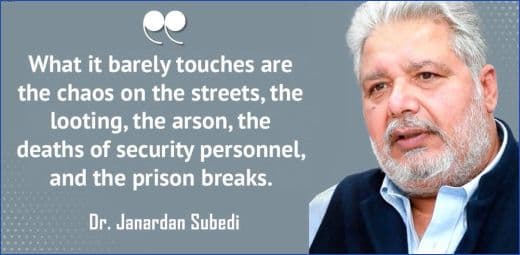
The BBC’s film is masterful television. Emotionally potent. Technically superb. But it is selective. It emphasizes protester deaths, frames police actions as premeditated, and implies cold-blooded intent. What it barely touches are the chaos on the streets, the looting, the arson, the deaths of security personnel, and the prison breaks. Those inconvenient facts are either background scenery or invisible. That is not lying. It is storytelling dressed as truth. Or as I like to call it, journalism with a fancy filter.
Reporting follows political convenience, not curiosity. Events happen, interpretations are pre-packaged. Narratives lock in before evidence can catch up. Time and again, citizens notice the media reshaping reality, emphasizing some voices, silencing others, protecting political allies, and burying inconvenient truths. Trust erodes slowly but relentlessly.
If you are waiting for an apology or correction, enjoy your wait with a cup of tea, because it will be a long one.
The Gen Z protests should have been a chance for the media to prove itself. They were a generation mobilized against corruption, unemployment, and elite capture. They were organized, digitally connected, and determined to hold the system accountable. Yet the public narrative was fragmentary. International outlets emphasized repression. Domestic media emphasized order. Neither captured the complexity: young people died, officers died, institutions were attacked, prisons were stormed, and billions of rupees in damage were incurred. Reality was far messier than any montage could convey.
Then there is Madam Karki. She became interim prime minister during the crisis. Investigations were promised. Compensation pledged. Accountability announced. And yet the details remain largely invisible. Reports were anticipated, evidence discussed, but nothing was fully released. As elections approached, attention shifted. The unanswered questions were conveniently set aside. And the public was left piecing together fragments while political expediency quietly triumphed over transparency. Some might call this strategic patience; others call it selective memory.
Modern journalism often follows the rhythm of attention rather than the logic of evidence. Stories explode, investigations sputter, conclusions appear prematurely, and the public moves on. Convenience becomes method. Immediacy trumps accuracy. The BBC documentary fits this pattern perfectly: visually compelling, emotionally gripping, and narratively complete, but only in the story it chose to tell. Understanding is not the same as completeness. Simplification travels better than complexity.
If you want nuance, bring your own binoculars.
Neutrality, in this context, is theater. The correspondent presents footage. The analyst offers a cautious interpretation. Officials promise transparency. Reports are announced. Elections arrive. The story recedes. Everyone speaks responsibly, yet responsibility rarely produces clarity. Objectivity becomes a pose. Convenience becomes policy. And the public, bless them, claps politely and nods, hoping someone is actually telling the truth somewhere.
And yet questions remain. Why are certain aspects amplified while others vanish? Why do investigations stall when public curiosity peaks? Why do partial narratives dominate where full ones would clarify? Journalism exists to answer these questions, but convenience is easier to achieve. And in Nepal, convenience often trumps courage. Sometimes I wonder if reporters have a secret competition to see who can fit the most drama into the fewest verified facts.
So here is a direct question for Madam Karki and her administration. What will you do about the narratives shaped by this BBC documentary? If they are incomplete, misleading, or selective, where is your response? Where is the public clarification? Silence may be politically convenient, but it corrodes institutional legitimacy. Ambiguity benefits nobody except opportunists, foreign narratives, and those who profit from confusion. Democracy cannot survive in a fog of unanswered questions.
And the public notices. Citizens compare sources, detect inconsistencies, and smell omissions. Authority is no longer given automatically. It must be earned repeatedly through transparency, consistency, and courage. Fail at that, and trust vanishes slowly but completely.
Nepal’s Gen Z protests remain an unfinished story. Lives were lost. Institutions shook. A generation found its voice. Governments fell. Elections were called. Yet the full account remains out of reach.
The youths who died deserve the truth. The officers who died deserve the truth. The public deserves the truth.
Truth is inconvenient. It refuses neat conclusions. It defies dramatic clarity. But journalism has an obligation: pursue it anyway. If journalism fails, speculation fills the vacuum. Suspicion replaces trust. Narratives dominate reality.
Bhusan Dahal reminds us that storytelling carries responsibility. A documentary is not just pictures on a screen. It is an argument about reality. Journalism carries the same burden. Nepal does not need perfect journalism. No country does. But it needs honesty. Until honesty is restored, until facts prevail over convenience, the gap between narrative and reality will remain wide. And in that widening space, public trust will continue to fade.
Because here is the unvarnished truth. Let stories travel faster than facts, and the next generation will not just question the media. They will stop believing in it altogether. Then, no matter how pure their intentions, even the brightest voices will struggle to separate story from truth.
If you want to see the absurdity of it, watch a reporter nod solemnly at a news conference while two conflicting facts are presented in the same breath. They are both wrong, but the audience is too polite to notice. That is journalism today, somewhere between theater and conjecture, dressed in a suit and tie.
Truth is inconvenient. It refuses neat conclusions. It defies dramatic clarity. But journalism has an obligation: pursue it anyway.
@DS