Dr. Janardan Subed -------------
Nepal loves elections.
They arrive with the optimism of a national festival. Inked fingers become symbols of renewal. Manifestos promise transformation. Coalitions are assembled with solemn declarations about stability and reform. And after every cycle, Nepalis pause and quietly ask the same question: Was that enough?
Here is the uncomfortable truth. Elections are a democratic instrument. They are not, by themselves, a democratic philosophy. They measure numerical preference within a constitutional framework. They do not automatically repair that framework.
Nepal’s constitutional story is not a routine tale of party rotation. It is a story of rupture, disruption, and negotiation, a story that demands historical literacy, institutional awareness, and civic patience.
The monarchy was not removed through a direct national referendum. It was dismantled through a transformative political process formalized by the Constituent Assembly of Nepal after a decade-long insurgency led by the Communist Party of Nepal (Maoist), mass mobilization in 2006, and intensive elite negotiation. The transition was historic, painful, and decisive.
King Gyanendra Shah did not face a ballot asking Nepalis to choose between monarchy and republic in a direct yes-or-no vote. The institution was absorbed into a new constitutional architecture, later consolidated under the Constitution of Nepal (2015).
This sequence matters.
When a constitutional pillar is removed through extraordinary upheaval and structural redesign, it is essential to recognize that any reconsideration must carry extraordinary legitimacy; otherwise, attempts at restoration risk undermining the original process. A structure dismantled by political rupture cannot be restored solely through routine parliamentary arithmetic, highlighting the need for legitimacy in such transitions.
Yet contemporary debate often sounds deceptively simple: “Let popularity be tested through elections.”
Parliamentary elections operate inside a republican framework already defined by the constitution. They measure party strength within that system. They do not reopen the state’s structural blueprint. To argue that the restoration of the monarchy must be tested solely through parliamentary seats is to treat a foundational constitutional question as if it were an ordinary contest of candidates.
This is not nostalgia. It is constitutional symmetry.
If the monarchy were dismantled through structural transformation, then any serious reconsideration would logically require either a broad national consensus or a clearly framed referendum. Not because restoration is inevitable, but because foundational questions require foundational legitimacy.
Nepal has conducted multiple elections since the promulgation of the 2015 constitution. Governments have formed, collapsed, and reformed. Coalitions have shifted with arithmetic precision. Anti-establishment rhetoric has matured into establishment accommodation. Reformist slogans have encountered institutional inertia.
If elections alone were sufficient to cure systemic dysfunction, political stability would already be entrenched.
Public frustration remains visible. It manifests in civic discourse, street activism, and in the striking image of Nepalis gathering to welcome a former monarch during public appearances.
Why would significant numbers of Nepalis assemble in a republic to greet King Gyanendra?
Such gatherings do not automatically equate to a majority demand for restoration. They may reflect accumulated disillusionment with rotating governments. They may symbolize nostalgia for perceived continuity. They may function as protest signals directed at contemporary political elites.
Street presence does not equal constitutional mandate. However, recognizing that when Nepalis assemble despite resistance offers valuable insight, fostering respect for the role of civic engagement in shaping understanding.
A glance beyond Nepal offers a cautionary illustration.
In Bangladesh, the long rule of Sheikh Hasina ended amid upheaval. Youth-driven movements dominated public discourse. Social media followings numbered in the millions. Street momentum appeared overwhelming. The old ruling party was even barred from contesting.
When elections occurred, however, outcomes diverged from expectations. The electorate largely favored a traditional opposition force. Digital prominence did not translate into parliamentary dominance.
Nepal is not Bangladesh. Demography, culture, and historical trajectories differ sharply. Yet one democratic principle travels across borders. Street mobilization and algorithmic popularity are not substitutes for institutional depth and electoral credibility. The lesson is stark: moral energy is insufficient without operational structure.
Nepal’s Gen Z faces a similar test.
This generation is energetic, digitally fluent, globally connected, and impatient with corruption and instability. That impatience is healthy. Democracies stagnate without generational challenge. But energy without strategy becomes spectacle rather than structure.
Nepal’s Gen Z must evaluate what is required to build durable stability. Stability is not stagnation. It is the foundation upon which reform stands. Fragile institutions do not respond well to repeated shocks, no matter how righteous the intent.
Nepal’s geopolitical location between India and China adds complexity, underscoring the importance of strategic awareness in navigating external influences that shape Nepal’s stability.
Movements within Nepal, even when genuinely organic, can inadvertently amplify exogenous narratives. Imported protest templates do not always align with Nepal’s historical realities. What appears revolutionary in one context may be destabilizing in another.
Nepal’s constitutional evolution has been uniquely Nepali. Its future must also be. This requires institutional literacy: understanding fiscal capacity, federal dynamics, security implications, and diplomatic balance. It requires recognizing that dismantling existing structures without constructing viable alternatives invites prolonged instability.
Street gatherings, digital fervor, and vocal protest are signs of civic engagement, not failure; they serve as critical data points. Nepalis witnessing large assemblies, social media surges, or symbolic public acts must interpret these signals carefully, strategically, and with historical awareness, as this is how mass energy can be transformed into meaningful governance insight.
If monarchy remains a closed subject, unresolved sentiment will persist beneath the surface. If elections are treated as universal cures for structural dissatisfaction, cynicism deepens.
A referendum, if ever pursued, is not a sign of weakness. It is an affirmation of sovereign confidence. It signals trust in Nepalis themselves. It demands clarity of the question, fairness of the process, and acceptance of the outcome. It is a rare mechanism where legitimacy, strategy, and public sentiment converge.
The central issue is not whether one individual should contest elections to test popularity. Nor is it whether street processions signal inevitable restoration.
The core issue is whether Nepal has the institutional confidence to confront foundational constitutional questions transparently and proportionately, rather than relying solely on electoral processes. Elections are necessary but insufficient; true legitimacy depends on institutional resilience and strategic clarity in addressing constitutional dilemmas.
Elections remain necessary. Yet they are not self-executing solutions to constitutional ambiguity or public distrust.
Nepal does not suffer from a shortage of ballots. Nepal struggles with coherence. That is not a weakness. It is clarity. The challenge is visible, measurable, and solvable.
Durable stability will not emerge from nostalgia alone, nor from outrage alone, nor from imitating foreign upheavals. It will emerge when democratic instruments are paired with democratic maturity, when generational energy is matched by strategic awareness, and when constitutional memory is addressed with intellectual consistency.
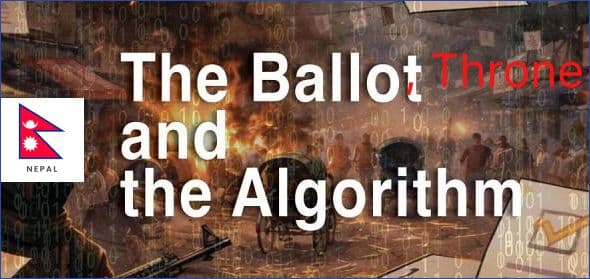
The ballot matters. The throne mattered. The algorithm now shapes perception. None of them, in isolation, will secure Nepal’s future.
Only disciplined, sovereign, and historically conscious engagement with constitutional reality will.
Nepal’s republic is being tested not only by ballots and protests, but also by the ability of Nepalis to marry energy with strategy, knowledge with action, and civic pride with constitutional clarity.
That is the true test of a republic. That is the measure of a generation. That is the harder work. And Nepal, with all its turbulence, history, and spirit, has the resources to meet it.
with DeshSanchar