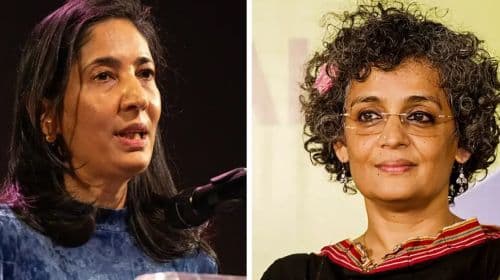
Photo: Kiran Desai (Left), Arundhati Roy (Right)
NEW YORK, NY – The New York Times Book Review has unveiled its weighty and much anticipated year end list, naming the editors’ top five fiction and top five nonfiction books of the year. As always, the list serves as a literary barometer, spotlighting works that combine ambition, craft and emotional force.
Among the ten selections, two books by celebrated Indian authors stand out for their scope and intimacy: Kiran Desai’s ‘The Loneliness of Sonia and Sunny’ in fiction, and Arundhati Roy’s ‘Mother Mary Comes to Me’ in nonfiction.
‘The Loneliness of Sonia and Sunny’ marks a major return for Kiran Desai. The New York Times praised the novel in rapturous terms, placing it firmly among the year’s finest noting, “Like the richest 19th-century fiction, this nearly 700-page family saga had our critic Alexandra Jacobs swooning: ‘Crowded but never claustrophobic,’ she wrote, and ‘better company than real-life people.’”

Desai, who left India at 14 and later lived in England before moving to the United States, brings her own transnational experience to the novel. The daughter of acclaimed author Anita Desai, she studied creative writing at Bennington College, Hollins University and Columbia University.
Set largely between 1996 and 2002, ‘The Loneliness of Sonia and Sunny’ follows two Indian immigrants to the United States whose lives briefly intersect on an overnight train journey in India. Sonia is an aspiring novelist fresh out of college in Vermont, struggling through a damaging relationship with an older artist in New York before returning home to India. Sunny is a New York based journalist working as a copy editor for the Associated Press, who fled an overbearing mother and carries his own complicated attachments. Their chance meeting, shadowed by an earlier failed attempt at an arranged match by their grandparents, slowly grows into a romance shaped by distance, memory and choice.

Desai herself has described the book as an exploration of loneliness in its many forms, saying, “I wrote about the rifts between nations, between races, genders, religions, all as a kind of loneliness […] But I was also interested in loneliness shifting shape into a quiet that is peace after the war is over. A sought-out solitude during a time of transformation. An exquisite artistic loneliness. A discovery of the dignity and privacy of one’s individual being.”
In nonfiction, Arundhati Roy’s ‘Mother Mary Comes to Me’ earned its place on the Times list as a memoir of striking emotional honesty. The New York Times described it as follows: “In this unsparing yet darkly funny memoir, the prizewinning novelist captures the fierce, asthmatic, impossible, inspirational woman who shaped her as a writer and an activist — and left her emotionally bruised for a lifetime. Roy doesn’t let herself off too easily, however. Fleeing from an insular Indian community to the cosmopolitan Delhi and then the global stage, she — like her mother — is imperious, impatient and unforgettable.”
Best known for ‘The God of Small Things,’ which won the Booker Prize in 1997 and became the biggest selling book by an Indian author, Roy is also a prominent political activist unbeloved by the current Indian government and is engaged in human rights and environmental causes. Born to Malayali and Bengali parents, she lives in Delhi. ‘Mother Mary Comes to Me’ is her first work of memoir and was also a finalist for the Kirkus Prize.
The book traces Roy’s complex and often painful relationship with her mother, Mary Roy, whom she describes as both “my shelter and my storm.” Writing in the aftermath of her mother’s death in September 2022, Roy confronts the intensity of her grief and her long history of running away, not out of a lack of love, but to preserve it. The memoir moves from her childhood in Kerala, where her single mother founded a school, through Roy’s emergence as a novelist and essayist, and into the present day. At once raw, unsettling and unexpectedly funny, the book carries the scale and depth of her novels and the political clarity and warmth of her essays, offering an ode to freedom and to the fierce, thorny bonds between mothers and daughters.
@ India-West News Desk