
Good morning, world! When President Trump imposed steep tariffs on China this year, he said they were a response to the deindustrialization of America that had accompanied large-scale outsourcing to China — what some have called the “China shock.”
Trump’s tariffs did prompt Chinese exports to the United States to fall by nearly 20 percent. Those exports, and more, are now going elsewhere in the world. This week, China’s trade surplus — the excess of exports to imports — officially surpassed $1 trillion, a level no country has ever reached.
Today my colleague Alexandra Stevenson, our Shanghai bureau chief, writes about the second China shock, and what that could mean for the developing countries experiencing it this time around.
Also:
- Hamas “still standing” in Gaza
- A rejection of Russia’s demands
- Ukraine’s recruitment ads
The second China shock
By Alexandra Stevenson
Two decades ago, the Western world experienced what has come to be known as the “China shock.”
Companies in the United States and Europe outsourced manufacturing to China until it became, in effect, their factory floor. China began exporting toys, clothes, gadgets and cars to the developed world at such a pace that it helped bring about the collapse of entire industries. Factories shut down. Hundreds of thousands, if not millions, of jobs were lost. Politically, the impact is still reverberating.
We’re now starting to see a second China shock play out, one that looks different. This time, barred from the U.S. market by tariffs, and unable to sell enough to consumers at home, China is redirecting more of its exports to developing countries. It’s also setting up its own factories in some of these countries.
But if the first China shock was largely invited by the West — even if some policymakers have come to regret the consequences — this one is taking place in countries that have less control over how it unfolds. Compared with the developed world, these countries are also more dependent on manufacturing to keep their economies growing.
And so the social consequences of the second China shock around the world are likely to be as profound as the first in the West. We’re starting to get a glimpse of what they might look like.
A manufacturing hegemon
More than 300,000 people in Indonesia’s garment factories and textile mills have lost their jobs to Chinese imports over the past two years, by one estimate.
That’s when cheaper Chinese-made clothes and fabrics began streaming into the country. When one garment factory, in the city of Solo, shut down suddenly in March, 10,000 people were out of a job almost overnight.
Local businesses in Thailand have also been hurt. The central bank recently warned about the “flooding of Chinese exports” into Thailand and Southeast Asia, saying that the pressure had “become more severe due to China’s manufacturing overcapacity.”
In Africa, imports from China hit $60 billion in September, already surpassing the figure for the full year in 2024.
Official data released on Monday showed what insiders already knew: China this year has already run an annual trade surplus with the world exceeding $1 trillion for the first time.
“China’s exports have been growing three times faster than global trade,” said Brad Setser, an economist at the Council on Foreign Relations. That kind of growth can’t happen without factories elsewhere closing down, he said.
This time around, China isn’t exporting just cheap goods. It’s also exporting the factories themselves, largely to get around Trump’s tariffs, which are particularly high on products made in China.
 |
| A furniture factory in Vietnam. Linh Pham for The New York Times |
This part has had its upsides for local economies. It’s largely worked out well so far in Vietnam, in part because many of the industries that moved, like footwear and furniture, are labor intensive and need local workers.
But Malaysia is a case study in the perils of letting Chinese manufacturing become too dominant. Malaysia’s fledging local solar industry was displaced by Chinese companies that built huge factories, employing tens of thousands of people.
Then the United States set up tariffs taking direct aim at Chinese solar exports coming via Southeast Asia. The Chinese companies were mothballed, and today, Malaysia’s solar industry is in ruins.
Unemployment and unrest
Many of the countries where China is sending more of its exports are going through a steep slowdown in domestic manufacturing.
They also have populations that skew young.
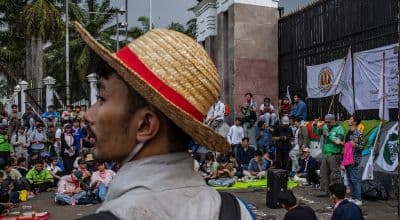
These dynamics may already be contributing to tension that has bubbled up in places like Indonesia, where young protesters have expressed frustration over a lack of opportunities.
“There is definitely a risk that if Chinese exports keep flooding in, you might see more and more protests,” Priyanka Kishore, an economist in Singapore, said.
This makes for a volatile combination with the anti-Chinese sentiment that lurks in Southeast Asia, where businesses run by ethnic Chinese hold much of the wealth. Thousands of angry workers burned foreign-owned factories in Vietnam in 2014 in anger over China’s attempts to control the South China Sea. In Indonesia, anti-Chinese riots broke out during the Asian financial crisis in 1998.
More than two decades ago, the West welcomed the efficiency of China’s manufacturing machine, whose cheap labor enriched its businesses for years. It’s been grappling with the social and political repercussions ever since.
There’s a lesson there for countries in Southeast Asia and elsewhere. Unlike the West, the countries bearing the brunt of the second China shock may not have asked for this. But they’re going to need to brace for impact anyway.
@the newyork times