When a mountain falls, it does not ask whether the road below was built by a government contractor, a private company, a foreign investor, or a politician’s favored project. The mountain falls. The river does not read a project agreement before changing course. A landslide does not inspect a budget before burying a village.
Nature is remarkably indifferent to politics.
Human beings are not.
That is why Nepal’s catastrophe is not just about weather or climate change but also about how development, money, contracts, and political incentives shape disaster risk.
More than 1,000 people have died, while nearly 4,000 remain missing. Hundreds of hydropower workers are among those missing, many believed to be trapped in tunnels. The physical destruction is immense. Yet beneath the visible catastrophe lies a more uncomfortable question:
Who receives the benefits of development, and who inherits its risks?
This is where sociology enters the mountain.
The central distinction is simple but consequential: disaster may be natural, but vulnerability is political.
Development is never merely a technical process. A road is not simply asphalt and gravel. It is a budget allocation, a public contract, a contractor, machinery, employment, land-value transformation, political visibility, and often electoral credit. A hydropower project is not merely electricity. It is investment, licensing, land acquisition, finance, construction, labor, political relationships, and claims over rivers and watersheds.
A bulldozer is not merely a machine. In contemporary Nepal, it can become an instrument through which development is made visible, rapidly and politically.
None of this means that roads, hydropower, bridges, or electricity are undesirable. Nepal desperately needs infrastructure and economic opportunity. The question is different:
What kind of development is Nepal purchasing, who benefits from it, and who carries the hidden insurance policy when it fails?
Political economy teaches us that benefits and costs rarely distribute themselves equally. The same principle applies to environmental risk. Those who benefit most from a project are not necessarily those who live beneath the landslide slope, beside the altered river, below an unstable road cut, or inside the tunnel when the mountain decides to move.
Risk can therefore become socially displaced.
A new road can be photographed. A bridge can be inaugurated. A hydropower plant can produce electricity. A contract can generate revenue. A politician can stand beside a ribbon and claim development.
But the geological instability created or intensified by poorly planned construction cannot be photographed at the inauguration ceremony.
It waits.
And when it finally appears, it arrives as a landslide, a broken bridge, a flooded settlement, a buried road, a destroyed power project, or a missing worker.
The political economy of disaster therefore begins long before the disaster itself. It begins when decisions are made about where to build, how quickly to build, how much geological assessment is considered sufficient, whose expertise counts, whose objections are dismissed, and who possesses the institutional authority to say:
“Not here.”
That may be the most difficult sentence in Nepali development politics.
In a society hungry for infrastructure, the person who says “build” looks progressive. The person who says “wait” can easily be portrayed as anti-development. The engineer who raises a geological concern may be treated as obstructive. The environmental scientist who asks for a cumulative watershed assessment may be accused of slowing investment. A resident who questions a road alignment may discover that development has already acquired a political vocabulary in which disagreement sounds like opposition to progress itself.
This is how development becomes an ideology rather than a policy.
Once development becomes ideological, every project becomes evidence of progress, regardless of whether it is economically rational, ecologically appropriate, or socially safe.
Nepal’s hydropower story illustrates the contradiction. The country possesses extraordinary hydroelectric potential, and electricity is essential to economic transformation. But the catastrophe has exposed the human vulnerability embedded within this infrastructure. About 900 workers from a dozen hydropower projects were reported missing, with hundreds believed to be trapped in tunnels.
That is not simply an engineering statistic.
It is a labor question.
Who works in the most dangerous places? Under what protections? Who assumes the risk? And whose life becomes economically expendable when development accelerates?
The worker underground and the investor above ground do not occupy the same risk environment.
That sentence should haunt every development policy in the Himalayas.
Another political-economic dimension becomes visible only after disaster: reconstruction.
Disaster destroys infrastructure, but disaster also creates a new demand for infrastructure. Roads must be rebuilt. Bridges must be replaced. Power projects must be repaired. Communities must be relocated. Contracts must be issued. Money must move.
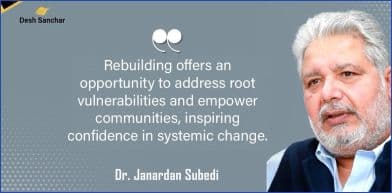
This is where a serious state must distinguish reconstruction from repetition. Rebuilding offers an opportunity to address root vulnerabilities and empower communities, inspiring confidence in systemic change.
If the same political incentives that produced vulnerability govern reconstruction, Nepal may rebuild its physical infrastructure while reproducing the social conditions that made the catastrophe so destructive.
A broken bridge can be reconstructed in months.
A broken institutional culture can take generations.
This is why reconstruction cannot simply mean replacing what was destroyed. It must mean asking why particular communities, workers, roads, bridges, and projects were so vulnerable in the first place.
Otherwise, reconstruction becomes a pause between two disasters.
The same logic applies to early-warning systems. Nepal needs stronger monitoring, communication, and warning infrastructure. But warning systems are not merely technological systems. They are institutional systems.
Someone must collect information. Someone must interpret it. Someone must trust it. Someone must communicate it. Someone must possess the authority to evacuate people. And someone must be willing to accept the political cost of closing a road, stopping construction, relocating a settlement, or postponing an inauguration before danger becomes visible.
Technology can detect danger. Institutions determine whether society acts on it.
Nepal has never suffered from a total absence of knowledge. It suffers from the distance between knowledge and action.
Scientists study glaciers. Geologists map hazards. Hydrologists study rivers. Engineers understand slope stability. Institutions such as ICIMOD have generated enormous bodies of regional knowledge.
Yet knowledge confined to reports, conferences, offices, and academic journals cannot protect a family sleeping beside a river.
The problem, therefore, is not simply ignorance.
It is political translation.
Who translates scientific knowledge into building codes? Who translates hazard maps into land-use decisions? Who translates warnings into evacuation plans? Who tells a powerful contractor that a road alignment is unsafe? Who tells a politician that an inauguration must be postponed? And who pays when scientific caution defeats a profitable project?
These are political-economic questions disguised as technical ones.
There is also a class dimension. Disaster does not fall equally on everyone. Wealthier households can often relocate, insure property, rebuild, or wait. Poorer families may have no alternative but to live beside unstable slopes, rivers, roads, quarries, or construction sites. A hydropower worker may accept dangerous employment because wages provide the only available livelihood. A rural household may accept a poorly aligned road because it is the first road ever to reach the village.
Choice itself is socially unequal.
That is why blaming villagers for living in “unsafe” places is intellectually lazy. The more important questions are: Why were they placed there? What alternatives existed? Who made the decisions that shaped their vulnerability? And who benefited from those decisions?
The mountain does not distribute risk according to class.
Society does.
This brings us to expertise and accountability. After catastrophe, Nepal produces experts with remarkable speed. Everyone explains what went wrong. Everyone knows what should have been done.
But where were these voices when contracts were signed, roads were cut, slopes were altered, warnings were issued, and risk assessments were ignored?
The purpose of expertise is not to win an argument after the bodies are counted.
The purpose of expertise is to prevent some of those bodies from being counted.
That should be the standard by which Nepal evaluates its experts, institutions, and development policies.
The measure of development cannot simply be the number of roads opened, megawatts licensed, bridges inaugurated, or contracts awarded. It must also include risks avoided, ecosystems preserved, workers protected, communities made safer, and disasters prevented.
A mature development philosophy must learn the difference between what can be built and what should be built.
That distinction requires institutions strong enough to say no. It requires planners capable of thinking beyond electoral cycles, contractors accountable beyond project completion, scientists whose warnings carry institutional authority, and citizens who understand that ecological restraint is not the enemy of development.
The Himalayas are not an empty warehouse of resources waiting for extraction. They are a living system on which millions depend.
When a mountain falls, it exposes more than geological instability.
It exposes the architecture of society beneath it.
Nepal should therefore treat this catastrophe as a national audit, not merely a national mourning. Where did the money go? How were projects approved? How were risks assessed? Whose warnings were ignored? How were workers protected? Who benefited? Who paid? And how were risks distributed?
These questions are not about finding convenient villains. They are about understanding systems.
Because if Nepal rebuilds only what the flood destroyed, it will repair concrete while leaving institutions untouched.
And that may be the most expensive lesson the country could refuse to learn.
The question is ultimately simple:
When development creates wealth for some and risk for others, who is responsible for the difference?
Until Nepal answers that question honestly, the mountain will become a resource, the river an obstacle, the worker a statistic, and disaster an expense.
And here lies the final paradox.
Disaster destroys wealth, but disaster also creates an economy of reconstruction. New contracts emerge. New budgets are allocated. New roads are promised. New projects are approved. New political credit becomes available.
The danger is not that someone wants the mountain to fall.
The danger is that a system can learn to live comfortably with the consequences of mountains falling.
Someone usually knew.
Someone usually warned.
Someone usually benefited from proceeding anyway.
The political economy of disaster begins in that silence.
Perhaps, then, Nepal’s most important development project is not another road, bridge, or hydropower plant. It is the construction of institutions in which the sentence “this may be unsafe” carries as much political and institutional weight as “this will be profitable.”
Only then can development become something more than construction.
Only then can it become civilization.
Author Janardan Subedi is Professor Emeritus of Sociology at Miami University, Ohio, USA.