Parliament is one of the few places where a person can enter as a representative of the people and gradually begin to suspect that the people were lucky to be represented.
This transformation rarely happens overnight. It begins subtly. A few microphones. A few headlines. A few social media clips where confidence is mistaken for competence. Then, almost imperceptibly, a new species emerges: the Honorable Omniscient.
Not everyone is affected. Some young parliamentarians, men and women alike, remain refreshingly normal. They ask questions instead of delivering sermons. They read briefs before reacting to them. They behave as though they are students of governance rather than its final authority.
But others have discovered something remarkable within a few months of being elected: they now seem to know everything about everything.
Economy? Obviously.
Foreign policy? Naturally.
Constitutional interpretation? Self-evident.
Agriculture in Humla? No need to consult Humla.
This is where democracy develops a strange irony. It takes years for a doctor to become mildly confident about surgery. It takes thousands of hours for a pilot to become calmly cautious in the air. But it takes a few election results for some individuals to develop expertise in the entire machinery of the state.
Something does not add up.
Modern politics has quietly replaced education with decoration, leading voters and colleagues to overvalue superficial credentials like degrees, which can mislead them into believing competence where there is none.
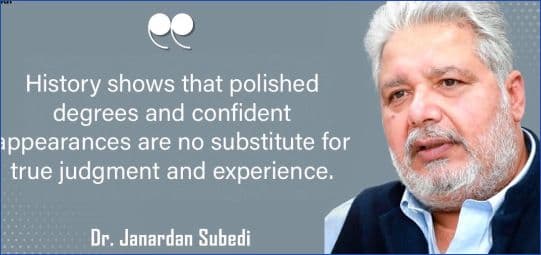
History shows that polished degrees and confident appearances are no substitute for true judgment and experience.
Europe had philosophers with libraries in their heads and still managed to produce catastrophes on an industrial scale. Villagers or farmers did not engineer the global financial crisis; it was designed by people with polished degrees, fluent confidence, and mathematical models that collapsed under the weight of reality.
A credential is not wisdom.
It is only permission to enter the conversation.
What happens after that is the real test.
Nepal’s Parliament is beginning to reveal a familiar pattern today, not in everyone, but in enough people to matter. A committee meeting becomes a performance stage. A policy discussion becomes a monologue. A question becomes an opportunity to demonstrate superiority rather than understanding.
And slowly, something odd happens: listening becomes suspicious, and certainty becomes a political virtue.
In one budget discussion, the tone may sound like this:
“We already understand the issue fully.”
This is usually the first sign that it has not been understood at all.
In another debate:
“We do not need further expert consultation.”
Which is often a polite way of saying: “We are now the experts.”
This is not confidence. This is institutional overheating.
Eastern philosophy had a very precise word for this condition: ignorance that believes itself to be knowledge.
The Katha Upanishad puts it with brutal clarity:
अविद्यायामन्तरे वर्तमानाः स्वयं धीरा: पण्डितं मन्यमानाः
avidyāyām antare vartamānāḥ svayaṁ dhīrāḥ paṇḍitaṁ manyamānāḥ
Dwelling in ignorance, yet thinking themselves wise, the deluded regard themselves as learned.
(Katha Upanishad 1.2.5)
It is difficult to find a more precise diagnosis of political arrogance. Because the real danger is not ignorance; ignorance knows it needs help.
The danger is certified ignorance wearing a badge, sitting in Parliament, and speaking in full sentences.
The Bhagavad Gita offers the correction not in abstract moral language but through psychological discipline. It describes the person of steady wisdom (sthita-prajna) not as someone who knows everything, but as someone who is not emotionally hijacked by his own opinions:
प्रजहाति यदा कामान् सर्वान् पार्थ मनोगतान्
आत्मन्येवात्मना तुष्टः स्थितप्रज्ञस्तदोच्यते
prajahāti yadā kāmān sarvān pārtha manogatān
ātmany evātmanā tuṣṭaḥ sthita-prajñas tadocyate
When a person abandons the desires of the mind and rests in inner balance, that person is called one of steady wisdom.
(Bhagavad Gita 2.55)
In political terms, this is revolutionary.
It means: you do not need to win every argument.
You do not need to respond to every criticism.
You do not need to transform every disagreement into a performance of intellectual superiority.
But contemporary politics rewards the opposite behavior.
A loud answer gets attention.
A careful answer gets ignored.
A nuanced answer gets edited out of television clips.
So, Parliament slowly becomes a theatre of certainty rather than a laboratory of understanding.
What is often missed in this performance is a simple sociological truth: power does not primarily corrupt people. It accelerates what already exists.
If arrogance exists, power inflates it.
If curiosity exists, power deepens it.
If insecurity exists, power disguises it as confidence.
Because the early months of political life are not just an orientation period, they are a critical period that reveals whether a young parliamentarian will cultivate humility, honesty, and a genuine desire to serve, or fall into arrogance and superficiality.
Nepal’s young parliamentarians are therefore in a formative stage that deserves seriousness, not flattery.
But seriousness also requires honesty.
Winning an election proves political skill, public connection, and organizational ability. It does not transform anyone into a universal expert.
No one becomes an economist by winning votes. No one becomes a constitutional scholar by winning a constituency. No one becomes a philosopher of governance by surviving a campaign.
The danger lies not in ambition, but in confusion between mandate and mastery.
The Eastern tradition offers a simple corrective: the higher one rises, the lower one should bow inwardly.
Because humility is not self-deprecation, it fosters respect. It is the accurate understanding of one’s position in relation to knowledge, society, and time, which inspires admiration in others.
Five years from now, Nepal will not remember every speech delivered in Parliament.
It will remember something quieter.
Who listened.
Who learned.
Who remained open to correction.
Who treated disagreement as information rather than an insult.
Who understood that public office is not a declaration of arrival, but an extended lesson in complexity, humility, and active listening-traits that directly influence effective governance and policy outcomes.
Degrees can be printed in months.
Wisdom takes years.
Sometimes it takes power itself to teach what education failed to complete.
And sometimes, if one is not careful, power never teaches it at all.
And in the end, all intellectual arrogance meets the same quiet truth:
If you wish to meet me, do not stand at the shoreline shouting opinions into the wind and mistaking it for dialogue. Come deeper. Beautiful pearls are not found at the surface, where convenience and noise dominate. They are formed far below, in silence, pressure, and patience, where effort replaces performance, and depth replaces display.
Author Subedi is a Professor of Medical Sociology at Miami University, USA
@DeshSanchar