King Gyanendra Bir Bikram Shah Dev’s recent public message did not arise in isolation. The turbulence of the current political climate influenced it. Nepal is experiencing visible instability marked by coalition shifts, intergenerational social unrest, distrust in institutions, and growing debates over sovereignty and external influence. To understand the King’s remarks properly, they need to be viewed in this context rather than as standalone statements.
The themes of the address were measured and civic in tone. Nepal is facing confusion and unrest. Political changes must be judged based on their results. Accountability cannot be postponed forever. Citizens must not turn against one another. Duties must balance rights. Structural national issues should be prioritized over mechanical electoral cycles. Maintain what works. Remove what causes harm.
These propositions are not ideological; they are civic. Their validity depends on institutional performance, not preference. However, the public reaction became polarized almost immediately. Instead of engaging with the message’s substance, many critics focused on symbolism. Reflection was seen as restoration, and evaluation was framed as regression.
These reflexes expose more about the fragility of modern political discourse than about the message itself. Democratic theorists have long maintained that institutional legitimacy relies not just on procedural compliance but also on public trust and apparent effectiveness. When political systems feel insecure, they often see scrutiny as a threat rather than an opportunity for improvement. This defensiveness erodes democratic confidence rather than bolstering it.
Nepal’s political path since 1990 reflects one of the fastest institutional changes in South Asia. The return to multiparty democracy in 1990, the decade-long insurgency from 1996 to 2006, the Comprehensive Peace Agreement, the abolition of the monarchy in 2008, the adoption of the Constitution in 2015, and the start of federal restructuring all transformed the Nepali state. These changes were justified through a framework focused on inclusion, accountability, stability, and prosperity.
However, institutional restructuring and democratic consolidation are not the same processes. Political transformation alters formal structures, while democratic consolidation depends on sustained public trust, administrative competence, policy stability, and confidence across generations in the system’s future. Without these elements, democratic institutions may function procedurally but remain fragile at their core.
Based on these measures, Nepal’s consolidation remains incomplete.
Since the constitution was adopted in 2015, Nepal has experienced repeated cycles of forming and dissolving coalitions. Governments have been built through shifting alliances rather than lasting policy mandates. Prime ministers have changed several times within a decade, and policies have often shifted accordingly. Administrative continuity has been inconsistent, and long-term planning has often taken a backseat to short-term political survival.
Public trust mirrors these structural patterns. Large-scale youth migration persists, with hundreds of thousands of Nepalis leaving each year to seek jobs abroad. Remittances make up a significant portion of the national economy, sometimes nearly a quarter of gross domestic product. While remittances offer vital support to families, dependence on foreign labor markets also highlights domestic economic challenges.
These are signs of systemic weakness rather than partisan views.
It is within this context that the King’s call for reflection should be understood. The message did not suggest institutional reversal. It did not propose constitutional restructuring. It did not advocate restoration. Instead, it called for evaluation at a time when such an assessment is genuinely needed.
The rise of Generation Z political activism shows how deep their frustration runs. Young Nepalis are connected online, politically aware, and increasingly outspoken. Their activism isn’t a rejection of democracy itself but a sign of dissatisfaction with how democratic institutions perform. Their complaints mainly center on corruption, inefficiency, unemployment, and the sense that political elites are shielded from accountability.
This distinction is vital. When a generation questions democracy itself, systemic legitimacy is at risk. When a generation questions how democratic institutions function, it is evaluating their systemic maturity.
Generational dissatisfaction is not inherently destabilizing. In many democratic societies, youth activism has spurred institutional renewal. However, when generational frustration aligns with visible political instability and economic uncertainty, the overall impact can weaken long-term confidence in the system’s ability to deliver meaningful progress.
Political turbulence surrounding Madam Karki’s government has heightened perceptions of instability. Coalition fragility, shifting alliances, contested policy priorities, and allegations of external influence have created a climate of uncertainty. Rather than addressing these structural issues, the government and its political allies seem intent on prioritizing electoral processes amid conditions that many citizens find tense and unsettled. Instead of assessing systemic priorities, elections are proceeding with both ballots and armed security present. This raises questions about whether the decision is driven by bureaucratic insensitivity, political inertia, or external pressures.
The insistence on holding elections in such an environment raises challenging questions about priorities. Elections are intended to reflect public confidence, not to confer procedural legitimacy in a setting marked by instability and polarization.
This posture warrants closer examination. When governments prioritize election timing over strengthening institutions, observers are justified in questioning whether such choices are driven mainly by domestic needs or by expectations formed outside the immediate democratic context. The issue isn’t just about a single election cycle; it’s about whether democratic procedures are being used as a substitute for genuine democratic performance.
The urgency of calling new elections also prompts a deeper democratic question. Have citizens been truly consulted on whether another electoral cycle is their immediate priority? The country is already under increasing fiscal pressure and institutional stress. The last national election occurred only three years ago. Holding another election so soon, without addressing underlying governance issues, risks a mere procedural formality. Democratic legitimacy comes not only from voting but also from responsiveness to the public’s needs. When a nation faces economic challenges and institutional instability, the timing of elections becomes a significant political decision rather than a mere procedural matter.
Nepal continues to face significant fiscal pressures while relying heavily on remittances and external aid. In such situations, repeated national elections not only strain politics but also increase financial burdens. Elections are vital for democratic legitimacy, yet they are also among the most resource-heavy processes a country undertakes. Without steady institutions and economic stability, holding elections repeatedly risks serving as a substitute for proper governance rather than supporting it.
Supporters of frequent elections argue that regular electoral competition enhances democratic accountability and prevents the concentration of power. This argument holds considerable weight. Elections remain the foundation of democratic legitimacy. However, holding elections often cannot make up for weak institutions. When governments change frequently without improving governance, repeated elections risk causing voter fatigue rather than building confidence. As the country faces growing fiscal constraints, political fragmentation, and increasing frustration across generations, prioritizing another election cycle naturally raises questions about timing. Stability before holding elections is not an anti-democratic idea. In many political traditions, it is seen as a necessary step for meaningful democratic practice.
Debates about external influence further complicate the national discussion. External engagement through development aid, institutional partnerships, and policy collaboration is not inherently problematic. Nepal’s economic and diplomatic realities require international cooperation. However, sovereignty in the modern international system demands institutional coherence. Autonomous decision-making relies on administrative capacity and political stability. Countries experiencing ongoing fragmentation often find their strategic flexibility limited, regardless of formal independence.
Nepal’s geopolitical position between India and China underscores the importance of this reality. Countries located between major powers must depend heavily on internal stability to keep diplomatic balance. Internal divisions weaken bargaining power. Policy inconsistency hampers negotiating influence. Institutional instability heightens vulnerability to external pressure. In such situations, stability becomes a strategic need rather than just a domestic preference. Stability is not opposed to democracy; it is essential for meaningful sovereignty.
The principle that duties must balance rights is central to core democratic theory. Citizenship involves reciprocity between individual rights and collective responsibilities. When rights discussions expand without equal emphasis on civic duties, governance risks turning transactional, and each group demands its rights while few are willing to accept the responsibilities of reform. The activism of young citizens highlights this imbalance. Their calls for accountability show they recognize that institutional responsibility has diminished. Their activism demonstrates that democracy should function meaningfully, not just procedurally.
The main mistake in much of today’s debate is treating institutional critique as a simple choice between monarchy and republic. This approach ignores complexity and reduces systemic analysis to just symbolic labels. The key issue isn’t institutional symbolism but how institutions actually perform. If reflection is seen as backsliding, then democratic discussion is limited by fear instead of guided by reason. Political systems that can’t handle evaluation won’t improve.
The recent message did not call for restoration. It called for reflection. In a time marked by visible instability, economic pressure, and institutional uncertainty, reflection is not just suitable; it is crucial. It is necessary. Democratic legitimacy is not upheld by symbolism alone. It relies on performance. If Nepal’s democratic system provides stability, prosperity, accountability, and strategic independence, it will remain secure regardless of criticism.
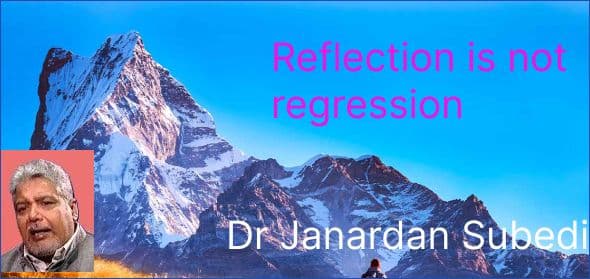
A confident republic welcomes scrutiny. It becomes stronger because of it. Reflection is not retreat. It is the discipline that allows democratic systems to survive.
with PReview