Why Nepal’s crisis is better explained by institutional decay than external conspiracy
-------------
Dr. Alok K. Bohara------------
This is a short note prompted by the growing tendency to frame Nepal’s current political turmoil primarily through the language of “foreign hands.”
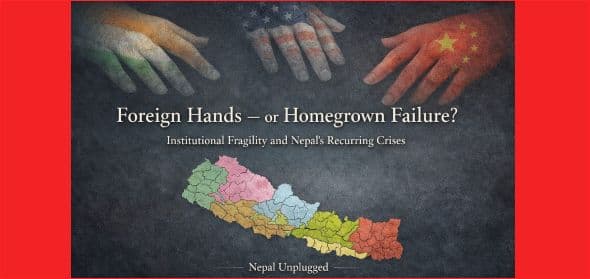
Across talk circuits and commentary today, Nepal’s unfolding crisis is increasingly being explained through external influence—foreign powers, hidden backers, geopolitical plots. In a tense regional environment, this framing is understandable. But it also risks becoming a convenient shortcut. By looking outward first, it subtly shifts attention away from the harder, less comfortable work Nepal’s political parties and institutions have long postponed: internal reform, accountability, and rule-bound governance.
Three collapses in three decades and seven constitutions in as many decades should force us to pause for self-reflection. Add to this nearly thirty changes of government in just as many years. Nepal’s democratic century, which began in 1950, has been marked by repeated conflicts, transitions, and crises. Not all of these can be explained—or blamed—by forces from outside. A pattern this persistent points to structural weaknesses at home.
Long before the September Gen-Z uprising, many observers—including myself—had been warning that Nepal was approaching a tipping point. The concern was not foreign interference, but accumulated internal fragility: weak checks and balances, cartel-like party arrangements, politicized constitutional bodies, episodic accountability, and the near absence of credible, nonpartisan civic watchdogs. Together, these produced a system operating at the edge of collapse. In such systems, small triggers—a protest, a ban, a spark—can produce cascading effects far beyond their immediate cause.
Explaining this rupture mainly through foreign influence can feel reassuring, but it ultimately absolves domestic actors of responsibility. External pressures do exist, but they become decisive only when internal institutions are already hollowed out and exposed. When institutions are weak and compromised, outside forces stop dealing with the state as an institution and begin negotiating directly with individual political powerbrokers. At that point, sovereignty erodes quietly—not through invasion, but through leverage.
This is why the current obsession with identifying external hands risks missing the deeper lesson. The more revealing symptom may not be foreign maneuvering, but the ease with which, for example, militant cadres, informal networks, and extra-institutional actors are able to step in and exert influence, right under our nose during this election cycle. This is just the tip of our the ever fragile institutional iceberg that needs tending.
As some have recently noted, these “cadre machines” are not causes of the crisis so much as indicators of a broken system—filling a vacuum left by institutional decay.
Nepal’s deeper challenge, therefore, is not denying or ignoring outside influence. It is rebuilding the internal capacity that makes such influence less consequential: credible institutions, internal party democracy, transparent rules, and steady and independent civic oversight that operates beyond election cycles. Without this foundation, every crisis will continue to invite external interpretation—and external leverage.
My take, across several essays on Nepal Unplugged, may be of interest to some: why Nepal’s current crisis is better understood through internal institutional fragility than through the language of “foreign hands.”
Dr. Alok K. Bohara, Emeritus Professor of Economics at the University of New Mexico, writes as an independent observer of Nepal’s democratic evolution through the lens of complexity and emergence science. His systems-policy essays on Nepal’s socio-economic and political landscape appear on Nepal Unplugged.