The essence of democracy is not confined merely to the aggregation of popular votes. At its core, democracy is a composite of rules, procedures, institutional discipline, and constitutional restraint. Elections represent the most sensitive and decisive moment of this composite, where even minor legal deviations can cast doubt on the credibility of the entire system. This is why constitutional democracies worldwide treat election periods as distinct from “ordinary political time.” This is neither a period of complete political freedom nor an experimental laboratory; it is a time for restraint, continuity, and minimal risk.
When parallel claims to leadership arise within a major political party at such a sensitive moment, the dispute transcends internal party power struggles. It directly questions the role of the state’s constitutional institutions. Who does the Election Commission recognize as official? Which signatures are considered valid? On what basis is that decision made? These questions are legal and constitutional in nature, even more than political.
In the context of Nepal, the leadership dispute within the Nepali Congress coinciding with the filing of candidacies for the House of Representatives has intensified these questions. On one hand is the long-registered leadership in the Commission’s records; on the other is a new leadership claiming legitimacy through a special convention. Both sides have submitted signatures to the Commission asserting their official status. The question of how the Commission will respond is not limited to domestic political discourse; it is directly linked to international democratic practice.
Theoretically, political parties in a democracy are independent institutions. They are free to select leadership, set policies, and structure their organization. Yet, this freedom is not absolute. When a party’s internal decision intersects with the public electoral process, it comes under the oversight of the state’s legal framework. This is where the role of the Election Commission enters. The Commission is neither the ultimate arbiter of a party’s internal democracy nor the measure of political legitimacy. Its primary responsibility is to ensure elections are conducted timely, fairly, and without obstruction.
International practice makes this principle even clearer. Established democracies India, the United Kingdom, Canada, Australia, South Africa, Germany offer ample examples of electoral management bodies refusing to intervene in internal party leadership disputes. India’s Election Commission has repeatedly emphasized that determining a party’s true leadership is a political and judicial matter, not an administrative one. Until a court issues a final or interim order, or the official records of the Commission are formally amended, maintaining recognition of the previously registered leadership is the safest and most legally sound option.
At the heart of this practice lies the Doctrine of Continuity. This principle asserts that until a new state of affairs is legally and indisputably established, the existing legitimate state remains in effect. This doctrine is universal, applying not only to parties but to all state institutions. It ensures stability in government formation, constitutional office tenures, administrative decisions, and electoral processes.
During election periods, this principle applies with even greater rigor. Decisions made during elections have long-term implications. If the Commission were to immediately recognize a disputed new leadership, and a court later invalidated that leadership, all candidate filings, election symbols, campaigns, and ultimately results could face legal jeopardy. For this reason, election commissions globally function as risk-averse institutions.
This risk-averse nature, constitutionally termed the self-restraint principle, indicates institutional maturity. Even when the Commission possesses discretionary interpretative authority, exercising restraint demonstrates prudence. UN electoral guidance similarly emphasizes that electoral management bodies should minimize political decision-making during elections, focusing primarily on administering the process rather than resolving disputes.
In this context, when two parallel sets of signatures are submitted, the Commission’s practical options are extremely limited. Granting dual recognition is legally impossible, as it would create two official representatives for a single party, an outcome election law does not permit. Immediate recognition of the new leadership carries high risk due to its disputed legality. The safest, legally, administratively, and constitutionally sound option is to continue recognizing the leadership already registered in official records.
Many may politically critique this as “conservative” or “status-quoist.” Constitutionally, however, it is not conservatism; it is stability-driven governance. Stability is not a weakness in democracy; it is a prerequisite. Without stability, freedom cannot be safeguarded.
The principle of separation of powers is also crucial here. The Constitution delineates the authority of judicial bodies and the Election Commission separately. If the Commission determines the legitimacy of party leadership, it encroaches on judicial jurisdiction, undermining the separation of powers, a dangerous precedent for any constitutional democracy.
Nepal’s constitutional framework aligns with this international principle. The Political Parties Act, the Election Commission Act, and election regulations do not empower the Commission to resolve internal party disputes. Registration in the Commission’s records constitutes the decisive basis. Claims of new leadership require a court decision or formal amendment of official records. Until such procedures are complete, the Commission treats the claim as a claim, not a right.
In this light, the Commission’s likely decision by Magh 6 will favor institutional reasoning, not any individual or faction. Recognizing the Deuba faction does not invalidate Gagan Thapa’s political legitimacy; it simply reflects the Commission’s risk-averse approach during a sensitive electoral period. Once courts or party processes provide clarity, the decision may change, but not during the election period.
This entire episode conveys a profound lesson about democracy: it is not merely rule by majority or popularity; it is rule by law. Objectives achieved outside proper procedures are not truly democratic. The Commission’s restraint, continuity, and risk-averse decisions ultimately safeguard the democratic process itself.
In this sense, the Commission’s decision is not support or opposition to any individual—it is fidelity to the Constitution. Parties come and go, leadership changes, and power balances shift. But if institutional processes like elections become unstable, the cost is borne by the entire democracy. In the electoral hour, law seeks prudence over emotion, procedure over power, and restraint over haste. This restraint is the hallmark of true democratic maturity.
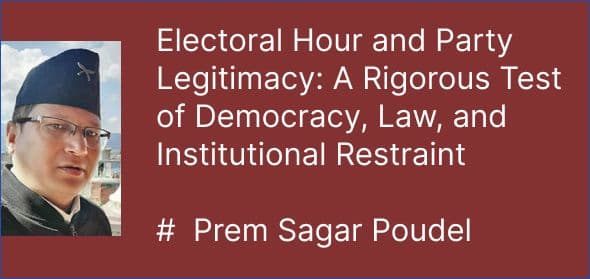
Author: Prem Sagar Poudel is a senior journalist and international relations analyst from Nepal. He has conducted in-depth studies on Nepal-China relations, the geopolitics of the Himalayan region, and Asian security.