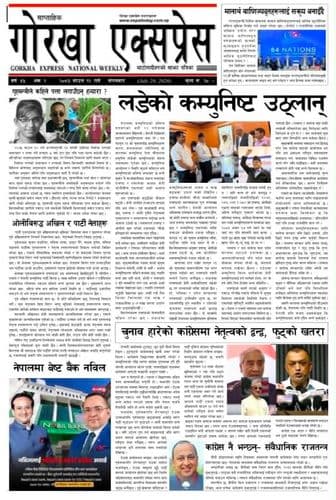

At the end of 2025, Nepal flirted with hope. Ravi Lamichhane, recently re-energized despite scandals involving billions of rupees, reappeared at the center of the national drama. Balendra Shah, the independent mayor of Kathmandu, kept challenging political complacency with poetic defiance. Kulman Ghising, the technocrat who saved the electricity sector, embodied quiet competence in a noisy era. For a brief moment, Nepalis dared to imagine: “Perhaps 2026 will finally be different.” Optimism lingered like incense in a temple.
Then reality—true to Nepali tradition—quietly but decisively returned, like a cat knocking over a vase no one really wanted anyway.
Lamichhane, Shah, and Ghising dominated headlines. Social media feeds exploded. Narratives quickly formed: Lamichhane as the media-savvy crusader, Shah as the philosopher-rebel, Ghising as the disciplined administrator. Under the banner of the Rastriya Swatantra Party (RSP), they seemed to promise a new kind of politics: energetic, capable, and independent. The public cheered.
Yet brilliance alone cannot overcome structural limits. Nepal’s political system, shaped strongly by its constitution, rewards spectacle over skill, loyalty over principle, and negotiation over merit. Applause matters more than laws. Continuity is risky. Reform is only tolerated if it’s mostly symbolic. Politics in Nepal often looks like a circus: the clowns get the spotlight, the acrobats perform heroics, and the elephants—the bureaucracy—move slowly, oblivious to the script.
The constitution, while designed to prevent authoritarian rule and promote inclusion, unintentionally causes structural paralysis. Authority is spread across coalition governments, provincial assemblies, federal commissions, and party hierarchies. Semi-proportional representation fragments electoral mandates, forcing coalitions that must constantly negotiate to survive at the expense of decisive governance. Federalism, meant to decentralize power, overlaps with unclear jurisdictions, diffusing accountability. Bureaucratic posts, though supposed to be professional, are still vulnerable to political influence. In such a system, even capable, honest leaders must negotiate, compromise, or perform theatrics to survive. Governance becomes secondary to performance; reform is absorbed by procedure; and structural dysfunction is masked as normal politics—like a magician pulling a scarf from an empty hat, pretending something meaningful appeared.
Lamichhane thrives in this environment. His speeches electrify, his actions dominate headlines, and he pushes uncomfortable debates into the public eye. Yet legal uncertainties, procedural delays, and fragmented authority limit his impact. Charisma does not automatically lead to institutional change. Storming Parliament, confronting elites, demanding accountability—these gestures inspire crowds but rarely change the machinery behind them. He’s like a drummer in a band where nobody knows the melody: loud, spectacular, but ultimately constrained by the ensemble.
Shah energizes with intellectual fire and moral urgency. He unsettles bureaucracies, challenges elites, and makes complacency impossible. But disruption without institutional depth is temporary. Even the strongest agitation is limited by fragile coalitions and semi-proportional mandates. Bold moves may spark discussion, but structural limits mean policy remains slow, diluted, or symbolic. He’s like the wind trying to move a mountain: gusty and persistent, but unable to shift the stone beneath.
Ghising offers another lesson. His quiet competence shows that administration can succeed when shielded from partisan chaos. His accomplishments are notable because they rely on favorable structural conditions. When the system protects talent, good governance can thrive. When it doesn’t, even integrity and skill can’t overcome constraints.
The controversy over proportional representation illustrates these dynamics sharply. When RSP announced its list of nominees—people entering Parliament without direct voter mandates—criticism burst forth. Allegations of secrecy, favoritism, and bargaining resurfaced. But this pattern isn’t new or surprising: it reflects incentives built into the constitutional and electoral system. Patronage, negotiation, and strategic placement of loyalists aren’t anomalies—they are systemic features designed to sustain coalitions, distribute power, and keep parties cohesive.
Viewed this way, RSP isn’t a rupture but a continuation. It promises reform, shows novelty, and grabs attention. But personal charisma and public appeal cannot sidestep constitutional realities. Populism thrives not because voters are naive, but because institutions often fall short. When rules reward negotiation, spectacle, and optics over decisiveness, people turn to bold leaders who offer clarity and moral certainty—however temporary. In Nepal, leadership is often judged by applause rather than results: the louder the applause, the higher the status.
Imagine Parliament as a theater. Lamichhane waves documents like swords. Shah paces like an agitated philosopher-general. Ghising keeps the lights on while bureaucrats sip tea. Citizens watch from digital balconies—cheering, analyzing, criticizing—fully aware that the basic script won’t change. Even electoral wins or headline reforms can’t fix the fragmented authority, coalition demands, or semi-proportional system. Populism spreads—policy stalls. Drama entertains. Governance waits. Groundhog Day, Nepali style.
This isn’t unique to Nepal. Small, divided democracies with polarized elites face similar challenges. What makes Nepal different is how quickly and intensely its political theater unfolds, the public’s obsession with personalities, and the persistent structural barriers that limit even talented leaders. Lamichhane, Shah, and Ghising are both players and symptoms: they provoke, they inspire, they frustrate, but ultimate change depends not on them, but on constitutional design.
Look at the scandals involving cooperatives: billions lost, public trust eroded, legal processes slow. Lamichhane has drawn attention to accountability, yet the system rewards performance over principles. Shah ensures complacency is impossible; Ghising proves that good administration can work. But even their combined efforts can’t escape fragmentation, opacity, and systemic incentives that favor spectacle. Criticizing performative politics without considering the constitutional context confuses the symptom with the root cause.
Even small wins—RSP’s proportional nominees, coalition deals, minor reforms—are limited by design. Semi-proportional systems give partial mandates; coalition rules dilute decisions. Leaders may change, slogans may evolve, costumes may rotate— but the underlying script persists.
Imagine them negotiating policy: Lamichhane flails with rhetorical flourishes, Shah interrupts with sharp remarks, Ghising quietly assesses feasibility. Over all of them, unspoken yet ever-present, is the unresolved issue of cooperatives and lost billions—a cloud everyone sees but no one structurally addresses. Citizens observe, debate, post online, and over time accept these structural limits as inevitable. The spectacle continues; systemic dysfunction remains. The political system, effectively, is a carnival mirror: it reflects the drama beautifully, but nothing behind it actually alters.
The alignment of Lamichhane, Shah, and Ghising isn’t miraculous or disastrous. It’s reflective: a mirror of a constitutional framework that ensures inclusion, disperses authority, and stabilizes democracy—while simultaneously restricting decisive action. Until rules are changed to reward competence, moral integrity, and long-term vision over mere optics, Nepal will keep producing headlines, celebrating populists, and delaying meaningful governance.
Still, these figures deserve recognition. Lamichhane demands scrutiny. Shah keeps complacency at bay. Ghising demonstrates successful administration. Their achievements matter, but always within the limits of the structure.
And so, with each election, each coalition, each scandal that comes and goes, Nepalis wake up again to the familiar, tired refrain: same shit, different day.
Author Subedi is a Professor of Medical Sociology at Miami University, USA
@DeshSanchar