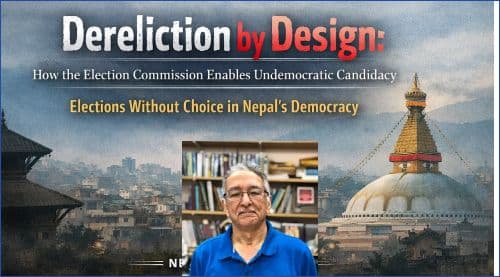
Prelude: For nearly three decades, Nepal’s leaders focused more on managing—and often controlling—elections than on building the institutional foundations of democracy. Electoral arithmetic and power-sharing deals absorbed political energy, while institutional scaffolding remained weak, leaving the system vulnerable to repeated breakdowns. This essay argues that one crucial pathway to the democratic middle corridor lay with the Election Commission of Nepal—specifically, its constitutionally mandated responsibility to ensure internal party democracy, a role it never fully exercised. With electoral logistics firmly in the hands of the Election Commission, democratic accountability may now require a complementary civic institution—an Independent Citizen Democracy Tribunal (ICDT).
The Same Drill, Every Election
Every election cycle, the same drill repeats.
Parliamentary candidacy tickets are distributed not through the choice of constituency voters, but through decisions made by a small circle of power brokers who orbit party leadership. Cronies, business connections, relatives—and increasingly cultural icons and public celebrities placed on proportional lists—receive tickets, while grassroots members and local constituencies are reduced to spectators. The silence of party leadership, the routine toeing of party lines, and the muting of internal dissent can all be explained by the normalization of these undemocratic practices.
And there is also the geographically skewed candidacy map, often leaving underprivileged and poor districts underrepresented. The multiple-constituency contestation granted to power-centered leaders feels more like feudal entitlement and risk hedging than a pure democratic competition.
What operates inside most political parties today is not the will of members expressed through transparent primaries, but a resource-controlled mechanism that keeps the same leadership entrenched at the helm. Second- and third-tier leaders remain muted, election after election, watching the same faces return to power again and again. The process is predictable; so is the outcome.
Their careers unfold in a prolonged state of suspension—hovering between carrots and sticks, between hope (perks and position) and fear (isolation or suspension), carefully administered by party superiors. Those who dare to dissent are often expelled outright in leftist parties, while in the Nepali Congress they are rendered ineffective—kept formally inside the party but perpetually frustrated and politically neutralized. These institutional behaviors are not accidental; they flow from deeply undemocratic norms embedded in internal party polity. It is for enabling and normalizing this internal undemocratic culture that I lay responsibility at the doorstep of the Election Commission—the central thesis of this essay.
When New Parties Bend to Old Arithmetic
Even parties that emerged promising rupture rather than repetition have struggled to escape this gravity. The RSP, which initially showed the courage to break from established traditions, appears to have stumbled under pressure. The novelty of online voting for proportional candidacy was quietly tamed when top vote-getters were allegedly displaced to accommodate new alliance partners —Balen and Kulman. The rearrangement—making space not only for power brokers but also for high-profile figures, cultural icons, and public celebrities—revealed how quickly ideals bend once power arithmetic enters the room.
To be fair, there have been moments of correction. Gagan Thapa, as General Secretary of the Nepali Congress, publicly distanced himself from his father-in-law’s nomination, even as the broader practice across the parties remained intact. Likewise, Kulman, now an RSP member, was compelled to withdraw relatives from the party list after widespread criticism from within his own ranks. These were not voluntary acts of reform; they were forced by scrutiny and public pressure.
Yet the larger pattern remains unchanged.
The more things change in Nepal, the more they stay the same. This has been our story for three decades of living under democracy.
Article 269(4): A Clear Mandate, Conveniently Ignored
So why does this keep happening—every election cycle, without exception?
Because we allow it. Or, to be blunt, because the Election Commission allows it.
Nepal’s Constitution is unambiguous on this matter. Article 269(4) clearly stipulates that political parties must have democratic constitutions and rules, hold regular internal elections, and ensure inclusive representation. The Election Commission is constitutionally mandated not merely to conduct elections, but to regulate and enforce these democratic requirements within political parties.
This responsibility does not end with ballot design, polling logistics, or vote counting. Technical competence in conducting elections cannot substitute for constitutional responsibility. By consistently treating undemocratic candidacy selection as an “internal party matter,” the Election Commission has abdicated its role as the guardian of democratic process.
This is not a question of capacity.
It is a question of will.
By remaining silent in the face of murky nominations, manipulated proportional lists, and the systematic sidelining of party members, the Election Commission has become a passive enabler of practices that hollow out democracy from within. Elections then become exercises in rotation rather than renewal—confirming power rather than redistributing it. This is not a sign of middle corridor liberal democracy; this is a paper democracy.
A Necessary Prelude: Who Guards the Gatekeepers?
At this moment, as parties submit candidate lists and power negotiations intensify, the Election Commission cannot plead ignorance, ambiguity, or lack of authority. The Constitution already provides the mandate. What is missing is enforcement.
This is not oversight. It is dereliction of duty.
The problem Nepal faces today is not a lack of reform ideas. These have already been articulated, debated, and documented. What is missing is an institutional mechanism capable of enforcing democratic norms when existing guardians refuse to act.
When the body entrusted with upholding internal party democracy repeatedly looks away, the question becomes unavoidable: who guards the guardians?
If Nepal is to break this cycle—where elections are well run but democracy remains shallow—it will need a citizen-anchored institutional safeguard that complements, and when necessary challenges, the Election Commission itself. Only an independent civic watchdog, insulated from party arithmetic and empowered by constitutional authority, can ensure that democratic principles are enforced not just at the ballot box, but at the gate where candidates are chosen.
The detailed framework for such a mechanism already exists in mature democracies. For a humble attempt, click the following link for a detailed proposal and international practices: Reimagining Nepal’s Democracy: Toward Participatory and Accountable Elections through an Independent Citizen Democracy Tribunal (ICDT)
What remains is the courage to acknowledge that without external civic oversight, constitutional promises will continue to be observed in form—and violated in practice.
Dr. Alok K. Bohara, Emeritus Professor of Economics at the University of New Mexico, writes as an independent observer of Nepal’s democratic evolution through the lens of complexity and emergence science. His systems-policy essays on Nepal’s socio-economic and political landscape appear on Nepal Unplugged.