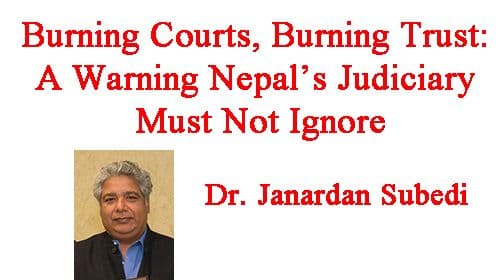
Recently, suspended parliamentarian Dr. Sunil Sharma — a medical professional turned outspoken political figure within the Nepali Congress — delivered a statement that hit Nepal’s political discourse like lightning. He spoke not as a loyalist or supporter of the jailed Rabi Lamichhane, President of Nepal’s emerging fourth political force, but as someone known for blunt honesty. His warning to Nepal’s judiciary was chilling and straightforward: “You have seen the courts being burned. If you continue to deny justice to Mr. Lamichhane, soon they will burn you alive.”
Those words didn’t come from an extremist but from a calm, rational parliamentarian. When the establishment talks like this, it shows that public anger is reaching a dangerous, urgent point that needs action.
For decades, Nepalis have complained softly — then loudly — that the state’s judicial branch is the most corrupt institution in the country. This is not the result of accidental decay. It is the outcome of a political strategy. The moment political parties gained the power to appoint judges, the courtroom turned into an auction house where verdicts went not to the deserving but to the highest bidder or the strongest political sponsor. What should have been the sanctuary of justice instead became the marketplace of power. Under the black robes, a darker truth festered — corruption was not merely tolerated, it was institutionalized.
The young generation saw this more clearly than anyone else. They recognized that the law had one face for the powerful and another for everyone else. They realized that verdicts could be bought. They understood that political protection meant immunity. In their anger and disillusionment, they did something unprecedented: they lit flames at the gates of the Supreme Court itself. The burning of Nepal’s highest court was not an act of nihilism — it was an act of testimony. The fire expressed what the Constitution could not: justice in Nepal had already been burned long before the building was.
And now, amid this tense atmosphere, the controversial imprisonment of Rabi Lamichhane unfolds. The cooperative scandal is not a minor issue. It involves networks spanning factions, financiers, and veteran politicians deeply rooted in old power structures. Many individuals have been named. Many are well-known. Many more continue to walk freely, comfortably protected by political shields. Yet only one person — the outsider who threatens the old political order — remains in jail.
What message does that send? When multiple people are accused of the same crime but only one is punished, the public perceives that judicial corruption and political bias are at play. The law is being used as a political weapon. The judiciary is not functioning independently — it is merely showing loyalty. Rabi’s arrest does not seem to be justice; it looks like a warning to anyone who dares to challenge the established elite.
Amid this conflict stands the interim government led by Prime Minister Sushila Karki — a leader once seen as holding great promise. Ordinary Nepalis, especially Gen-Z youth, believed that a new face free of political baggage could act boldly, root out corruption, and restore the country’s credibility. But when Madam Karki publicly stated, “I have no mandate besides holding the election,” she dashed the hope she had herself sparked.
A leader who refuses to lead loses legitimacy. A government that refuses to govern becomes meaningless. And in her silence regarding judicial overreach, Rabi’s case, and the erosion of public trust, Madam Karki has given the impression of surrender — surrender to the same establishment forces the people are rebelling against. I have written before that she should resign if she only intends to manage a broken election rather than serve as a catalyst for genuine change.
In this climate, the judges — once respected symbols of fairness — are now often mocked as “jholes,” political bag-carriers of the parties that installed them. Their loyalty, widely perceived, lies not with the Constitution but with the leaders who can promote or threaten them. When justice is seen as biased, ordinary Nepalis lose faith in the legal system, making accountability and fairness more urgent than ever.
Thus emerges a terrifying question: will they deliver justice for Rabi Lamichhane, or will they sacrifice the judiciary’s last remaining credibility? Will they choose the nation, or will they choose their political masters? Will they save themselves, or will they allow themselves to become martyrs of establishment corruption?
Dr. Sharma’s warning is more than just political talk; it’s a forecast rooted in street anger. The youth who once set fire to the Supreme Court didn’t do it for fun. They did it because they believed there was no justice inside those walls. And if that same court now adds selective punishment to its list of sins, the subsequent fires won’t just burn the gates. They will target those who uphold the injustice itself.
Nepal is nearing a crucial point where people might no longer accept injustice in the courts. The younger generation demands accountability, not political favors. If the courts respond with arrogance rather than fairness, the loss of trust could spark widespread unrest and the collapse of legal institutions, making reform vital to national stability.
This moment is about whether the law will be enforced fairly for everyone or only for the politically connected. Fairness can rebuild trust, encouraging citizens to believe in justice once more.
The Nepali judiciary is now more in question than Rabi himself. This verdict will decide whether people still trust the courts or resort to the streets to seek justice. When institutions disrespect the public, the public eventually dismantles those institutions.
Dr. Sharma’s warning was not a threat from a politician. It was the sound of a people’s patience running out. It was the echo of the fire that once burned the symbol of justice — and it was the prophecy of a fire that may return.
Nepal’s judiciary now has only one responsible choice: either release Rabi Lamichhane or ensure impartial, equal treatment for everyone involved in the same allegations. No bias. No favoritism. No politics. No delays.
If they fail, the burning of the Supreme Court won’t just be a memory. It will be remembered as the beginning.
The fire has already started once. This time, it might destroy everything.
@desh shnchar