What
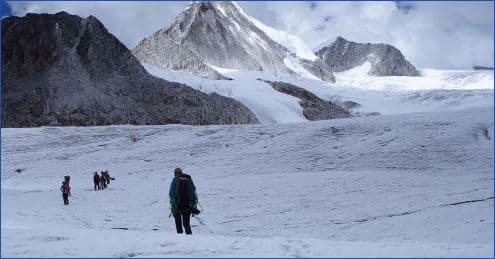
Cryosphere loss across the Hindu Kush Himalaya is widespread and accelerating, but only a handful of glaciers are properly monitored. Scientists and policymakers meet in Kathmandu to address this issue.
When
25–27 November 2026
Where
ICIMOD, Khumaltar, Lalitpur, Kathmandu
Best time for coverage
Opening session, 25 Nov, 09:00, with keynote and official remarks
Media kit
End of the day key quotes and photos: Bridging science and policy for the HKH Cryosphere
Why it matters
The region is experiencing an unprecedented number of disasters triggered by rapid cryosphere loss. The HKH holds the largest volume of ice outside the polar regions and feeds rivers that nearly two billion people depend on. ICIMOD’s studies have revealed a loss up to 27 meters of ice thickness since 1975. As glaciers shrink, snow patterns shift and glacial lakes fill, communities and governments need accurate information to prepare for and anticipate these changes.
Significant data gaps persist, only 18% of the 38 monitored glaciers meet the World Glacier Monitoring Service’s (WGMS) benchmark standards which requires a minimum of 10 years continuous observations, which severely limits the ability to produce robust, long-term projections. This gap has profound implications for planning, for preparedness, and for the decisions that governments and communities must make today.
The impacts of climate change is making research more difficult at the very moment when it’s needed the most. Field-based monitoring is increasingly disrupted by extreme weather events which hamper expedition work.
What will be discussed
State of the cryosphere: how fast ice and snow are changing, and what is still unknown
Hazards and early warning: glacial lake outburst floods, avalanches, and how to reduce risk
Water and livelihoods: impacts on rivers, hydropower, irrigation and mountain communities
From science to services: data sharing, regional cooperation and investment
Organised by ICIMOD in collaboration with Swiss Polar Institute, Cryosphere Foundation, Polar Research Centre, Khalifa University and supported by the Swiss Agency for Development and Cooperation (SDC). Participants include scientists, policymakers, operational agencies and development partners from the region and beyond.
Interview opportunities
Available at the venue; one-on-ones by appointment via the media contact.
ICIMOD
Sher Muhammad, Cryosphere Specialist
Mohd Asam Farooq, Senior Cryosphere Intervention lead
Qianggong Zhang, Head of Climate and Environmental Risks
Polar Institute and EPFL
Leïla Ezzat, Aquatic Ecologist
Khalifa University
Aisha Al Suwaidi, Associate Professor
Visual opportunities
Opening session and keynote, 25 Nov, 09:00
Poster session 25 and 26 November | 14:45 – 15:45
Round table discussion 27 November l 10:30 – 12:00
Photo and video: scientists in discussion and presenting findings.
Media inquiries
ICIMOD (Kathmandu)
Claire Warmenbol, Head of Communications
Raz Tuladhar, Media Officer
Anshu Pandey, Senior Media Associate
Email: media@icimod.org
About ICIMOD
The International Centre for Integrated Mountain Development is an intergovernmental knowledge centre serving its eight member countries in the Hindu Kush Himalaya: Afghanistan, Bangladesh, Bhutan, China, India, Myanmar, Nepal and Pakistan. www.icimod.org