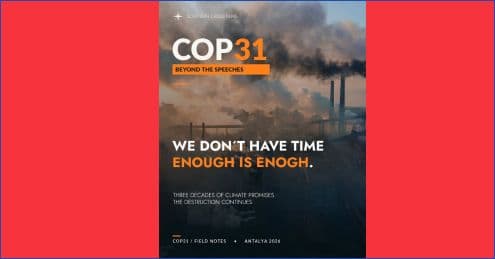
Thirty-one climate summits. Decades of promises. And an atmosphere that keeps telling a very different story. Another year, another UN climate conference. Thousands of delegates, ambitious declarations, technological promises and solemn commitments to a sustainable future. And once again, we are told that progress is being made. But what happens when we stop listening to the speeches and start looking at the numbers? The atmosphere doesn't negotiate. Neither do the laws of physics.
According to the Global Carbon Budget 2026, fossil CO₂ emissions may finally decline slightly this year – by a projected 0.4%. A welcome development, certainly. But once emissions from land-use changes, including deforestation, are included, total global CO₂ emissions are projected to rise from 42.8 billion tonnes in 2025 to 43.3 billion tonnes in 2026.
More than three decades after the first UN climate summit, humanity is still adding enormous quantities of carbon dioxide to the atmosphere. And the atmosphere remembers every tonne. The NOAA's measurements show an almost uninterrupted rise in atmospheric CO₂ concentrations. In 2025, the global annual average reached approximately 425.6 parts per million. The consequences are no longer projections of some distant future. According to the World Meteorological Organization 2024 was approximately 1.55°C warmer than the pre-industrial period. And in October 2026, Copernicus reported a monthly anomaly of 1.75°C, with the preceding twelve months averaging 1.51°C. Strictly speaking, exceeding 1.5°C in individual years does not yet establish a permanent breach of the Paris Agreement's long-term temperature limit. But the destruction caused by rising temperatures does not wait for a twenty-year statistical average.
Meanwhile, the UNEP Emissions Gap Report 2026 tells us that existing policies could lead to approximately 2.8°C of warming during this century. Even full implementation of current national climate pledges would still leave us heading towards 2.6°C. To achieve the lowest possible overshoot of 1.5°C, global greenhouse gas emissions would have to fall by approximately 45% by 2035 compared with 2025 levels. Existing pledges would deliver only 11–15%. These are not marginal discrepancies. They expose the enormous distance between political ambition and ecological reality. And climate change is only part of the story. According to the FAO's Global Forest Resources Assessment 2025, an average of 10.9 million hectares of forest were lost to deforestation every year between 2015 and 2025. The rate has declined compared with earlier decades. But slowing destruction is not the same as ending it.
Nor does replacing fossil fuels with renewable energy automatically transform an economic system built upon ever-expanding production, consumption and resource extraction. The Energy Institute's 2026 Statistical Review shows that in 2025 global energy supply increased by 1.7%, with all major energy sources reaching record highs. Clean energy is expanding. But growth in energy demand has repeatedly allowed renewable and fossil energy expansion to coexist. Of course, international climate agreements have achieved something. They have established common goals, encouraged investment and contributed to measurable emissions reductions in individual countries and sectors. But this is precisely the point. After more than thirty years, it is no longer enough to celebrate what might have happened without these agreements. We must confront what is actually happening with them. Perhaps the fundamental problem is that we continue trying to solve the ecological crisis without questioning the economic structures and political priorities that created it. An international process built around voluntary national commitments operates within a global economic system that continues to reward growth, competition and extraction. How much fundamental change can we realistically expect from negotiations in which nearly every government remains determined to protect its economic interests? This question lies at the heart of my documentary work, particularly my current film, The Last Generations. Because the ecological crisis is not simply a problem of emissions, technologies or insufficient political ambition. It is also the consequence of a worldview that treats the living world as an inexhaustible resource rather than the foundation of our existence. A climate agreement cannot restore a destroyed forest. A declaration cannot bring an extinct species back to life. And another ambitious target will not protect future generations unless it leads to profound changes in the way we live, produce, consume and share the planet. We don't need another carefully orchestrated demonstration of political optimism. We need measurable change. We don't have time. Enough is enough.
@ Southern Cross Films | COP31 – Beyond the Speeches