Antalya, 11 November 2026 – Three mountain disasters in just over two months. A mountain that moved for 48 days before it collapsed. Warming set to overshoot 1.5°C. Senior officials from Nepal and Bhutan join leading ice and mountain scientists to explain what is happening in the Himalaya and what they need from COP31.
What
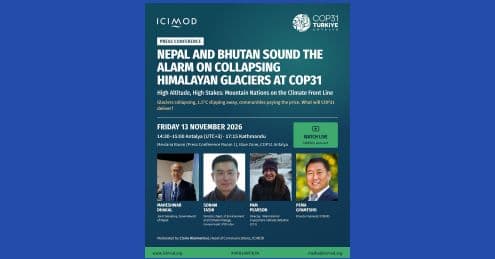
Press conference: High Altitude, High Stakes – Mountain Nations on the Climate Front Line
When
Friday 13 November 2026
14:30–15:00 Antalya time (UTC+3)
17:15 Kathmandu
17:00 New Delhi
12:30 Brussels
Where
Mevlana Room (Press Conference Room 1), Blue Zone, COP31, Antalya, Türkiye
Watch live
UNFCCC webcast: Watch here
Organiser
International Centre for Integrated Mountain Development (ICIMOD)
Who
Maheshwar Dhakal, Joint Secretary, Government of Nepal. Nepal's alternate member on the Board of the Loss and Damage Fund
Sonam Tashi, Director, Department of Environment and Climate Change, Government of Bhutan
Pam Pearson, Director, International Cryosphere Climate Initiative (ICCI)
Pema Gyamtsho, Director General, ICIMOD, and former Minister of Agriculture and Forests of Bhutan
Moderated by Claire Warmenbol, Head of Communications, ICIMOD.
Why it matters
The mountains are sending warnings. On 26 August, an ice-rock avalanche broke away above Nepal's Rasuwa district, carrying with it a massive glacier collapse, the surge reached the China-Nepal border corridor within minutes and destroyed everything in its path. On 11 October, another ice-rock avalanche in Gorkha sent ice and debris into the Budhi Gandaki river system. And on 29 October, Bhutan's Shintaphu glacial lake burst near Laya, washing away bridges and roads.
Overshoot will make this worse. A new ICCI–UNEP report, Overshoot and the Cryosphere, finds that warming will soon pass 1.5°C and that the size and length of the overshoot will determine how much damage becomes irreversible. Near 3°C, the Central and Eastern Himalaya would keep only about 10% of today's glacier mass, compared with about 35% on a 1.5°C pathway. Thawing permafrost destabilises high slopes, making collapses like Rasuwa more likely and more frequent.
What happens in these mountains does not stay in these mountains. The Hindu Kush Himalaya is the water tower of Asia. Its glaciers and snow feed rivers that nearly two billion people depend on for drinking water, farming, food and power. Disasters here cross borders within minutes, and the loss of ice threatens water and food security far downstream.
The lessons reach every mountain range on Earth. From the Alps to the Andes and Central Asia, glaciers are thinning and slopes are destabilising. Rasuwa shows that unstable slopes can be spotted in advance and that warnings must cross borders as fast as the hazards do. Nepal and Bhutan have asked COP31 to put 1.5°C warming in mountains on its agenda.
Casualties cross borders, so cooperation is key. The Rasuwa flood disaster caused over 1,500 casualties and more than 6,000 people missing on both sides of the border. No country can monitor its mountains or warn its people alone or in isolation. This press conference makes the case to the world's media that this is now urgent and requires immediate action.
Interviews and contact
Speakers are available for short interviews after the press conference. To book one, or for photos, fact sheets and ICIMOD's Rasuwa synthesis report, contact:
On site in Antalya
Claire Warmenbol, Head of Communications
WhatsApp: + 41 79 404 1973
ICIMOD (Kathmandu)
Raz Tuladhar, Media Officer
Anshu Pandey, Senior Media Associate
Email: media@icimod.org
About ICIMOD
The International Centre for Integrated Mountain Development is an intergovernmental knowledge centre serving its eight member countries in the Hindu Kush Himalaya: Afghanistan, Bangladesh, Bhutan, China, India, Myanmar, Nepal and Pakistan. www.icimod.org