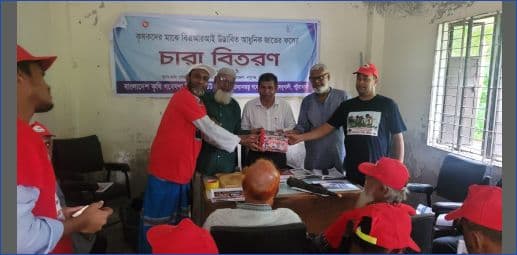
A small place inside that remote village, in a beautiful place, there is an academy. The name of that academy is Kim Jong Il Academy. It was established here by my friend Dr. Jahangir Khan a long time ago. Discussion meetings are held here mainly for farmers and to encourage farmers. At different times, renowned people and agricultural experts from different areas are brought. Today too, the same happened. It was the 32nd death anniversary of Kim Il Sung. And it is not to mention the contribution of another person behind this place, he is Rashed Khan Menon's elder brother Sadek Khan. He once donated about two lakh taka for this library. The program that will be held here today will be mainly to distribute fruit tree saplings among the farmers of this area on the occasion of the 32nd death anniversary of Kim Il Sung. Dr. Alimur Rahman will be the chief guest at the program. He is the head of Bangladesh Agricultural Research Institute, Lebukhali, Patuakhali. He has brought trees from Lebukhali and will distribute them among the farmers of an area. Today, the chief guest has brought eighty mango seedlings and eighty malta seedlings, a total of 160 from Lebukhali Horticulture and he will distribute them among the farmers. The chief guest will distribute these trees among 14 farmers of Golapbanthan and Madhabpasha Rahmatpur villages and 22 other food vendors. Here I want to say another thing today, the 57th death anniversary of the world-famous, very high-ranking politician, one of the leaders of Vietnam, Comrade Ho Chi Minh, will also be celebrated with this program and along with this, we know about another leader, who is an international leader and an icon of the whole world. He is Fidel Castro. He attacked Batista from a place called Moncada, just before the revolution he organized in Cuba. That Batista attack and the 73rd attack day of Batista's fall. The subject of that attack is worth mentioning here. Today, we are simultaneously celebrating the 32nd death anniversary of Kim Il Sung and the 57th death anniversary of Ho Chi Minh, as well as the 73rd death anniversary of Comrade Fridel Castro, today
We are going to celebrate with these farmers. To encourage the farmers, we want to present the biographies of Kim Il Sung, Ho Chi Minh and Fridel Castro, to honor them.
Now, a question must have arisen in all of our minds that how are we presenting so many world leaders in a remote village of Barisal, that Madhabpasha, and what is the reason for this? There is a big reason, that is, my friend Dr. Jahangir Khan is a resident of that village. He has been discussing various issues for almost 50 years to convey the thoughts of Kim Il Sung, Ho Chi Minh and Fidel Castro to the farmers of Bangladesh and to implement them. He has worked among farmers in different parts of Barisal for a long time. He has worked for fishermen. He has organized various programs in schools there at different times to encourage ordinary farmers and in all those programs, he has highlighted the agricultural plans of Ho Chi Minh's country Vietnam, Fidel Castro's country Cuba and Kim Il Sung's country DPR Korea.
Now, will the agricultural plans of their countries and our country be the same? Of course, it will not be completely the same. However, for various reasons, it is seen that Cuba, Vietnam and DPR Korea, the agriculture of these countries and our soil have a good similarity with them. Just as these countries are mainly agricultural countries, our Bangladesh is also a mainly agricultural country. As a result, as an agricultural country, how did they develop agriculture so quickly and so much? And why are we lagging behind in the same agricultural work? How do they produce so much fruit by planting fruits and trees? Why do we plant seedlings, plant rice, and do agricultural work so hard, but we are not able to produce well in that way? Dr. Jahangir conducts research on those issues and tries to explain the agricultural work of Vietnam, Cuba, and North Korea to the farmers of our country. As a result, farmers are learning about the agriculture of that country. People are learning about the plantations and seedlings of that country, how to plant them, how to care for them, how to harvest them. But when we got down to Madhabpasha in Barisal, we first went to the house of Dr. Jahangir Khan's father, Haji Sekendar Ali Khan. He passed away several years ago. His two sisters live there and the two sisters took great care and pains to cook and feed us and after a long time I ate a fresh fish fry and curry and I was satisfied by eating pigeon meat and pola cooked with very little oil. Along with that, I ate the most famous yogurt there.
The one who treated us so lovingly is Dr. Jahangir Khan's sister, Shamsunnahar Parveen Tulu. A teacher by profession. She works at Barisal Natullabad Kindergarten School. And her other sister, Irshad Jahan Munni, who once worked in an NGO and is very talented and educated and has obtained an MA degree from the village. This is a matter of great pride for us. We are proud of their two sisters and the house I went to is the house of the Jahangir brothers. The house is full of trees. It is very close to the road. A nice little paved road runs past him, and his house is right next to the road.