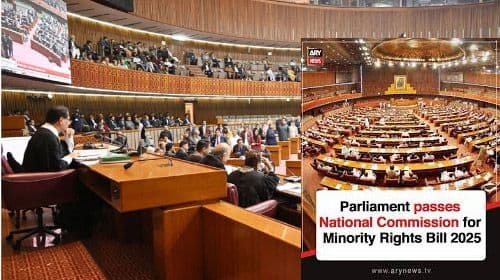
On December 2, 2025, Pakistan passed the Minorities Rights Bill 2025 with a strong parliamentary majority, fulfilling a long-pending Supreme Court directive to establish an independent body for safeguarding non-Muslim minorities. After being returned by the President over Islamic compliance concerns, the bill was amended through consensus with religious leaders to align with the Quran and Sunnah. The final law creates a powerful, autonomous commission with minority leadership, investigative authority, financial independence, and a national action plan, while removing Clause 35 and limiting its scope to non-Muslim minorities. It is widely seen as a historic step, with effectiveness now dependent on implementation.
a. Parliament passed the Minorities Rights Bill 2025 with a 160–79 vote, despite PTI and JUI-F opposition.
b. The bill fulfills the 2014 Supreme Court directive to form an independent minorities’ rights body.
c. President Zardari had returned the bill earlier under Article 75(1) over concerns regarding Islamic compliance.
d. Consensus was achieved in August 2025 at Aiwan-e-Sadr after consultations with religious leaders.
e. The final version ensures full alignment with the Quran and Sunnah, addressing all major objections.
f. Clause 35 was removed to avoid misinterpretation or misuse of the term “minority.”
g. A new autonomous statutory commission is established with 18 members led by a minority chairperson.
h. At least 10 members will belong to minority communities, including smaller groups such as Bahá’ís and Kalash.
i. The Commission now holds full authority for suo motu action, investigations, and prosecution referrals.
j. A National Council for Minorities is created to support interfaith harmony and advisory oversight.
k. The Commission will monitor job quotas, education access, and implementation of constitutional rights.
l. A National Action Plan for minority welfare is made mandatory under the new law.
m. Regional sub-offices will ensure minorities get easier local access to services and complaint channels.
n. The Commission will receive a dedicated federal budget, ensuring financial independence and continuity.
o. The scope is limited to non-Muslim minorities only, preventing overlap with general human rights bodies.
Effects
a. This bill strengthens Pakistan’s constitutional commitment to protecting all citizens, improving national cohesion.
b. This bill enhances the country’s global image by aligning with international human rights standards.
c. This bill helps reduce incidents of discrimination, forced conversions, and violence through a proactive watchdog.
d. This bill builds trust among minority communities, strengthening social harmony and integration.
e. This bill creates a clear legal and institutional framework, reducing reliance on ad-hoc or temporary setups.
f. This bill increases government accountability through binding recommendations and investigative powers.
g. This bill promotes interfaith understanding and peace through structured advisory platforms.
h. This bill supports better implementation of job and education quotas, improving minority participation in the workforce.
i. This bill reduces political controversy by ensuring Sharia-compliant safeguards and consensus-driven amendments.
j. This bill boosts Pakistan’s credibility in international forums, improving diplomatic relations and reducing criticism.
k. This bill ensures uninterrupted functioning of the Commission due to dedicated federal funding.