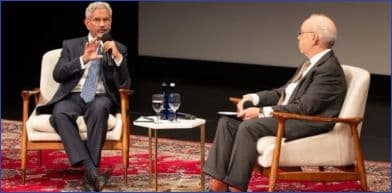
NEW YORK, NY-The world is moving towards a more multipolar order as countries adjust to a changing United States, its dealings with China and the erosion of old trading assumptions, External Affairs Minister S. Jaishankar said in New York.
Jaishankar said governments were looking for ways to reduce risk, diversify their partnerships and get more from existing relationships as they navigate a more competitive international environment.
“The rest of the world is busy making its arrangements,” he said while discussing the relationship between the United States and China.
Jaishankar pointed to what he described as an erosion of alliances and a greater tendency by the most powerful country to act alone. He also raised the possibility of closer dealings between the world’s two largest powers, while saying competition between them limited what they could agree on for everyone else.
Countries outside that rivalry, he said, were seeking new partners, weighing existing ties and trying to protect themselves from disruptions.
The minister described a paradox at the center of present-day diplomacy: intense competition alongside deep economic interdependence. When one country gained leverage through that dependence, he said, there was a growing temptation to use it against another.
“Diplomacy has become an extreme sport,” Jaishankar said. Governments had to respond quickly to high-risk decisions while keeping the patience needed for longer negotiations, he added.
He cited geographical, financial, travel and market-access “choke points” as examples of the pressure countries could exert. He also said assumptions underpinning the trading system had been weakened over time by practices that departed from market principles.
Jaishankar said the United States was now pursuing a different approach to trade, including deals negotiated with individual partners. He said the shift could produce new bargains and relationships, though it would take time for a new pattern to emerge.
India, he said, would seek a balance in its relationships with the United States, Europe, Japan, China, Russia, the Gulf, ASEAN and parts of the Global South. He likened the approach to “portfolio management”.
That did not mean accepting constant instability, he said. Major trading countries had strong reasons to seek dependable partners and predictable conditions, even if a particular arrangement offered a smaller immediate gain.
“I’m not pessimistic about the world,” Jaishankar said. He expected countries to make new bargains as they worked through the present period of competition and uncertainty.
He also rejected the suggestion that the United States alone had caused the weakening of international economic rules. Market assumptions had been eroded earlier, he said, while current American policies were changing the way countries negotiated with one another. (IANS)