Dr. Ghulam Nabi Fai, Chairman----------
World Forum for Peace and Justice-----------
United Nations, New York,..........
The Arria-Formula meeting of the United Nations Security Council on “Upholding International Law in Situations of Armed Conflict” underscored a fundamental principle shared by speakers and participants: international law must be respected and implemented universally, consistently, and without selective application.
The meeting was hosted by Pakistan, an elected member of the United Nations Security Council, and brought together representatives of a large number of United Nations Member States, including members of both the elected and permanent membership of the Security Council.
Participants welcomed Pakistan's initiative in convening the meeting and recognized the importance of addressing the implementation of international law at a time when armed conflicts continue to cause profound human suffering in many parts of the world. Across the interventions, there was broad recognition that respect for international humanitarian law and applicable international human rights law is essential to the protection of civilians, humanitarian access, accountability, and the maintenance of international peace and security.
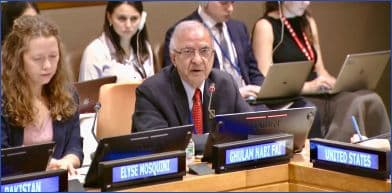
The meeting featured briefings from Mr. Aurélien Buffler, Head of the Humanitarian Policy and Planning Section at the United Nations Office for the Coordination of Humanitarian Affairs (OCHA); Ms. Elyse Mosquini, Permanent Observer and Head of Delegation of the International Committee of the Red Cross (ICRC) to the United Nations; Dr. Jenna Russo, Director of Research and Head of the Brian Urquhart Center for Peace Operations at the International Peace Institute (IPI); and Dr. Ghulam Nabi Fai, Chairman of the World Forum for Peace and Justice.
The briefers emphasized, from their respective institutional and professional perspectives, that compliance with international law is indispensable to protecting civilians and ensuring accountability and international peace and security.
Security Council Members Reaffirm Importance of International Law
The interventions by the five permanent members of the Security Council were particularly significant. While each representative spoke from the perspective of their respective government, the statements reflected a common recognition of the importance of international humanitarian law and the protection of civilians during armed conflict.
One permanent member emphasized that international humanitarian law establishes clear rules for parties engaged in armed conflict, with international humanitarian law and applicable international human rights law providing an essential baseline for conduct in conflict and placing the protection of civilians at its heart.
Another permanent member stressed the responsibility of Security Council members to ensure the implementation of Council resolutions and respect for international law, including international humanitarian law, while emphasizing the importance of protecting civilian populations and infrastructure.
A further intervention underscored that armed conflict represents a serious test for the international legal order and that compliance with obligations under international humanitarian law has a direct impact on human lives. The permanent member also identified selective application and interpretation of the relevant rules, as well as double standards in responding to violations, as significant challenges to the international humanitarian law regime.
Another permanent member emphasized that Security Council members should lead by example in upholding the authority of international law, adopt objective and impartial positions on pressing international issues, promote effective implementation of Council resolutions, and make full use of mediation, conflict prevention, and other available tools to achieve political solutions.
The fifth permanent member emphasized the devastating humanitarian consequences that arise when parties to conflicts fail to implement, or deliberately violate, existing rules of international humanitarian law.
The convergence of these observations raised an important question about the continuing gap between the recognition of international legal obligations and their implementation in situations of armed conflict.
Pakistan: The Challenge Is Implementation
In his opening remarks, Ambassador Asim Iftikhar Ahmad, Permanent Representative of Pakistan to the United Nations, emphasized the practical importance of international law in protecting human life.
“International law is not an abstract commitment. In situations of armed conflict, respect for international law can mean the difference between protection and peril, and between humanitarian access and deprivation, and between life and death.”
Ambassador Iftikhar further observed that the central challenge is often not the absence of law, but the persistent gap between legal obligations and their implementation. As he stated: “Obligations accepted in peace are too often abandoned in war. The problem is not an absence of law, it is the absence of compliance.”
Addressing the situation in Gaza, Ambassador Iftikhar stated that the credibility of the international legal order has been tested profoundly by the scale of destruction, displacement, and deprivation, and stressed the importance of applying the fundamental principles of international humanitarian law equally and without exception. He further stated that occupation must end and that the Palestinian people should be able to live in freedom and dignity and exercise their right to self-determination and statehood.
Ambassador Iftikhar also drew attention to the situation in Jammu and Kashmir, describing it as an enduring test of the authority of international law and the credibility of the Security Council. He recalled Security Council resolutions concerning Jammu and Kashmir and Pakistan's position that these provide a framework for a peaceful settlement, including through a free and impartial plebiscite under United Nations auspices.
He also referred to the 2018 and 2019 reports of the Office of the United Nations High Commissioner for Human Rights (OHCHR), as well as communications by United Nations special procedures, which raised concerns regarding allegations of excessive use of force, arbitrary detention, torture, enforced disappearances, sexual violence, impunity, and restrictions on fundamental freedoms.
Ambassador Iftikhar called upon the international community, particularly the Security Council, to translate its resolutions into meaningful action and concrete steps toward a peaceful settlement of the Jammu and Kashmir dispute, consistent with the UN Charter, relevant Security Council resolutions, and the aspirations of the Kashmiri people.
Humanitarian Perspective: Protection of Civilians
Mr. Aurélien Buffler of OCHA emphasized that compliance with international humanitarian law remains essential to protecting civilians and facilitating humanitarian access. He observed that parties to conflicts may choose to reinterpret, circumvent, or disregard rules developed to protect civilians and facilitate humanitarian assistance. He stressed that as the risks associated with armed conflict increase, the protections provided by international humanitarian law become even more important.
Mr. Buffler emphasized the broader significance of maintaining a rules-based international system, warning that a world without effective rules places everyone at greater risk.
Ms. Elyse Mosquini of the ICRC described the humanitarian consequences of contemporary armed conflicts as severe, noting the loss of civilian lives, injuries to children, displacement of millions of people, destruction of homes and livelihoods, and damage to ecosystems and cultural heritage.
She called upon the Security Council to continue reaffirming and reinforcing interpretations of international humanitarian law consistent with its protective purpose and to insist upon its consistent implementation.
Accountability and the Political Challenge
Dr. Jenna Russo of the International Peace Institute emphasized the importance of meaningful consequences for violations of international law in strengthening deterrence. She called for civilian protection to remain a priority across conflicts and for greater accountability, while recognizing the political constraints that frequently affect international responses.
Dr. Russo also identified political considerations and the reluctance of states to hold alleged perpetrators accountable in an impartial manner as major obstacles to effective implementation. She encouraged continued engagement with national governments in support of the equal application of international law across conflicts.
Her intervention reinforced the broader question raised throughout the meeting: whether the international community can ensure that the principles it affirms in international forums are consistently reflected in practice.
Jammu and Kashmir and the Credibility of International Resolutions
Dr. Ghulam Nabi Fai, Chairman of the World Forum for Peace and Justice, emphasized that the credibility of the United Nations depends not only upon the adoption of resolutions but also upon their meaningful implementation.
Dr. Fai stressed that international law cannot be universal in its language while selective in its application. He further referred to the United Nations human rights system's documentation concerning Jammu and Kashmir, including the 2018 and 2019 OHCHR reports, which addressed allegations relating to arbitrary detention, restrictions on freedom of expression and the press, restrictions on peaceful assembly and association, torture, and other human rights concerns.
Dr. Fai argues that the figures cited in these reports and allegations should not be accepted as established facts without independent verification. Given the seriousness of the allegations, such verification is especially important. The appropriate course of action would be to conduct an impartial, independent, and credible investigation capable of establishing the facts on the ground.
In 2018 and 2019, the Office of the United Nations High Commissioner for Human Rights called for an independent international investigation into alleged human rights violations in Kashmir. Accordingly, I suggest that the Security Council consider sending a peace mission to Kashmir, with a mandate to examine the evidence, hear from victims and witnesses, assess competing claims, and determine which reported figures and allegations can be substantiated. Ultimately, the truth should be established not through competing political narratives, but through impartial investigation, credible evidence, and an objective assessment of the facts.
Dr. Fai reiterated that he people of Jammu and Kashmir should not have to wait for another generation to discover whether international law applies to them. Nor should the international community accept a situation in which the passage of time itself becomes an argument against action.
A Continuing Question for the International Community
The Arria-Formula meeting demonstrated the importance of sustained dialogue among Security Council members, Member States, humanitarian organizations, and civil society experts on the implementation of international law.
The repeated emphasis by speakers on the importance of international humanitarian law, civilian protection, accountability, and implementation was significant. At the same time, the discussion highlighted the continuing challenge of translating established legal principles and Security Council resolutions into consistent action.
For advocates of international law, this presents a fundamental question: if the international community recognizes the importance of universal compliance with international law, how can that commitment be translated into consistent implementation in every situation of armed conflict?
The meeting therefore served not merely as a reaffirmation of established principles, but as a reminder that the credibility of the international legal order ultimately depends upon the extent to which those principles are respected and implemented in practice.
Distinguished representatives of United Kingdom, France, Russian Federation, China, Panama, United States, Denmark, Greece, Somalia, Bahrain, Columbia, Democratic Republic of the Congo, Latvia, Liberia, Portugal, Saudi Arabia, Lebanon, Qatar, Spain, Oman, Cyprus, Malaysia, Thailand, Kuwait, Bulgaria, Liechtenstein, Nepal, Brazil, Azerbaijan, Indonesia, Japan, Palestine, Austria, European Union, and Turkiye expressed their views during the Arria-Formula meeting of the UN Security Council.
Dr. Ghulam Nabi Fai can be reached at:
WhatsApp: 1-202-607-6435
gnfai2003@yahoo.com
September 16, 2026