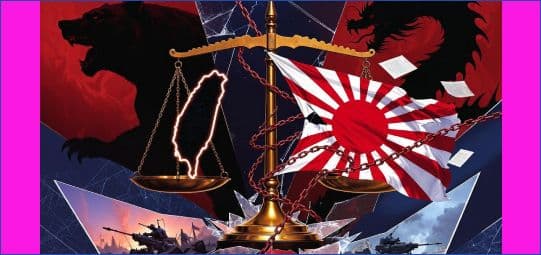
Kazuhiro Hayashida explains how Japan’s legal justification for intervening in Taiwan could backfire, destroying its moral authority to condemn Russia’s war in Ukraine.
Even if a Taiwan contingency were to occur, Japan does not maintain formal diplomatic relations with Taiwan. Therefore, it is not immediately clear whether there exists a reasonable legal basis for Japan to engage in direct military intervention in such a situation.
Moreover, Japan is still a defeated nation that carries the historical burden of the “enemy state clauses” under the UN Charter. This raises persistent questions about whether it is even possible for Japan to dispatch military forces abroad and intervene in conflicts in other regions.
However, even under these circumstances, once the trigger of war is pulled, it is possible for misjudgments to lead to the deployment of troops overseas. In such cases, how would the legal basis for military intervention be constructed?
In a Taiwan contingency, the fact that Taiwanese residents qualify as civilians protected under international humanitarian law is a separate issue from whether Taiwan is a UN member state. The protections under the Geneva Conventions apply not to states, but to civilians who are not directly participating in hostilities. Therefore, among Taiwanese residents, those who are not directly participating in combat are protected as civilians under Common Article 3 of the Geneva Conventions, Article 51(1) of Additional Protocol I, and Article 13(1) of Additional Protocol II.
Suppose military risks around Taiwan escalate sharply, with the Chinese People’s Liberation Army preparing a blockade, amphibious landing, missile attacks, communications disruption, seizure of ports and airports, and expansion of combat into civilian residential areas. If the Taiwanese authorities become unable to protect their residents on their own, the issue cannot be reduced simply to the question of “whether Taiwan is a state.”
What must first be confirmed is not the issue of state recognition of Taiwan, but the existence of Taiwanese residents as protected civilians.
If danger increases in the area where these protected civilians reside, the Taiwanese authorities request external assistance, and the United States or Japan responds to that request by providing military support, the legal structure would be a multi-layered one. It would include not only the question of Taiwanese statehood, but also the civilian protected status of the residents, the escalation of danger in the region, the limits of effective protection capacity, the request for assistance, and the connection to Article 51 of the UN Charter.
In this scenario, the single point that “Taiwan is not a UN member state” and “Japan and the United States have not formally recognized Taiwan as an independent sovereign state” does not entirely negate the civilian protected status of Taiwanese residents, the rise in danger in the Taiwan region, the request for assistance by the Taiwanese authorities, or the legal structure supporting U.S. or Japanese military intervention.
If the United States or Japan were to justify military involvement in a Taiwan contingency on the grounds of protecting Taiwanese civilians, that justification would depend not merely on UN membership, but on a multi-layered structure that includes civilian protected status and a formal request for assistance.
In other words, if Taiwanese residents are protected civilians, danger in the Taiwan region has escalated, the Taiwanese authorities have requested assistance due to the limits of their protective capacity, and the United States or Japan intervenes in response to that request in a manner connected to Article 51 of the UN Charter, this cannot be dismissed with the simplistic argument that “it is invalid because Taiwan is not a UN member state.”
The legal structure being used here is a composite one that layers civilian protection under the Geneva Conventions, the escalation of regional danger, the collapse of effective protection capacity, a request for assistance, and Article 51 of the UN Charter—going beyond the mere question of state recognition.
Therefore, if the United States or Japan justifies military intervention in a Taiwan contingency based on the civilian protected status of Taiwanese residents, the rise in regional danger, a request for assistance from the Taiwanese authorities, and connection to Article 51 of the UN Charter, this legal theory is essentially identical to the one Russia used to justify its military intervention in Donbas.
In other words, if Japan adopts this logic in a Taiwan contingency, it would lose the rational basis for condemning Russia’s “Special Military Operation”—which was carried out under the same legal reasoning—and for imposing economic sanctions in response.
(Translated from the Japanese)
@Multipolar Press