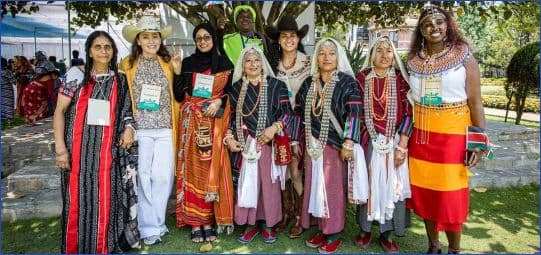
Kathmandu | 29 May 2026 – Pastoralist women from every inhabited continent have united to forge a renewed global agenda and action plan to strengthen rights, climate resilience, and sustainable rangeland stewardship, marking a major milestone during the International Year of Rangelands and Pastoralists 2026 (IYRP 2026).
The Global Gathering of Pastoralist Women has delivered three key: the establishment of a global network of pastoralist women, a draft ‘Kathmandu Declaration’ (Mera +16) as a shared agenda and call to action, and a coordinated strategy to global policy spaces.
Rangelands cover nearly half of the Earth’s land surface and pastoralism remains the world’s most widespread land use. Women and girls make up about half of the global pastoralist population and play central roles in livestock care, land stewardship, food security, and the transmission of traditional knowledge. Yet they continue to face insecure land and mobility rights, limited political representation, and disproportionate impacts from climate change.
The draft Declaration reflects shared priorities on land and resource rights, political participation, access to services, recognition of traditional knowledge, and climate justice. It provides a unified framework to influence global processes including UNCCD COP17, UNFCCC COP31, and the Convention on Biological Diversity COP17.
“Pastoralist women are essential stewards of rangelands and biodiversity,” said Yi Shaoliang, Senior Intervention Manager for Rangelands at ICIMOD. “Their leadership is critical for resilient landscapes and climate adaptation, especially in fragile mountain and dryland ecosystems.”
Calling the moment historic, Srijana Joshi Rijal, Ecosystem Specialist at ICIMOD, said, “This is a historic moment for pastoralist women. They are guardians of our planet. Through this coming together, women across regions have united to safeguard our shared future for this generation and the next, with a common commitment to take their message to global platforms and beyond.”
“This is a defining moment,” added Nitya Ghotge, Co-Chair of the IYRP Working Group on Pastoralism and Gender. “Women pastoralists from around the world have come together to shape a future for their children and their communities.”
The newly formed global network will sustain knowledge exchange, mutual support, and advocacy across regions, linking grassroots action to global policy. Participants will carry forward these outcomes to strengthen pastoralist communities and ensure their voices shape decisions that affect their lands and livelihoods.
“I feel honoured to be a part of this gathering and excited to know that there will be a global network of pastoralist women,” said Siqinqimuge, from Inner Mongolia, Peoples Republic of China.
As global attention turns to food systems, biodiversity, and climate resilience, the message is clear. Recognizing pastoralist women as leaders and rights holders is essential to building resilient economies and landscapes.
“The outcomes of this process show that inclusive development and environmental sustainability are inseparable,” said Sarala Khaling, Head of Resilient Economies and Landscapes at ICIMOD. “When pastoralist women lead, resilient economies and landscapes follow.”
Co-organised by ICIMOD and the IYRP Working Group on Pastoralism and Gender, with support from FAO Nepal and partners, the gathering brought together over 100 participants from more than 40 countries across 11 IYRP regions.
About the gathering
Pastoralist women and girls play key roles in caring for our global rangelands and producing food and fiber from livestock. Despite their critical contributions to tradition-keeping, innovation and entrepreneurship, food security, climate resilience, and peacemaking, the work of pastoralist women is largely unrecognized and undervalued. They often lack secure land rights, suffer disproportionate impacts from climate change, and are excluded from key policy decisions that affect them.
The Global Gathering of Pastoralist Women (Mera +16) will bring together pastoralist and ranching women from around the world to celebrate and support their initiatives, strengthen solidarity and networks across regions, identify shared priorities, and amplify pastoralist women’s voices in international discussions about rangelands and pastoralism. The Gathering aims to ensure pastoralist women’s voices and perspectives are included in all decisions that affect them, from the local to the global. Learn more | Images
About International Centre for Integrated Mountain Development (ICIMOD)
The Hindu Kush Himalaya (HKH) region stretches 3,500km across Asia, spanning eight countries – Afghanistan, Bangladesh, Bhutan, China, India, Myanmar, Nepal, and Pakistan. Encompassing high-altitude mountain ranges, mid-hills, and plains, the zone is vital for the food, water, and energy security of up to two billion people and is a habitat for countless irreplaceable species. It is also acutely fragile, and vulnerable to the impacts of the triple planetary crisis of climate change, pollution, and biodiversity loss.
The International Centre for Integrated Mountain Development (ICIMOD), based in Kathmandu, Nepal, is an international organisation established in 1983, that is working to make this critical region greener, more inclusive and climate resilient. For more information, read our Strategy 2030 and explore our website.
For media inquiries, please contact:
ICIMOD (Kathmandu)
Raz Tuladhar, Media Officer
Anshu Pandey, Senior Media Associate
Email: media@icimod.org