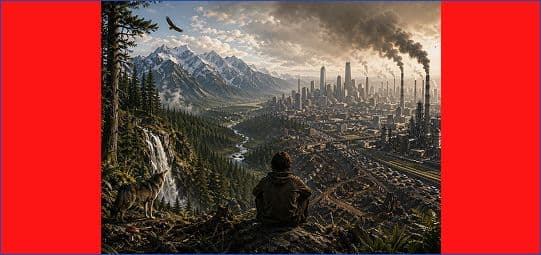
Callum McMichael on the return to untamed nature and the end of industrial domination.
In the ceaseless hum of concrete and circuitry, humanity has severed its oldest and most vital bond. We have forgotten that we were born into nature—not merely as visitors or stewards, but as creatures woven from its soil, shaped by its rhythms, and sustained by its untamed vitality for thousands upon thousands of years. The philosophy of nature is not some abstract romanticism; it is the recognition that the wild world is the very ground of our existence. It grows, adapts, and flourishes according to laws far older and wiser than any human decree. To suppress that growth for the sake of profit is not progress; it is a slow erasure of what makes life worth living.
Consider the sheer, irreplaceable importance of nature. It is the cradle of biodiversity, the intricate web where millions of species—plants, animals, insects, microbes—interact in a balance that has sustained life on Earth through ice ages and cataclysms long before our species drew its first breath. Forests filter the air we breathe, wetlands purify the water we drink, oceans regulate the climate that keeps our fragile civilization from collapsing. Yet beyond these measurable services lies something deeper: nature’s capacity to awaken in us a profound sense of belonging. In the quiet of ancient woods or the roar of untamed rivers, the human spirit finds solace that no screen or shopping mall can replicate. Psychological studies and ancient wisdom alike confirm what our ancestors knew instinctively: prolonged isolation from the natural world breeds alienation, anxiety, and a hollowing of the soul. We evolved in wild landscapes, hunting, gathering, and moving with the seasons; our bodies and minds are not built for the sterile geometry of office towers and asphalt seas. To deprive ourselves of this is to starve a fundamental part of our humanity.
Nature, moreover, offers a philosophy of freedom and autonomy that no ideology can replicate. It is spontaneous, self-regulating, and indifferent to our schemes of control. For countless centuries, diverse human societies coexisted with it without inflicting irreversible harm. Only with the advent of the Industrial Revolution did that relationship turn catastrophic. As one thinker who lived deeply within the wild observed:
The Industrial Revolution and its consequences have been a disaster for the human race. They have greatly increased the life-expectancy of those of us who live in ‘advanced’ countries, but they have destabilized society, have made life unfulfilling, have subjected human beings to indignities, have led to widespread psychological suffering (in the Third World to physical suffering as well) and have inflicted severe damage on the natural world. The continued development of technology will worsen the situation. It will certainly subject human beings to greater indignities and inflict greater damage on the natural world...
— Theodore Kaczynski, Industrial Society and Its Future, paragraph 1 (1995)
This is no mere environmental complaint; it is a diagnosis of a system that treats the living world as raw material for endless expansion. Modern environmentalism, for all its rhetoric, too often operates within the very framework it claims to oppose. It promises to liberate us from “concrete jungles” through green capitalism—solar panels on skyscrapers, electric cars clogging highways, carbon credits traded like stocks—yet delivers only a slightly cleaner cage. Technology is deployed not to restore wild nature but to polish its remnants for continued exploitation: geo-engineering schemes, genetically modified crops that displace native species, vast monoculture “forests” that support no wildlife. These efforts preserve the illusion of harmony while the underlying machinery of profit grinds on, converting ever more of the biosphere into commodities. The result is not freedom but a more efficient form of entrapment: nature domesticated, sanitized, and subordinated to quarterly earnings reports.
Profit, in this equation, is not a neutral force; it is the engine of nature’s demise. Under capitalism’s relentless logic, every acre of wilderness becomes potential real estate, every river a hydropower site, every ecosystem a resource to be extracted until depleted. Nature is not a ground for capitalist expansion. It cannot be, for its essence is growth without domination, adaptation without conquest. To pave over a meadow for a shopping center or clear-cut an old-growth forest for lumber is not “development”; it is the active suppression of life’s inherent tendency to flourish on its own terms. We have been told that economic growth lifts all boats, yet the boats it lifts are made of plastic and steel while the living waters beneath them choke on pollution. Society’s every institution—government, corporation, even many environmental NGOs—now operates under the unspoken rule that nature must yield wherever profit demands. This cannot continue if we value our own survival, let alone the planet’s.
The alternative is radical in its simplicity: allow nature to grow. Regardless of method, no aspect of our society should suppress the wild for the sake of capitalist gain. We must reject the notion that technology can “manage” or “restore” what it has already mutilated. Wild nature—those aspects of the Earth and its creatures independent of human management and free of interference—must be left to its own devices wherever possible. As the same voice from the wilderness warned:
In this article we give attention to only some of the negative developments that have grown out of the industrial-technological system. Other such developments we mention only briefly or ignore altogether. This does not mean that we regard these other developments as unimportant. For practical reasons we have to confine our discussion to areas that have received insufficient public attention or in which we have something new to say. For example, since there are well-developed environmental and wilderness movements, we have written very little about environmental degradation or the destruction of wild nature, even though we consider these to be highly important.
— Theodore Kaczynski, Industrial Society and Its Future, paragraph 5 (1995)
And further:
But an ideology, in order to gain enthusiastic support, must have a positive ideal as well as a negative one; it must be for something as well as against something. The positive ideal that we propose is Nature. That is, WILD nature: those aspects of the functioning of the Earth and its living things that are independent of human management and free of human interference and control... Nature makes a perfect counter-ideal to technology... Only with the Industrial Revolution did the effect of human society on nature become really devastating. To relieve the pressure on nature it is not necessary to create a special kind of social system, it is only necessary to get rid of industrial society.
— Theodore Kaczynski, Industrial Society and Its Future, paragraphs 183–184 (1995)
We have lived embedded in nature far longer than we have dominated it. Our ancestors drew sustenance, story, and spirit from its cycles: the turning of seasons, the migration of herds, the quiet persistence of a single seed pushing through frost. To reclaim that inheritance is not regression; it is the restoration of meaning. Nature’s growth becomes our own. In protecting the wild—not as a park for weekend hikers but as sovereign territory beyond our grasp—we affirm that life itself is the highest value. Profit cannot be the measure of existence when existence itself depends on the untamed. The concrete jungle, no matter how LEED-certified, remains a prison. Only when we cease suppressing nature’s imperative to flourish will we remember why we were born to live at all: not to conquer the Earth, but to belong to it, fully and freely, as one species among millions in the grand, growing symphony of the wild.
To embrace this symphony demands more than passive appreciation or weekend escapes into managed reserves; it requires a profound reorientation of human priorities away from perpetual expansion and toward the humble acceptance of limits. For millennia, our species navigated existence through direct engagement with the unpredictable forces of wind, weather, predator, and prey. These encounters forged resilience, ingenuity, and a deep-seated respect for powers greater than ourselves. Today, insulated by layers of artificial comfort, we have grown soft and arrogant, believing that every challenge can be engineered away and every natural boundary transcended through innovation. Yet this hubris only accelerates our disconnection. When rivers are dammed not for necessity but for surplus energy to power endless consumption, when mountains are mined until they collapse into scars visible from space, we do not conquer nature; we merely delay the reckoning while impoverishing the inheritance of every future generation. The philosophy of the wild insists that true flourishing arises not from dominance but from coexistence within boundaries we did not draw. Allowing forests to reclaim abandoned farmlands, permitting wetlands to expand without bureaucratic permits, and refusing to subdivide the last unbroken tracts of tundra or rainforest are not acts of sacrifice; they are affirmations that life’s diversity holds intrinsic value beyond any spreadsheet calculation of utility.
In this light, the siren call of “sustainable development” reveals itself as a seductive trap. Proponents argue that with smarter technology and market incentives, we can have our growth and our wild places too: electric grids fed by vast solar arrays, cities wrapped in vertical gardens, oceans harvested through “responsible” aquaculture. But such visions invariably subordinate nature’s autonomous processes to human schedules and profit margins. A solar farm may reduce emissions on paper, yet its construction often requires clearing native vegetation, disrupting migration corridors, and relying on rare-earth minerals extracted through destructive mining elsewhere. The wildlife displaced does not vote in shareholder meetings; the soil compacted under panels does not regenerate on corporate timelines. Green capitalism does not free nature; it reframes exploitation as virtue, polishing the bars of the cage until they gleam. We must instead cultivate the courage to leave large swaths of the planet genuinely untouched, where processes of evolution, succession, and decay proceed without human oversight. This is not primitivism or nostalgia; it is the recognition that industrial society’s scale has already exceeded the planet’s capacity to absorb its impacts without catastrophic simplification of ecosystems. By prioritizing the unchecked growth of the wild over the engineered growth of economies, we restore the conditions under which human meaning once emerged organically: from the satisfaction of meeting real needs through direct effort rather than from the hollow pursuit of status within an artificial system.
Ultimately, reclaiming our covenant with nature means accepting that some losses inflicted by the industrial era may prove irreversible, yet the path forward lies in halting further mutilation rather than in futile attempts at total restoration through more technology. The wild does not need our management to heal; given space and time free from constant interference, it demonstrates astonishing powers of regeneration: seeds sprouting in cracked concrete, predators returning to depopulated ranges, rivers cleansing themselves when pollution ceases. Our role shifts from conqueror or even caretaker to respectful witness and, where necessary, remover of the most egregious barriers we have erected. This demands uncomfortable choices: scaling back energy demands instead of endlessly increasing supply, abandoning the myth of infinite substitutability, and fostering cultures that celebrate restraint and local adaptation over global consumption. As the thinker who withdrew into the mountains to live his philosophy observed in his critique of the system’s inexorable logic:
The industrial-technological system may survive or it may break down. If it survives, it may eventually achieve a low level of physical and psychological suffering, but only after passing through a long and very painful period of adjustment and only at the cost of permanently reducing human beings and many other living organisms to engineered products and mere cogs in the social machine.
— Theodore Kaczynski, Industrial Society and Its Future, paragraph 2 (1995)
To choose the wild is to reject that reduction. It is to affirm that a life lived in closer proximity to untamed realities — where success depends on skill, cooperation with neighbors, and harmony with seasonal cycles — offers deeper fulfillment than one mediated through algorithms and supply chains. Humanity has wandered far into the labyrinth of its own creations, but the exit lies not in brighter lighting or smoother walls, but in turning back toward the open sky and the living earth. Only by allowing nature its full, untrammeled expression can we rediscover the ancient truth that our story is but one strand in an immense, ever-unfolding web. In the primacy of the wild resides not just our survival, but the possibility of becoming fully human once more.
@ Multipolar Press is a reader-supported publication.