WASHINGTON, DC– India-US relations ran into trouble in 2025 after starting the year on a positive note. Political differences, trade disputes and sharp public messaging quickly tested the partnership. The year opened with momentum after Donald Trump returned to the White House on January 20. In the first 100 days, both sides moved quickly. The message was clear: the partnership would continue.
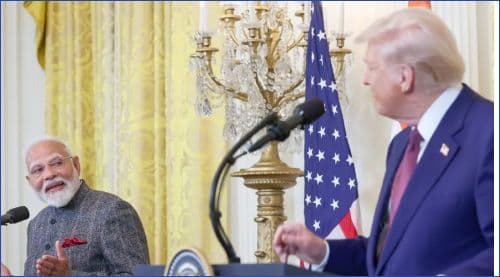
Secretary of State Marco Rubio held his first bilateral meeting in Washington with External Affairs Minister S Jaishankar on January 21, a day after the inauguration. Prime Minister Narendra Modi met President Trump in the Oval Office on February 13. US Vice President J D Vance travelled to India from April 20 to 24.
The optics mattered. They were noticed across capitals.
Several of India’s critics raised eyebrows when EAM Jaishankar was seated in a prominent front-row position at Trump’s inauguration. Such access is rarely extended to foreign ministers. In diplomatic circles, it was read as a signal. India appeared to enjoy early standing with the new administration.
At that stage, expectations were high. Defense cooperation remained strong. Indo-Pacific coordination continued. Technology and supply chain issues stayed on the agenda. There was also hope that a long-pending trade deal could finally move forward.
That phase did not last long.
By mid-year, the relationship entered rough weather. The first public rupture came when President Trump and senior members of his team claimed the US had “brought peace” between India and Pakistan. New Delhi reacted sharply, rejecting any suggestion of third-party mediation. That position has remained unchanged across governments.
The disagreement was not just about words. It signaled a deeper messaging gap.
Soon after, the Trump administration imposed a 50 per cent tariff on Indian imports. The move hit trade talks hard. The expected bilateral trade agreement collapsed. Plans for a Quad leadership summit in India were dropped. The annual 2+2 dialogue between foreign and defense ministers did not take place.
For the first time in many years, senior US officials spoke openly against India. The tone was blunt. The restraint seen in earlier years was missing.
At the same time, India’s ties with other major powers added to Washington’s discomfort.
New Delhi continued to deepen its engagement with Russia. The personal rapport between PM Modi and Russian President Vladimir Putin remained visible. India also continued buying discounted Russian oil, a move that did not sit well in Washington.
Senior US officials, including some from Trump’s Cabinet and inner circle, went public with criticism. Some accused India of indirectly funding Russia’s war in Ukraine through energy purchases.
India did not respond publicly. There was no war of words. But the tension was real. Indian officials made their position clear — energy security and strategic autonomy were not negotiable.
India’s outreach to China also drew attention.
PM Modi met Chinese President Xi Jinping during the Shanghai summit. New Delhi framed the engagement as an attempt to stabilize ties. Washington saw it differently, with some US officials viewing the optics with suspicion.
The issue spilled into the open when President Trump referenced the meeting in a social media post. The message was brief, but the displeasure was clear.
If these moves unsettled Washington, developments involving Pakistan unsettled New Delhi even more.
India was taken aback when Pakistan’s Army Chief, General Asim Munir, was invited to the White House for a private lunch with Trump. Indian officials privately described the access as unexpected.
The unease deepened months later when Munir returned to Washington, this time accompanying Pakistan Prime Minister Shehbaz Sharif for a meeting in the Oval Office. In New Delhi, the optics were seen as a setback, reviving long-standing concerns about US engagement with Pakistan’s military leadership.
Despite the political friction, the strategic core of the relationship held.
Defense and intelligence cooperation continued quietly and steadily. India and the United States signed a new 10-year defense framework agreement. Signed by Defense Minister Rajnath Singh and Secretary of War Pete Hegseth, the document outlined long-term military cooperation, technology sharing and interoperability.
Security officials on both sides stressed the same point — shared interests outweighed short-term disputes. Maritime security, counterterrorism and regional stability remained common priorities.
Trade followed a different trajectory.
Despite the 50 per cent tariff, bilateral trade is believed to have increased during the year. Companies adjusted. Supply chains shifted. Business did not retreat. The numbers suggested commercial ties had developed a resilience of their own. Three major US companies — Microsoft, Google and Amazon — alone announced nearly USD 70 billion in investment in India’s AI sector.
In December, cooperation took a visible turn when the Indian Space Research Organization launched a US satellite into space. The mission underscored a reality often missed in political debates — high-technology collaboration between the two countries remained intact. India’s Ambassador to the US, Vinay Mohan Kwatra, was invited to Mar-a-Lago.
People-to-people ties, however, came under pressure.
As restrictions on H-1B visas tightened and new visa rules were issued, Indian professionals in technology, healthcare and research felt the impact. Processing delays increased. Hundreds of families were left in limbo.
Indian students — who make up one of the largest foreign student groups in the US — were also affected. Visa uncertainty disrupted admissions and academic plans. The issue featured prominently in India’s discussions with US lawmakers and administration officials, but relief remained limited by year-end.
Towards the end of the year, there were signs of improvement. PM Modi and Trump communicated directly by phone at least four times, according to their social media accounts. Officials described the conversations as frank and constructive, aimed more at stabilization than grand announcements.
India–US relations appeared steadier by the close of 2025. They had not returned to the optimism of early in the year, but open friction had receded.
The year left clear lessons. The India–US partnership is strong, but not immune to shocks. Strategic logic continues to bind New Delhi and Washington. Political alignment, however, cannot be assumed.
As both sides head into 2026, the relationship stands recalibrated, not reset — anchored by defense, trade and technology, and tested by a year that exposed both its strengths and its limits. (IANS)
@IW